EU Digital Product Passports: Textile Compliance 2026
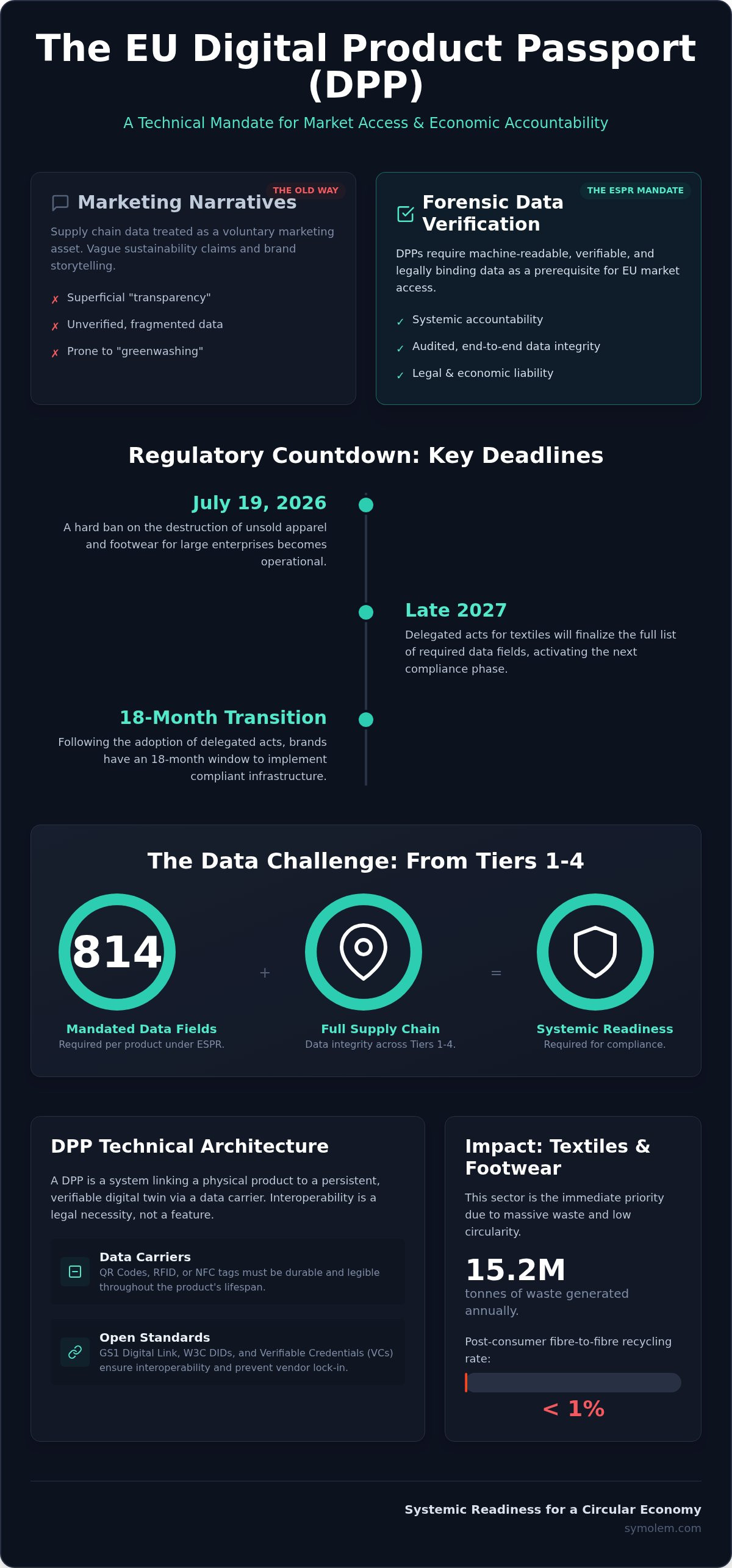
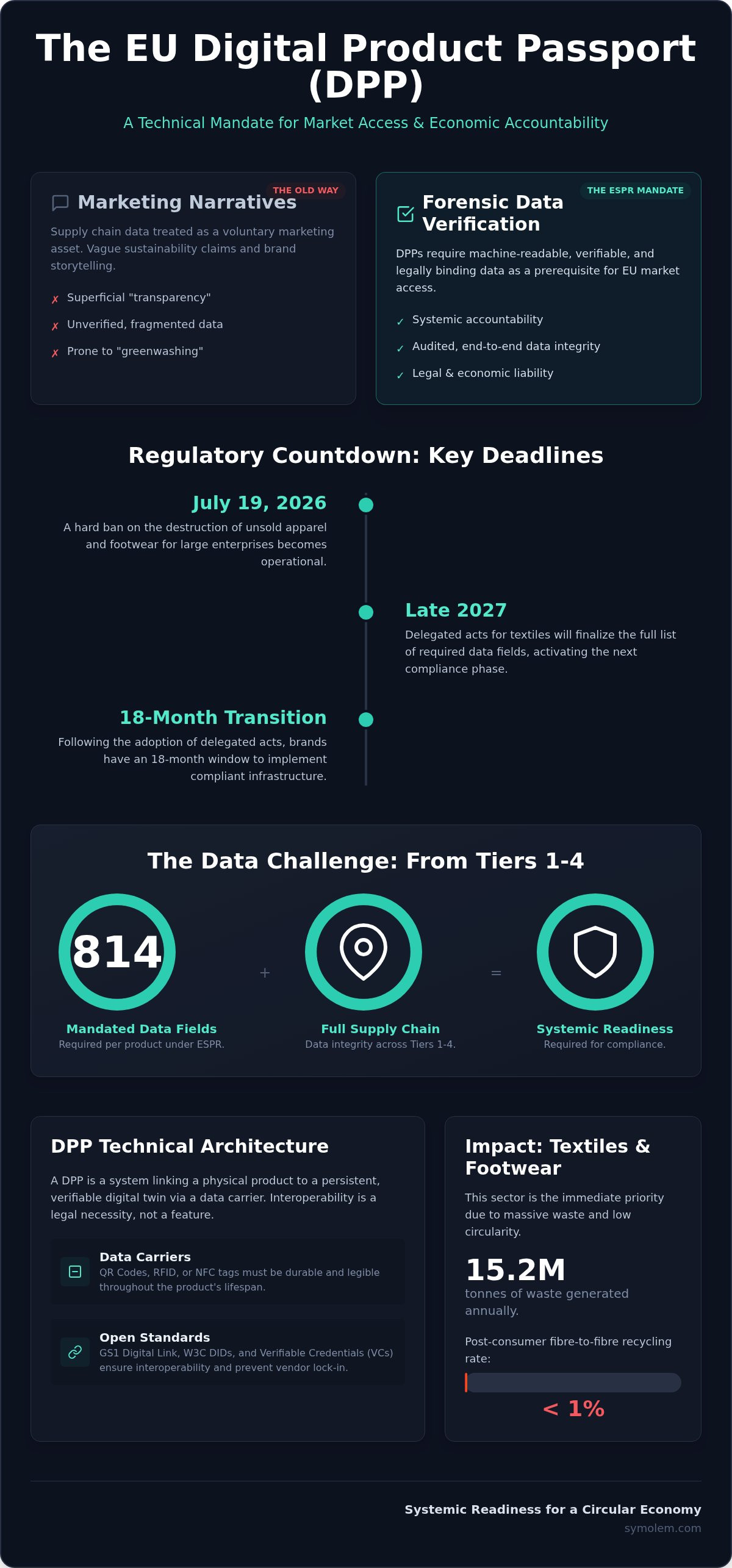
Digital Product Passports aren't a transparency tool; they're a legal architecture for economic accountability. As of July 19, 2026, the ban on destroying unsold apparel has moved from a policy proposal to a hard operational constraint for large enterprises. This shift signals a broader systemic overhaul where Digital Product Passports for EU compliance become the primary mechanism for market access. Most brands currently treat supply chain data as a marketing asset, yet the Ecodesign for Sustainable Products Regulation (ESPR) demands a level of forensic accuracy that superficial storytelling won't survive.
You likely recognize that the complexity of mapping data across tiers 1 through 4 presents a massive risk to your bottom line. We'll provide a clinical diagnostic of the current regulatory requirements to help you bridge the gap between fragmented spreadsheets and a verified data registry. This article outlines a technical roadmap for achieving systemic readiness, focusing on data integrity and the construction of a cost-effective circular infrastructure. We'll examine the up to 236 data points in the UNTP schema and the structural changes required to meet upcoming implementation deadlines without compromising your value chain economics.
Key Takeaways
- Understand the shift from voluntary sustainability narratives to mandatory, machine-readable data requirements under the ESPR framework.
- Learn the technical architecture of Digital Product Passports for EU compliance, including the integration of data carriers and the GS1 Digital Link.
- Identify the integrity gap between marketing storytelling and the forensic data verification required across all four tiers of the supply chain.
- Discover a strategic framework for conducting an ESPR Readiness Diagnostic to map internal systems against the 814 mandated data fields.
- Transition from superficial digital twins to a fully integrated circular business model that ensures long-term regulatory and economic stability.
Table of Contents
- The ESPR Mandate: Why Digital Product Passports are a Legal Imperative
- Decoding the Technical Architecture: Data Carriers and Resolvers
- The Integrity Gap: Why Marketing Narratives Fail ESPR Scrutiny
- A Strategic Implementation Roadmap: From Mapping to Costing
- Orchestrating Circularity: Symolem’s Strategic Advisory
The ESPR Mandate: Why Digital Product Passports are a Legal Imperative
The Ecodesign for Sustainable Products Regulation (ESPR) is not an invitation to volunteer. It's a structural enforcement mechanism. Specifically, the Digital Product Passport (DPP) functions as a digital identity for every physical item placed on the EU market, ensuring that product characteristics are accessible, verifiable, and machine-readable. This isn't about marketing storytelling. It's about systemic compliance. For fashion brands, Digital Product Passports for EU entry are now a prerequisite for legal operation. If you can't provide the data, you can't sell the product.
Textiles and footwear are the immediate priorities for this regulatory rollout. The industry generates 15.2 million tonnes of waste annually, yet less than 1% of post-consumer textiles undergo fibre-to-fibre recycling. The EU is closing the loophole on unsold goods to stop this economic and environmental leakage. As of July 19, 2026, large companies face a hard ban on the destruction of apparel and footwear. Non-compliance results in immediate market access restrictions and heavy financial penalties that threaten the economic viability of global value chains.
The Regulatory Timeline: 2026 and Beyond
The countdown has already begun. While the central EU DPP registry went live in July 2026, the specific delegated acts for textiles will finalize the up to 236 data points in the UNTP schema by late 2027. Brands have an 18-month transition period to align their infrastructure once these acts are adopted. During this window, you must identify your "Responsible Operator", which is the entity legally liable for data accuracy. Starting with an ESPR readiness diagnostic is the only way to establish a baseline for these complex requirements. Waiting for the final deadline is a strategy for failure.
Beyond Transparency: The Accountability Shift
Transparency is an observation; accountability is a liability. The EU is systematically dismantling "soft" sustainability claims that lack technical verification. Digital Product Passports for EU markets serve as the enforcement layer for Extended Producer Responsibility (EPR) schemes. By navigating EPR for textiles through the lens of a DPP, brands move from vague aspirations to hard, audited impact measurement. This shift ensures that every actor in the supply chain is financially and legally responsible for the product's entire lifecycle. It's a transition from storytelling to systemic integrity.
Decoding the Technical Architecture: Data Carriers and Resolvers
Compliance isn't a sticker. It's a system. A Digital Product Passport consists of a physical data carrier linked to a persistent digital twin. While many vendors market QR codes as a total solution, the reality is more complex. The carrier, whether a QR code, RFID tag, or NFC chip, must remain legible throughout the product's lifespan to facilitate repair and recycling. This technical requirement is a cornerstone of the EU strategy for sustainable and circular textiles, which aims to transform how information flows across the value chain. Digital Product Passports for EU markets require that this data stays accessible even after the original manufacturer ceases operations.
Proprietary silos are a strategic liability. If your data is locked in a vendor's closed ecosystem, you risk systemic failure when regulatory standards shift. Interoperability isn't a feature; it's a legal necessity. Brands must move toward open-source frameworks to ensure that data remains machine-readable and transferable across different platforms. This architectural choice prevents vendor lock-in and ensures that your circular infrastructure remains resilient against future policy shifts.
Standards and Protocols: GS1, UNTP, and W3C
The GS1 Digital Link serves as the primary compliance gateway. It bridges the physical product to the web by providing a standardized URL structure that any scanner can resolve. However, the architecture goes deeper. Decentralized Identifiers (DIDs) and Verifiable Credentials (VCs), governed by W3C standards, ensure that the data within the passport is tamper-proof and authenticated. This cryptographic layer prevents fraud and verifies that the data fields, from fibre composition to REACH compliance, are accurate. Implementing Digital Product Passport (DPP) Frameworks based on these global protocols is the only way to ensure long-term stability.
The EU DPP Registry and Issuer Credentials
The EU central registry is the ultimate authority. It doesn't store all your data, but it stores the pointers and metadata required for market surveillance. Brands must manage issuer credentials to digitally sign every data entry, creating a permanent audit trail. This requires robust API integration between your internal ERP systems and the EU's decentralized infrastructure. Machine-readability is non-negotiable. If a regulator's automated system cannot pull your data via an API, your product is effectively non-compliant. Access control must also be granular, allowing consumers to see care instructions while reserving technical manufacturing data for recyclers and authorities.
The Integrity Gap: Why Marketing Narratives Fail ESPR Scrutiny
Narratives are a liability in a regulated market. Most fashion brands rely on aspirational storytelling to mask a structural ignorance of their upstream supply chains, yet the ESPR replaces this ambiguity with forensic requirements. Digital Product Passports for EU compliance aren't meant to be engaging; they're meant to be accurate. This shift exposes the "Data Gap" in Tier 2 and Tier 3 reporting, where the lack of primary data makes traditional sustainability claims legally indefensible. According to a recent European Parliament study on DPP, the transition to mandatory digital documentation is essential to eliminate the information asymmetry that currently plagues the textile sector.
The cost of non-compliance outweighs the investment in data infrastructure. Fines, product recalls, and market bans are the high-stakes consequences for failing to provide verified impact metrics. Properly verifying textile sustainability claims for ESPR requires a shift from "best effort" estimates to rigorous Monitoring, Reporting, and Verification (MRV). Systemic integrity isn't achieved through a press release; it's built through the meticulous auditing of every material input and chemical treatment used in production.
Diagnostic Precision: Mapping the up to 236 data points in the UNTP schema
Brands must move beyond the surface. The up to 236 data points in the UNTP schema under the ESPR cover technical specifications, circularity metrics, and environmental footprints that most ERP systems aren't designed to track. Our approach identifies "Unknown-Unknowns" through a clinical auditing process that maps every attribute to its original source. This diagnostic analysis reveals where data is missing, corrupted, or unverified before it reaches the regulator's desk. Without this level of precision, your passport is just a digital version of a flawed marketing claim.
Audit Readiness for Market Surveillance
Authorities won't just look at your website; they'll audit your API. Market surveillance authorities will use Digital Product Passports for EU goods to conduct automated spot checks against REACH standards and durability claims. If your data doesn't align with the physical product, you're vulnerable to immediate litigation. Moving to a legally defensible data set is the only protection against the aggressive enforcement of the EU's anti-greenwashing directives. It's time to trade marketing fluff for digital evidence that stands up to regulatory scrutiny.
A Strategic Implementation Roadmap: From Mapping to Costing
Implementation is an architectural challenge, not a software procurement exercise. Brands that treat Digital Product Passports for EU compliance as a simple digital add-on will fail the first audit. Success requires a four-phase transition from fragmented data silos to a verified, machine-readable ecosystem. This isn't about adding a QR code to a label; it's about re-engineering the flow of information across your entire global value chain.
Phase 1 begins with a forensic ESPR Readiness Diagnostic. This process identifies systemic vulnerabilities in your current data architecture, highlighting where information is missing or unverified. Phase 2 moves into technical data mapping, where internal ERP systems are aligned with the up to 236 data points in the UNTP schema mandated by the EU. This stage requires a fundamental shift in how data is captured, stored, and shared between stakeholders.
Engagement with suppliers represents the third critical phase. You must transition from trusting supplier declarations to deploying verifiable credentials that are cryptographically signed and authenticated at the source. Finally, Phase 4 focuses on costing the circular infrastructure. This stage determines the financial viability of the recovery and recycling systems that the passport must document to meet legal end-of-life requirements.
Infrastructure Costing and Economic Modeling
Circular economy models often fail because they lack economic realism. A rigorous cost-benefit analysis of circular textile models is essential for calculating the ROI of your compliance investment. You must model the economics of take-back schemes and textile-to-textile recycling to ensure the data in your passport reflects a functional, cost-effective system. Without this modeling, the end-of-life instructions in your DPP remain a theoretical exercise rather than a legally defensible plan.
The Role of Digital Product Passport Consultants
Software vendors often promise "out-of-the-box" compliance, but software cannot fix a broken value chain. The challenges of Digital Product Passport implementation require a cross-functional strategy that bridges legal, technical, and operational teams. Independent advisors provide the clarity needed to navigate Digital Product Passports for EU mandates without the bias of specific software sales. Selecting partners based on policy expertise ensures that your strategy remains resilient as delegated acts evolve.
Ready to secure your market access? Contact Symolem to request your ESPR Readiness Diagnostic and begin your technical roadmap.
Orchestrating Circularity: Symolem’s Strategic Advisory
Compliance is the floor, not the ceiling. While competitors treat the Digital Product Passport as a technical hurdle to be cleared, Symolem positions it as the foundational architecture for a resilient business model. We operate as technical and strategic architects, moving brands beyond the superficiality of a "digital twin" toward a fully integrated circular economy. The 2026 mandate isn't just a reporting requirement. It's a structural reset of global commerce. Understanding the textile regulation impact on business models allows early adopters to convert regulatory pressure into a definitive competitive advantage.
The transition from linear risk to circular opportunity requires more than a software subscription. It demands a clinical diagnostic of your current infrastructure. For brands seeking Digital Product Passports for EU market entry, the challenge lies in the economic reality of textile recovery. We provide the intellectual rigor needed to design take-back schemes and recycling partnerships that aren't just legally compliant but economically viable. This isn't about ethical sentiment; it's about structural design and long-term economic stability.
Proprietary Frameworks for Implementation
Symolem utilizes a proprietary methodology for data mapping and infrastructure costing. We don't rely on vendor-led narratives. Instead, we employ a diagnostic auditing process that scrutinizes every material input against the 814 mandated data fields. This clinical approach identifies where supply chain data is corrupted or missing, allowing brands to build a legally defensible digital record. By transitioning from a best-effort reporting style to an audited, machine-readable framework, we eliminate the systemic vulnerabilities that lead to market exclusion and litigation.
Securing Your Position in the 2026 EU Market
The window for strategic maneuvering is closing. As market surveillance authorities prepare for automated enforcement, the distinction between "marketing narratives" and "systemic integrity" will determine which brands survive. Digital Product Passports for EU compliance is a high-stakes imperative that rewards those who prioritize data accuracy over superficial storytelling. You can't fix a broken value chain with a press release, but you can re-engineer it through expert-led advisory. Secure your market access by establishing a baseline of truth today. Contact Symolem for an ESPR Readiness Diagnostic to begin your technical roadmap toward 2026 compliance.
Securing Market Access Through Systemic Integrity
Execution is the only defense against regulatory obsolescence. The 2026 mandate represents a high-stakes transition from voluntary disclosure to forensic accountability. Implementing Digital Product Passports for EU compliance requires a clinical approach to data integrity and a complete re-engineering of supply chain transparency. You've seen the technical roadmap, from mapping the up to 236 data points in the UNTP schema to costing circular infrastructure. Now, the priority shifts to operational reality. Systemic readiness isn't achieved through software alone; it requires the rigorous scrutiny of experts who understand the intersection of policy, economics, and global value chains.
Symolem operates as a bold, independent voice in this complex landscape. As independent policy experts and technical data mapping specialists, we serve as global textile circularity advisors, building frameworks that stand up to regulatory audits. Don't leave your market access to chance. It's time to build a legally defensible architecture that ensures long-term economic stability and operational resilience. Secure your market access with a Symolem ESPR Readiness Diagnostic and lead the transition to a truly circular future.
Frequently Asked Questions
What is the deadline for Digital Product Passports in the textile industry?
Mandatory compliance for textiles is expected between late 2028 and mid-2029. The specific delegated act for the sector is anticipated in late 2027, which triggers an 18-month transition window for brands to finalize their systems. While the central registry went live in July 2026, fashion brands must utilize this interim period to map their supply chains before these legal deadlines lock non-compliant products out of the market.
Does the EU DPP requirement apply to UK fashion brands selling into Europe?
Yes. The Ecodesign for Sustainable Products Regulation (ESPR) applies to almost all physical goods placed on the EU market, regardless of where the manufacturer is headquartered. UK brands exporting to Europe must implement Digital Product Passports for EU compliance to maintain their market access. Geographic location offers no exemption from these technical requirements; if the product enters the EU, it requires a verified passport.
What specific data fields are required for a textile Digital Product Passport?
The initial framework identifies 67 data points in the passport sample accepted by the EU DPP Registry, while a UNTP-conformant passport can carry up to 236. Mandatory data includes:
- Fibre composition for all fibres exceeding 1% by weight.
- REACH chemical compliance and hazardous substance disclosure.
- Country of origin and manufacturer identification.
- Instructions for care, durability, and repairability.
- End-of-life instructions for recycling or disposal.
Who is the "Responsible Operator" for DPP compliance in the fashion supply chain?
The "Responsible Operator" is the legal entity placing the product on the EU market and is held liable for data accuracy. This role is typically filled by the manufacturer if they're based in the EU, or the importer for global brands. They're responsible for ensuring the passport is created, the data is verified, and the information remains accessible to authorities and consumers for the product's entire lifecycle.
How much does it cost to implement a Digital Product Passport system?
Total investment depends on your supply chain's complexity and existing data maturity. Brands don't just face software costs; they must account for the structural expenses of data mapping, supplier engagement, and infrastructure design. An ESPR Readiness Diagnostic is the first step to identify these costs. This proactive investment is significantly lower than the financial penalties and inventory write-offs associated with regulatory non-compliance.
Can we use existing QR codes for EU DPP compliance?
Existing QR codes are rarely sufficient in their current form. To meet ESPR standards, the data carrier must support the GS1 Digital Link protocol to ensure global interoperability and machine-readability. Furthermore, the carrier must be persistent. It's not enough to have a sticker on a hangtag; the link must remain legible through the product's entire lifecycle to facilitate repair, resale, and eventual recycling.
What is the difference between a DPP and a sustainability label?
A sustainability label is a marketing tool; Digital Product Passports for EU compliance is a legal architecture. Labels often rely on "soft" storytelling and voluntary disclosure, whereas a DPP requires forensic, machine-readable data verified through an audit trail. While a label aims to influence consumer choice, the passport is designed for regulatory accountability, market surveillance, and the technical enablement of a circular economy.
How does the DPP link to Extended Producer Responsibility (EPR) schemes?
The DPP functions as the essential data layer for EPR enforcement. It provides the precise material weights and chemical compositions required to calculate eco-modulated fees with clinical accuracy. By documenting a product's end-of-life instructions and material value, the passport ensures that producers are held financially accountable for the waste they generate. It moves EPR from broad estimates to verified, product-specific economic liability.