ESPR Readiness Diagnostic: A Strategic Framework for Textile Compliance in 2026
Compliance is a structural mandate, not a marketing choice. As the July 19, 2026, deadline for the ban on destroying unsold textiles approaches, fashion brands find themselves trapped between fragmented global supply chains and the uncompromising data requirements of the EU Ecodesign for Sustainable Products Regulation. Executing a rigorous ESPR readiness diagnostic is the only method to identify systemic gaps before they become existential legal liabilities.
You likely recognize that your current data infrastructure is insufficient to meet the looming Digital Product Passport (DPP) standards, which demand a level of transparency that most legacy systems simply cannot provide. This article provides a clinical framework to navigate these complexities, moving beyond superficial sustainability narratives toward a technical architecture for compliance. We'll examine the mechanics of mapping 814 specific DPP data fields, the necessity of verifiable impact measurement, and the strategic design of circular infrastructure that preserves both systemic integrity and your operational bottom line. By treating compliance as a diagnostic challenge rather than an administrative burden, you can transform regulatory pressure into a definitive map for long-term structural stability.
Key Takeaways
- Understand why the 2026 mandates represent a shift from voluntary disclosure to mandatory performance standards for the global textile industry.
- Conduct a comprehensive ESPR readiness diagnostic to identify structural failures in supply chain data and map critical compliance gaps.
- Navigate the technical complexity of Digital Product Passports by preparing to manage 814 specific data fields across your entire product portfolio.
- Develop an iterative roadmap for systemic redesign that prioritizes high-impact categories and builds a foundation for cost-effective circular infrastructure.
Table of Contents
- The Regulatory Mandate: Why ESPR is Not a Voluntary Sustainability Goal
- Anatomy of the Diagnostic: Mapping Structural Gaps in the Textile Value Chain
- Digital Product Passport (DPP) Integration: From Data Silos to Verifiable Transparency
- Implementation Roadmap: Transitioning from Diagnostic to Systemic Compliance
- The Symolem Framework: Architecting Circular Resilience for Global Fashion
The Regulatory Mandate: Why ESPR is Not a Voluntary Sustainability Goal
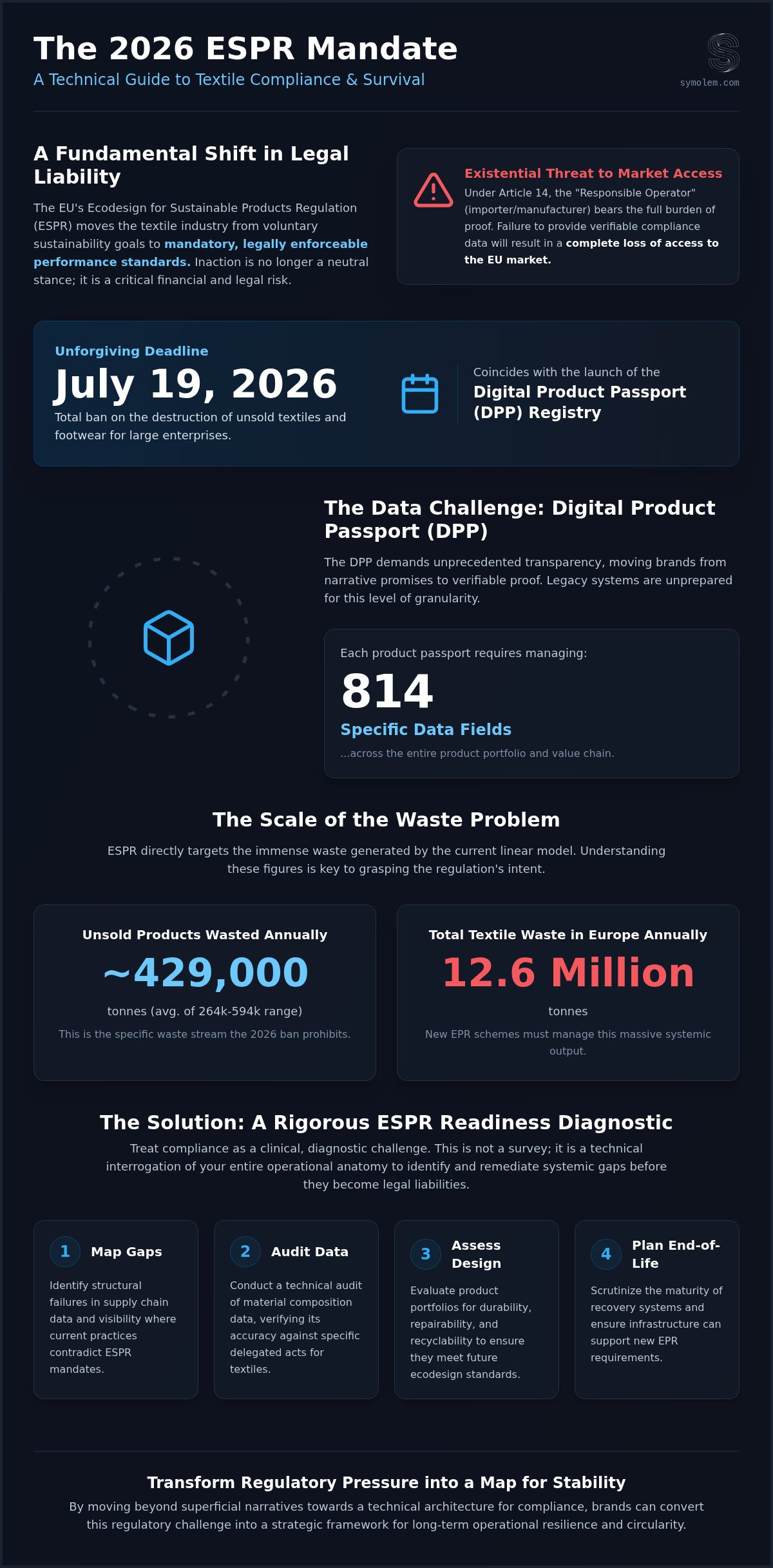
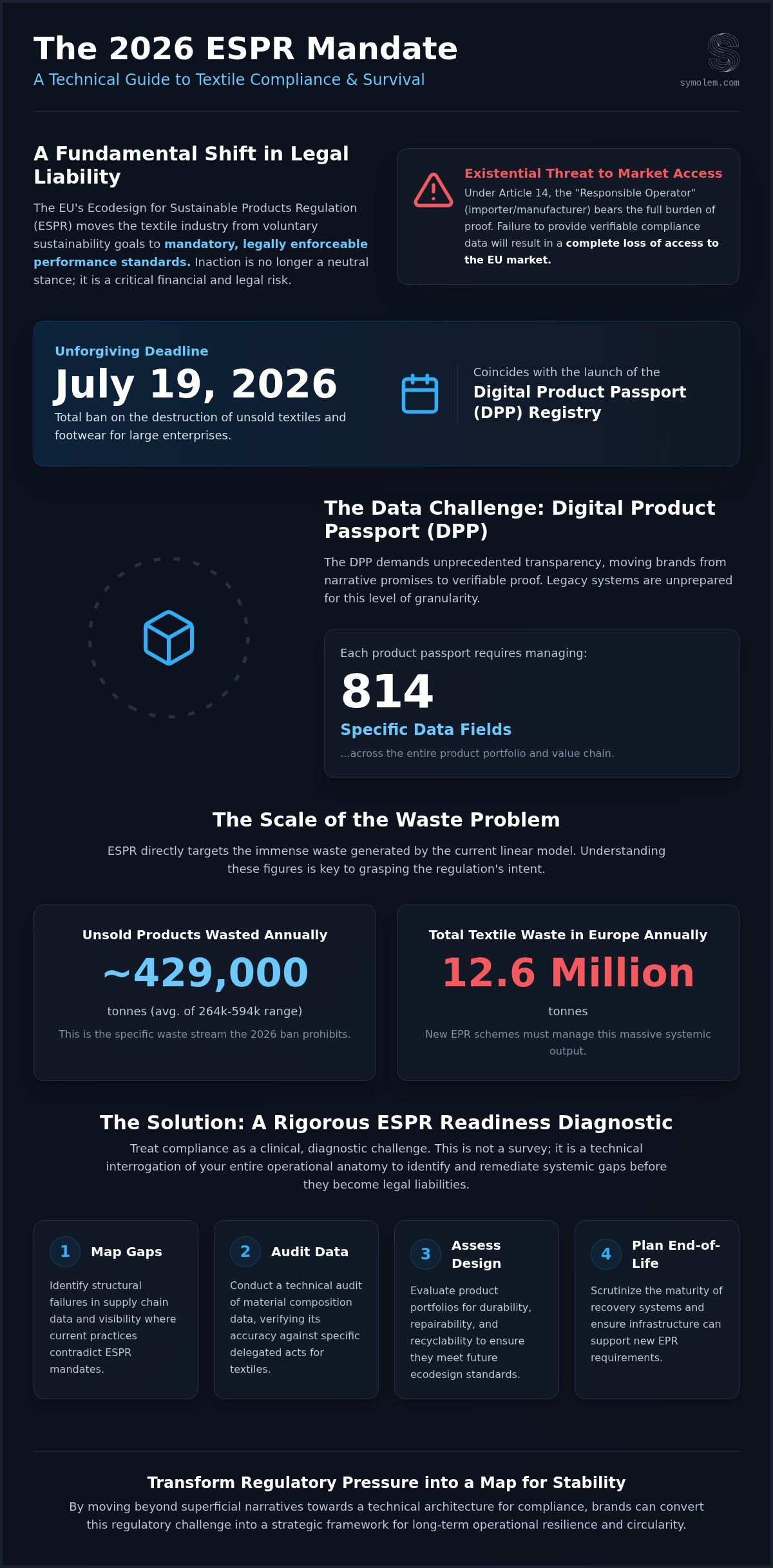
The era of aspirational sustainability has ended. With the entry into force of the Ecodesign for Sustainable Products Regulation (ESPR) on July 18, 2024, the European Commission transitioned from encouraging voluntary disclosure to enforcing mandatory performance standards. This is a fundamental shift in legal liability. Under Article 14, the "Responsible Operator", typically the importer or manufacturer, bears the entire burden of proof for a product’s environmental integrity. If your structural data fails to verify compliance, your access to the EU market simply ceases. This uncompromising reality demands an immediate ESPR readiness diagnostic to identify where legacy supply chains collapse under the weight of new durability and repairability requirements. Systemic integrity is the new prerequisite for market participation.
Beyond Compliance: The Economics of Regulation
Profitability in the textile sector is being fundamentally recalculated. Traditional business models that rely on high-volume, low-durability output face existential threats as the cost of circular infrastructure is internalized. Regulatory inertia is no longer a neutral stance; it's a high-stakes financial risk that erodes market valuation and invites litigation. Understanding how textile regulation impact on business models redefines the bottom line is critical for survival. Brands must move beyond superficial narratives and architect systems capable of managing the entire product lifecycle, from raw material extraction to end-of-life recovery. This requires a clinical audit of existing cost structures and a pivot toward value chains that prioritize material longevity over rapid turnover.
The 2026 Compliance Timeline
The 2026 horizon is fixed and unforgiving. By July 19, 2026, large enterprises will face a total ban on the destruction of unsold textiles and footwear, a move targeting the 264,000 to 594,000 tonnes of products currently wasted annually. This milestone coincides with the operational launch of the Digital Product Passport (DPP) Integration registry. To avoid market exclusion, firms must align their Extended Producer Responsibility (EPR) schemes with ESPR mandates immediately. A clinical ESPR readiness diagnostic serves as the first technical step in mapping these delegated acts. The first ESPR working plan, adopted in April 2025, has already set the trajectory for these requirements. You must act now to ensure that your data architecture is robust enough to support the first wave of textile-specific mandates that become effective following the 18-month transition period.
Anatomy of the Diagnostic: Mapping Structural Gaps in the Textile Value Chain
Identification is the prerequisite for remediation. A robust ESPR readiness diagnostic functions as a high-resolution scan of a brand's operational anatomy, exposing the friction points between current manufacturing practices and future legal requirements. It is not a survey. It is a clinical interrogation of data availability, material integrity, and value chain visibility. Many brands operate under the delusion that their current sustainability reports satisfy these new mandates. They don't. The 2026 landscape requires verifiable proof, not narrative promises.
We must identify structural failures where existing business logic directly contradicts The Regulatory Mandate: Why ESPR is Not a Voluntary Sustainability Goal. This assessment evaluates the durability and repairability of product portfolios, often revealing that current designs are technically incapable of meeting the ecodesign standards slated for 2026. Beyond design, the diagnostic scrutinizes the maturity of end-of-life recovery systems. It ensures that infrastructure exists to handle the 12.6 million tonnes of textile waste Europe generates annually, preventing the systemic collapse of waste management protocols under new EPR requirements.
Technical Data Auditing
Verification requires precision. This phase involves auditing material composition data against the specific delegated acts for textiles and analyzing the accuracy of Life Cycle Assessments (LCAs). Many existing LCAs rely on secondary, generalized data that lacks the granularity required for the Digital Product Passport. A technical audit establishes a baseline for recycled content verification, moving from estimates to forensic proof. This process ensures that every material claim is backed by a stable, auditable data chain.
Supply Chain Transparency Mapping
Granularity is non-negotiable. Visibility must extend beyond Tier 1 suppliers to reach the fiber and raw material levels where the most significant environmental impacts occur. The diagnostic evaluates supplier readiness for mandatory data sharing, identifying high-risk nodes in the global value chain where data gaps could trigger a compliance collapse. Establishing this level of transparency is a complex architectural task that requires expert policy and regulatory advisory to navigate correctly. Without this visibility, the technical requirements of the DPP remain an insurmountable barrier to market access.
Digital Product Passport (DPP) Integration: From Data Silos to Verifiable Transparency
The Digital Product Passport (DPP) is the technical vanguard of the ESPR. It functions as a mandatory enforcement mechanism, requiring verifiable data at the individual SKU level rather than the broad product category. This is not a superficial QR code for consumer engagement; it is a complex data architecture that bridges the gap between physical goods and digital records. An ESPR readiness diagnostic must prioritize the technical architecture of the passport to ensure that every product placed on the EU market carries a secure, auditable history of its material composition and environmental impact.
A primary technical hurdle is the strategic mapping of 814 specific data fields required for textiles. Most brands currently operate within siloed environments where critical information is scattered across disparate spreadsheets and legacy databases. Integrating these requirements into existing Product Lifecycle Management (PLM) and Enterprise Resource Planning (ERP) systems is a prerequisite for compliance. This integration must occur without triggering operational paralysis or compromising the speed of the value chain. Effectively addressing the challenges of Digital Product Passport implementation requires a clinical audit of your current data governance protocols.
Data Governance and Security
Verifiability is the cornerstone of the DPP framework. Brands must establish rigorous protocols for verifiable credentials to ensure that data shared across the value chain is both secure and tamper-proof. This involves understanding the specific roles within the EU DPP Registry and the requirements for issuer credentials. As multi-stakeholder recovery systems become mandatory, maintaining data integrity across third-party recyclers and sorters is a critical business imperative. Your ESPR readiness diagnostic should identify vulnerabilities in your current data sharing agreements to prevent systemic compliance failures.
Architecting the Digital Link
Interoperability is the only path to global compliance. Utilizing GS1 Digital Link standards allows for seamless product identification that works across different jurisdictions and retail environments. This architecture should also incorporate UNTP standards to ensure that product passports remain functional within a globalized economy. Forward-thinking brands are already future-proofing their systems to align with upcoming UK digital product records, ensuring that their data infrastructure remains stable regardless of regional regulatory shifts. This technical foresight transforms a legal burden into a resilient, long-term asset.
Implementation Roadmap: Transitioning from Diagnostic to Systemic Compliance
Diagnostic findings are useless without execution. Transitioning from a clinical assessment to systemic compliance requires a phased, iterative approach that fundamentally alters how products are conceived and managed. This isn't a one-time audit. It's a structural overhaul of the textile value chain where every design decision is measured against its regulatory impact. Brands must prioritize high-impact product categories for an immediate ESPR readiness diagnostic to mitigate the highest legal risks first. By focusing on volume-heavy or material-complex lines, you establish a blueprint for enterprise-wide resilience.
Alignment is critical. You can't address ecodesign in isolation from the broader requirements for navigating EPR for textiles. These regulations are interconnected components of a single circular framework. Failure in one area creates a cascade of non-compliance across the entire operation. Building internal capacity for ongoing regulatory risk management is the only way to ensure that your organization remains stable as the European Commission releases subsequent delegated acts. This requires a shift from reactive problem-solving to proactive architectural design.
Phase 1: The Gap Analysis
The roadmap begins with a forensic gap analysis. This involves a comprehensive audit of existing product data to determine where supply chain visibility ends and legal risk begins. You must identify immediate non-compliance risks, such as materials that fail durability thresholds or suppliers who can't provide verifiable data. Once these failures are mapped, you can draft a remedial roadmap for technical data acquisition. This document serves as your technical guide for closing the distance between current operations and 2026 mandates.
Phase 2: Structural Redesign
Redesign is a business imperative. Phase 2 moves beyond data to physical and economic restructuring. You must implement ecodesign principles directly into the product development lifecycle, ensuring that durability and repairability are baked into the initial SKU specifications. This often necessitates redesigning business models to support circularity, shifting the focus from transactional sales to long-term product stewardship. Developing cost-effective infrastructure for textile recovery and recycling ensures that your brand can fulfill its EPR obligations without eroding profitability. To secure your market position, you should initiate an ESPR readiness diagnostic to begin this structural transition immediately.
The Symolem Framework: Architecting Circular Resilience for Global Fashion
Precision is the only antidote to regulatory chaos. Symolem functions as a technical architect, providing the clinical rigor necessary to navigate the 2026 textile landscape. Our proprietary ESPR readiness diagnostic moves beyond aspirational sustainability to address the uncompromising economic and legal realities of the EU's new framework. We don't offer superficial narratives. We build the structural integrity required to secure market access in an era of mandatory performance standards. By treating compliance as a strategic business imperative, we ensure your operations remain stable under the pressure of incoming delegated acts.
High-level policy often collapses at the point of operational implementation. We bridge this gap by translating complex EU regulations into granular technical requirements for your specific value chain. This process involves designing circular infrastructure that is not just compliant, but cost-effective. By internalizing the costs of durability and recovery now, we prevent the systemic financial shocks that will inevitably follow the July 2026 enforcement deadlines. Our framework focuses on building a foundation of stability, verification, and systemic integration across every tier of your global operations.
Independent Technical Advisory
Verification requires independent scrutiny. Software-only compliance solutions often fail because they lack the diagnostic depth to map 814 specific DPP data fields across fragmented global tiers. A tool cannot fix a broken supply chain. Our advisory model leverages global expertise in textile circularity and policy to conduct forensic audits that automated systems cannot replicate. We identify the structural failures that software overlooks, ensuring that your data is not just present, but verifiable and legally sound. This independent perspective provides the truth and scrutiny required to survive a regulatory audit.
Next Steps for Strategic Readiness
The window for reactive adjustments is closing. Engaging with Symolem for a pilot ESPR readiness diagnostic project allows your organization to stress-test existing systems against the 2026 requirements before they become mandatory. This proactive engagement identifies material risks and data gaps within high-impact product categories, providing a clear remedial roadmap for technical data acquisition. Preparing your organization for this shift is a strategic imperative. Structural integrity is the only way to guarantee long-term market access and operational stability in a regulated global economy.
Securing Systemic Stability in a Regulated Value Chain
The 2026 regulatory landscape is a fixed reality that demands a fundamental pivot from narrative sustainability to technical verification. Compliance requires mapping 814 specific data fields and redesigning business models to support circular infrastructure. Relying on legacy systems or superficial data silos is a path to market exclusion. Compliance is the floor. Resilience is the goal. A clinical audit identifies the precise structural failures within your supply chain, allowing for the iterative implementation of ecodesign principles before enforcement begins. As an independent advisory firm, Symolem provides the expert-led scrutiny required to navigate these complexities with technical rigor. We specialize in mapping intricate data requirements and architecting the circular frameworks that preserve operational profitability. Secure your market access with a Symolem ESPR Readiness Diagnostic today. By building these systems now, you transform a legal mandate into a resilient foundation for global growth.
Frequently Asked Questions
What is the primary objective of an ESPR readiness diagnostic?
The primary objective is to conduct a forensic audit of a brand's current operations to identify structural failures and data gaps relative to the 2026 mandates. This ESPR readiness diagnostic serves as a technical blueprint for transitioning from voluntary sustainability goals to mandatory performance standards. It focuses on material integrity, supply chain visibility, and the technical prerequisites for the Digital Product Passport. Without this clinical assessment, brands risk entering the 2026 regulatory environment with unquantified legal liabilities.
Does ESPR apply to UK fashion brands selling into the EU market?
Yes, the regulation applies to any brand placing products on the EU market, irrespective of their headquarters' location. UK fashion brands must satisfy all ESPR and DPP requirements to maintain access to European consumers. This includes adhering to ecodesign standards and managing the technical data fields required for SKU-level transparency. Failure to comply results in immediate market exclusion, making geographic distance irrelevant to the legal necessity of structural alignment and verifiable data management.
What are the up to 236 data points in the UNTP schema required for the Digital Product Passport?
These up to 236 data points in the UNTP schema comprise a granular dataset covering material composition, chemical presence, durability metrics, and end-of-life recovery instructions. Managing this volume of information requires a sophisticated data architecture that transcends traditional PLM or ERP capabilities. Symolem specializes in mapping these specific fields to ensure every SKU carries a verifiable digital record. This technical mapping is essential for achieving interoperability within the EU DPP Registry and avoiding the systemic failures associated with incomplete product passports.
How does ESPR compliance differ from existing sustainability reporting?
ESPR compliance shifts the focus from brand-level narratives to SKU-level, mandatory performance standards. Traditional sustainability reporting often relies on voluntary disclosure and generalized impact estimates. In contrast, the ESPR framework demands verifiable data and adherence to specific ecodesign requirements, such as durability and repairability thresholds. This regulatory shift treats environmental integrity as a legal prerequisite for market participation rather than a marketing choice, necessitating a rigorous ESPR readiness diagnostic to ensure technical accuracy.
Who is considered the "Responsible Operator" under the ESPR framework?
Under Article 14, the Responsible Operator is the entity placing the product on the EU market, which typically includes manufacturers, importers, or authorized representatives. This role carries the entire legal burden of proof for a product's compliance with ESPR mandates. They're responsible for ensuring the Digital Product Passport is accurate, accessible, and linked to the physical product. This centralization of liability means that importers cannot outsource their legal accountability to upstream suppliers without robust verification systems.
What happens if a brand fails to meet the 2026 ESPR deadlines?
Failing to meet the July 19, 2026, deadlines results in immediate market exclusion and potential legal penalties across EU member states. Large enterprises specifically face an uncompromising ban on the destruction of unsold textiles and footwear starting on that date. Beyond fines, non-compliant brands suffer from systemic operational disruption as their products are barred from entry at EU borders. This high-stakes environment leaves no room for administrative delays or technical inaccuracies in data reporting.
Can a diagnostic help in reducing the costs of EPR compliance?
A diagnostic identifies the most cost-effective path for architecting circular infrastructure, which directly reduces the financial burden of Extended Producer Responsibility (EPR) fees. By designing for durability and recyclability, brands can lower their eco-modulated fees and prevent the waste of unsold inventory. This strategic foresight ensures that circularity is built into the business model rather than added as a reactive expense. Efficient infrastructure design transforms regulatory compliance into a stabilized, long-term economic asset.
How does an ESPR readiness diagnostic address the EU Green Claims Directive?
The diagnostic provides the forensic evidence and verifiable data required to satisfy the substantiation requirements of the Green Claims Directive. It ensures that every environmental claim is backed by a stable, auditable record within the Digital Product Passport. By identifying where current marketing narratives lack technical support, the diagnostic prevents the litigation risks associated with greenwashing. This clinical approach ensures that brand communications remain legally defensible and aligned with the actual environmental performance of the product.