
ESPR Compliance Framework for Textiles: An Implementation Roadmap
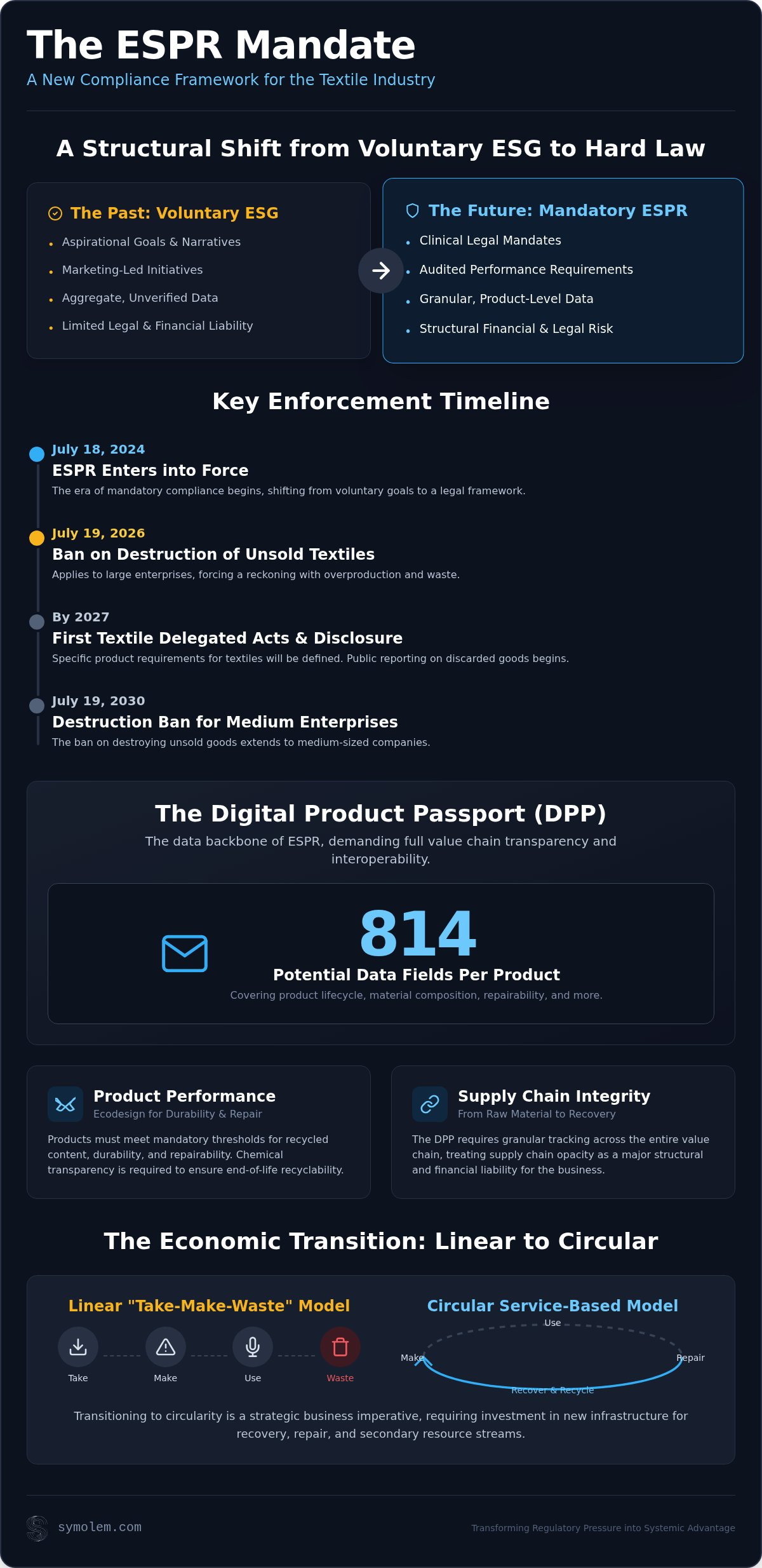
The era of voluntary sustainability narratives is dead. It's been replaced by a clinical, legal mandate that treats supply chain opacity as a structural financial liability. You likely recognize that the entry into force of the Ecodesign for Sustainable Products Regulation (ESPR) on July 18, 2024, signaled a permanent shift from aspirational goals to rigorous, data-driven accountability. With the ban on the destruction of unsold textiles for large enterprises looming on July 19, 2026, the margin for technical illiteracy has vanished.
This article delivers a definitive ESPR compliance framework for textiles, providing fashion executives with a diagnostic roadmap to navigate the complex technical mandates of the EU. We'll move beyond superficial reporting to address the granular requirements of the Digital Product Passport (DPP) registry and the up to 236 data points in the UNTP schema that define product lifecycle integrity. We will unpack the mechanics of the first textile delegated acts expected by 2027, audit the infrastructure needed for circularity, and map a strategic roadmap that transforms regulatory pressure into a verified, systemic advantage for your organization.
Key Takeaways
- Shift from voluntary ESG narratives to a mandatory legal framework where product durability and recycled content are audited performance requirements.
- Prepare for the Digital Product Passport by mapping 814 potential data fields, ensuring your technical architecture supports full value chain interoperability.
- Utilize a clinical ESPR compliance framework for textiles to conduct a structural gap analysis between current data capabilities and EU mandates.
- Quantify the economic transition from linear production to service-based circular models, treating infrastructure costing as a strategic business imperative.
The Structural Mandate: Why ESPR Redefines Textile Business Models
The Ecodesign for Sustainable Products Regulation (ESPR) is a structural reset. It's no longer about marketing narratives or soft-focus sustainability goals; it is a clinical legal mandate that entered into force on July 18, 2024. For fashion executives, this means the voluntary era has ended. A robust ESPR compliance framework for textiles is now a prerequisite for market access, shifting the burden of proof from brand storytellers to legal, operational, and technical architects. This regulation treats environmental impact as a core financial and legal liability, demanding a radical integration of circular economy principles into product design and supply chain management. Current business models, often built on high volume and linear waste, are fundamentally incompatible with these requirements.
From Voluntary ESG to Hard Law
The shift in liability is absolute. Marketing departments can no longer lead the sustainability conversation because the ESPR introduces hard law penalties and market exclusion for non-compliance. Most current ESG reports fail to meet this new rigor. They rely on aggregate data and aspirational targets rather than the granular, product-level verification required by the EU. This transition demands a total reorganization of internal data governance. Failure to align your business model with these mandates creates immediate systemic risk. Conducting an ESPR readiness diagnostic is the only logical first step for identifying and mitigating these structural gaps before they result in legal friction.
Timeline of Enforcement: 2026 and Beyond
The clock is already ticking. Large enterprises face a definitive ban on the destruction of unsold textiles and footwear starting July 19, 2026. This is the first major structural hurdle. It forces a reckoning with overproduction and inventory management. By February 2027, companies must publicly report the quantity of unsold goods they discard, exposing their operational inefficiencies to the market. While medium-sized enterprises have until July 19, 2030, to comply with the destruction ban, the technical requirements for the Digital Product Passport (DPP) registry will be established as early as July 2026. Waiting for the 2027 textiles delegated act is a tactical error. Preparation must begin now to ensure the technical architecture is in place before the application dates in 2028 and 2029.
Core Pillars of the ESPR Compliance Framework
The ESPR is not a singular regulation; it is an interconnected ecosystem of technical standards. Achieving a functional ESPR compliance framework for textiles requires a clinical deconstruction of how products are engineered, tracked, and eventually recovered. This framework rests on four operational pillars: performance requirements, information transparency, unsold inventory management, and public procurement alignment. Each pillar represents a shift from speculative sustainability to verified, systemic integrity.
Product Performance and Ecodesign Criteria
Design is no longer a purely aesthetic exercise. Under the ESPR, products must meet specific ecodesign requirements that prioritize durability, repairability, and reliability. This includes mandatory thresholds for recycled fiber content and strict transparency regarding chemical additives that hinder recyclability. For a comprehensive circular economy overview, one must understand that these mandates aim to decouple economic growth from resource consumption. Brands must now map their material choices against the 2027 delegated acts, ensuring every garment is architected for a multi-cycle lifespan rather than a single use.
The Destruction Ban and Disclosure Mandates
The economic reality of the 2026 destruction ban is a direct assault on the waste-based business models of the past. Large enterprises are prohibited from destroying unsold textiles and footwear starting July 19, 2026, a mandate that forces a total overhaul of inventory management and recovery infrastructure. This isn't just a physical logistics challenge; it's a data challenge. Organizations must disclose the quantity of discarded goods starting in 2027, exposing structural inefficiencies to investors and regulators alike. Navigating these disclosure obligations requires a sophisticated Circular Economy Strategy Development to transform potential waste into a secondary resource stream.
Information requirements serve as the connective tissue of this framework. The Digital Product Passport (DPP) acts as the foundational data layer, ensuring that every stakeholder in the value chain has access to verified impact metrics. Simultaneously, the regulation integrates Green Public Procurement (GPP) criteria, essentially making ESPR compliance a prerequisite for B2B and B2G market opportunities. This ensures that only products with verified systemic integrity can compete for large-scale EU contracts.
Digital Product Passport (DPP) Technical Architecture
The Digital Product Passport is not a label. It is a sophisticated data architecture that mandates the granular mapping of 814 potential data fields for textiles. Integrating a robust ESPR compliance framework for textiles requires more than a superficial QR code implementation; it demands a total restructuring of how product information is captured, stored, and shared. This is a technical imperative. Brands must move beyond siloed data to create a system where unique identifiers and data carriers, such as RFID or high-density QR codes, serve as the gateway to a product's entire lifecycle history. Security and interoperability are the baseline, not the objective.
Data Field Mapping and Supply Chain Rigor
Mapping up to 236 data points in the UNTP schema is a clinical exercise in supply chain forensic accounting. Executives must differentiate between mandatory fields, such as raw material origin and chemical composition, and voluntary data points that may provide a competitive edge. This level of detail requires automated data ingestion from Tier 2 and Tier 3 suppliers, moving away from manual spreadsheets to verified, real-time reporting. Accuracy at this scale is impossible without a standardized protocol for fiber-level transparency. You must confront the challenges of Digital Product Passport implementation early to avoid the systemic bottlenecks that occur when fragmented supplier data meets rigid regulatory requirements.
Interoperability and System Integration
Compliance is a function of system integration. A successful DPP architecture must be decentralized, ensuring that data is searchable and machine-readable for regulators, recyclers, and consumers alike. This data layer cannot exist in isolation; it must align perfectly with existing Enterprise Resource Planning (ERP) and Product Lifecycle Management (PLM) systems to ensure a single source of truth. Interoperability is the only way to prevent data decay across the value chain. If your technical stack cannot facilitate the seamless transfer of impact metrics between stakeholders, your compliance framework is fundamentally broken. We treat this as a structural engineering problem where the stability of the data determines the legality of the product.
The requirement for machine-readable access means that the EU registry, expected by July 2026, will act as a central clearinghouse for these passports. This necessitates a transition to open standards that allow for cross-border verification without compromising proprietary business intelligence. Technical readiness is the only shield against the high cost of regulatory non-compliance.
Implementation Roadmap: From Diagnostic to Execution
Execution is the graveyard of pilot projects. Transitioning to a functional ESPR compliance framework for textiles demands a departure from isolated sustainability initiatives toward a centralized, cross-functional compliance task force that integrates legal, procurement, and design. This roadmap isn't a suggestion; it's a structural necessity for maintaining market access. Brands must move beyond the "wait and see" approach, treating the 2026 regulatory baseline as a hard deadline for operational readiness. Success requires a clinical assessment of where your data ends and where legal liability begins.
Phase 1: Diagnostic and Data Auditing
Audit your data. Most organizations discover that their existing supplier documentation is a collection of fragmented claims rather than verifiable evidence. This phase requires a clinical gap analysis of current product data against the technical mandates of the EU. You must identify the "blind spots" in supplier transparency, particularly within Tier 2 and Tier 3, where raw material origins and chemical treatments are often obscured. Mapping your existing data against the 2026 baseline reveals the systemic failures that must be addressed before the first delegated acts apply. It's a process of forensic accounting applied to the physical garment.
Phase 2: Strategy and Infrastructure Design
Infrastructure is not an option; it's a legal requirement. Phase 2 focuses on costing the circular systems necessary for product take-back and end-of-life recovery. This involves securing board-level buy-in for structural CAPEX investments that align product design with recovery requirements. You must integrate a rigorous cost-benefit analysis of circular textile models to ensure that your compliance roadmap remains economically viable. Designing for repairability and recyclability at the outset reduces the long-term financial burden of the unsold goods destruction ban. The goal is to build a system where recovery is as streamlined as production.
The economics of recovery are unforgiving without scale. Establishing internal task forces ensures that every department understands the technical and financial stakes of non-compliance. These teams must bridge the gap between design intent and the technical reality of the Digital Product Passport. To begin this transition with technical precision, organizations should initiate an ESPR Readiness Diagnostic to pinpoint exactly where their current infrastructure fails to meet EU mandates.
Strategic evolution requires more than just meeting the letter of the law. It demands a total realignment of business models with the realities of a resource-constrained economy. By treating compliance as an architectural challenge rather than a reporting burden, brands can transform regulatory pressure into a verified competitive advantage.
Strategic Evolution: Beyond Compliance to Circular Value
Compliance is the floor, not the ceiling. While the immediate focus for fashion executives remains on avoiding the high costs of regulatory friction, the true strategic opportunity lies in the total realignment of the revenue model with circularity. A robust ESPR compliance framework for textiles provides the data infrastructure required to move from volume-based linear sales to service-oriented, high-integrity business models. It's a clinical necessity for brands that intend to remain solvent in a regulated market where waste is treated as a financial liability rather than an externalized cost. Systemic integrity is becoming the only viable path to long-term profitability.
Revenue Shifts in a Regulated Market
Profitability is being redefined by the physics of resource recovery. In an economy where the destruction of unsold goods is prohibited, the financial case for repair, resale, and rental becomes undeniable. These are no longer peripheral sustainability experiments; they are core operational strategies that maximize the lifetime value of every garment produced. Precision ecodesign reduces waste-related costs by ensuring that products are architected for end-of-life recovery from the first technical sketch. By leveraging granular data from the Digital Product Passport, executives can optimize inventory management and reduce the systemic overproduction that currently erodes margins. Systemic circularity isn't just an ethical choice; it's a long-term economic imperative that secures the viability of the enterprise.
Securing the Future of Global Value Chains
Transparency is the new currency of global trade. The textile regulation impact on business models creates a blueprint for resilient supply chains that can withstand increasing global scrutiny. We're seeing the beginning of a global expansion of ESPR-style regulations, making early adoption a verified competitive advantage in markets far beyond the European Union. Brands that prioritize radical transparency today are building the infrastructure needed to navigate future regulatory shifts with agility. Symolem acts as the strategic architect in this transition, providing the technical frameworks and diagnostics required to turn complex mandates into operational stability. Systemic integrity is the only way to secure a future where business success is decoupled from resource extraction.
Positioning your brand as a leader in accountability requires more than just meeting the letter of the law. It demands a commitment to truth and scrutiny that challenges established industry failures. By treating compliance as a catalyst for structural evolution, you transform a legal burden into a platform for innovation and market leadership. The roadmap is clear; the execution is mandatory.
Architecting for a Regulated Circular Economy
The window for reactive compliance is closing. ESPR isn't a reporting hurdle; it's an architectural challenge that demands the total restructuring of textile value chains. We've moved beyond the era of aspirational sustainability into a landscape defined by up to 236 data points in the UNTP schema and the clinical economic reality of the 2026 destruction ban. Implementing a rigorous ESPR compliance framework for textiles is the only way to ensure market access and transform legal pressure into a verified competitive advantage. It requires a shift from linear waste to service-based models where durability and repairability are the primary drivers of value.
Symolem provides the independent advisory and clinical diagnostic precision needed to navigate this transition. We specialize in the complex economics of textile circularity and the technical mapping of DPP data requirements. Don't leave your organizational integrity to chance. Secure your structural compliance with a Symolem ESPR Readiness Diagnostic and begin building a resilient, data-driven future today. The shift is mandatory, but your strategic response remains within your control.
Frequently Asked Questions
What are the specific penalties for ESPR non-compliance in 2026?
Penalties for ESPR non-compliance are determined at the Member State level but must be effective, proportionate, and dissuasive. This typically translates to significant administrative fines calculated as a percentage of global turnover and the potential for immediate product withdrawal from the EU market. Non-compliant brands face severe reputational damage and the total loss of market access, as regulators prioritize systemic integrity over superficial corporate corrections.
Does the ESPR destruction ban apply to small and medium-sized fashion brands?
The ban on destroying unsold textiles applies to large enterprises starting July 19, 2026, while medium-sized enterprises have until July 19, 2030, to comply. Micro and small enterprises remain exempt from this specific prohibition. However, all entities must eventually align with broader reporting requirements. Waiting for these deadlines is a tactical error; brands must overhaul inventory management systems now to avoid future structural liabilities.
How many data fields are actually required for the Digital Product Passport?
Current technical assessments identify up to 814 potential data fields required for a comprehensive ESPR compliance framework for textiles. These fields cover the entire product lifecycle, from fiber origin and chemical composition to repairability metrics and end-of-life recovery instructions. While not every field is mandatory for every product, the technical architecture must be capable of mapping this complexity to ensure full interoperability with the EU registry.
Is my brand liable for supplier data inaccuracies under the new EU regulation?
Brands and importers are legally liable for the accuracy of all data contained within the Digital Product Passport. You can't delegate this legal responsibility to your suppliers; the brand placing the product on the EU market remains the ultimate guarantor of data integrity. This mandate necessitates a move toward forensic-level supply chain verification, replacing self-reported supplier claims with audited, machine-readable evidence to mitigate the risk of regulatory friction.
What is the difference between ESPR and Extended Producer Responsibility (EPR)?
ESPR is a framework regulation focused on product design and information requirements, whereas Extended Producer Responsibility (EPR) focuses on the financial management of a product's waste phase. ESPR dictates how a product is built and tracked through a ESPR compliance framework for textiles; EPR dictates how you pay for its eventual collection and recycling. Both are critical, but ESPR represents a more fundamental structural shift in product architecture.
Can existing PLM software manage the requirements of the Digital Product Passport?
Most existing Product Lifecycle Management (PLM) systems are currently incapable of managing the decentralized, interoperable data requirements of the Digital Product Passport. Legacy software often lacks the specific field mapping and machine-readable output necessary for real-time regulatory verification. Brands must audit their technical stack to ensure it can facilitate seamless data transfer across the value chain, as siloed data remains a primary barrier to systemic compliance.
How does ESPR impact textiles manufactured outside the EU but sold within it?
The regulation applies to all textile products placed on the EU market, regardless of where they were manufactured. Non-EU manufacturers must appoint an authorized representative within the Union to ensure compliance with ecodesign and information requirements. This creates a level playing field, forcing global supply chains to adopt EU standards of transparency and durability if they intend to maintain access to one of the world's largest consumer markets.
What steps should a CSO take immediately to prepare for the 2027 delegated acts?
A Chief Sustainability Officer must immediately initiate a clinical gap analysis of current product data and supply chain transparency. This involves mapping existing information against the 2026 regulatory baseline and identifying the structural CAPEX required for circular infrastructure. Preparing for the 2027 delegated acts requires moving beyond aspirational goals toward a rigorous, data-driven implementation roadmap that prioritizes technical readiness and board-level strategic alignment.