Digital Product Passports for Workwear: ESPR Compliance
Compliance is no longer a choice. The Ecodesign for Sustainable Products Regulation (ESPR) has transformed the EU market into a landscape where technical transparency is the only currency. Integrating Digital Product Passports for workwear requires a shift from superficial narratives to precise, machine-readable data. For industrial manufacturers, this isn't about a simple QR code; it's about auditing a supply chain to mapping up to 236 data points in the UNTP schema while accounting for the unique laundering and repair cycles that define this sector. The 2027 deadline is approaching with clinical certainty, and the infrastructure for this transition cannot be built overnight.
You're likely aware that standard fashion frameworks fail to capture the durability and safety requirements of heavy-duty garments. This guide delivers a strategic roadmap to navigate these complex regulatory waters. We'll unpack the specific data attributes required for industrial textiles and provide a diagnostic framework for achieving regulatory readiness. By the end of this analysis, you'll understand how to bridge the gap between fragmented supplier data and a fully compliant, interoperable digital record. The goal is systemic integrity, ensuring your operations are prepared for the 2026 operational launch of the central EU registry.
Key Takeaways
- Understand the legal architecture of the ESPR mandate and why industrial workwear is a primary target for EU circularity enforcement.
- Learn how to filter the 814 potential data fields to develop a tiered strategy for Digital Product Passports for workwear.
- Identify why tracking industrial laundering cycles and repair data is the critical technical link for proving garment durability and compliance.
- Evaluate the economic requirements for building circular infrastructure, moving beyond simple data collection to actual recovery systems.
- Establish a diagnostic-led implementation roadmap that bridges the gap between complex regulatory theory and operational reality.
Table of Contents
The ESPR Mandate for Workwear: A Regulatory Imperative
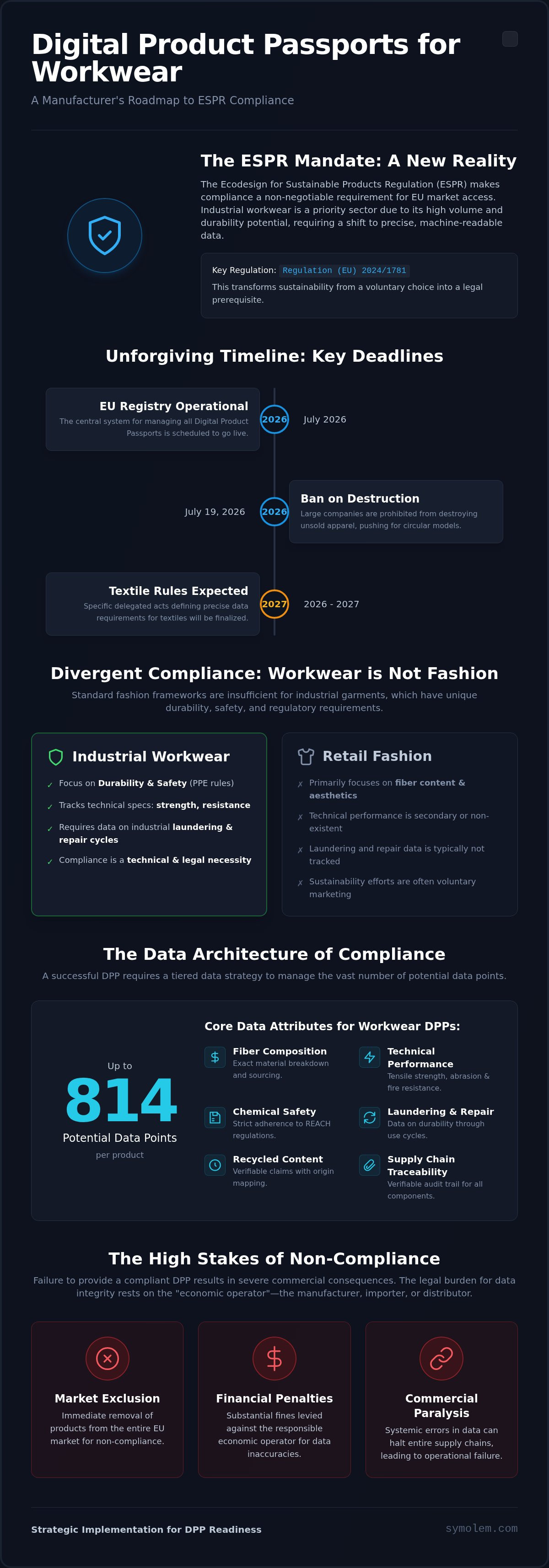
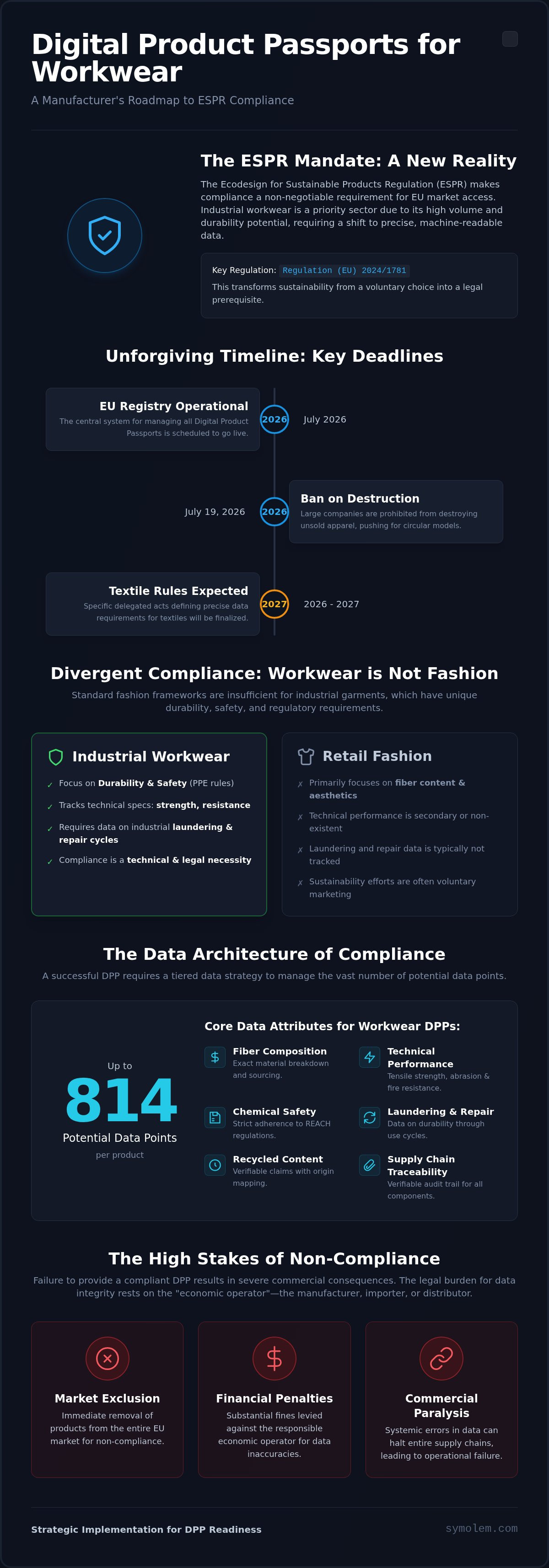
Regulation is the new reality. The Ecodesign for Sustainable Products Regulation (ESPR), specifically Regulation (EU) 2024/1781, has fundamentally altered the legal landscape for industrial textiles. It's no longer a voluntary exercise in sustainability; it's a mandatory prerequisite for market access. The EU has identified workwear as a priority sector because of its high production volumes and inherent durability potential. This focus is underscored by the ban on the destruction of unsold apparel, which takes effect on July 19, 2026, for large companies. A Digital Product Passport (DPP) serves as a persistent digital identity for every industrial garment, recording its material composition, supply chain origins, and environmental performance.
The timeline is unforgiving. With the central EU registry scheduled to be operational by July 2026 and specific delegated acts for textiles expected between 2026 and 2027, the window for strategic planning is closing. Implementing Digital Product Passports for workwear isn't a matter of selecting a software vendor; it's a structural challenge that requires mapping complex data flows long before a QR code is printed. Companies that prioritize software over strategy will find themselves with expensive tools that can't reconcile fragmented supplier data.
Workwear vs. Fashion: Divergent Compliance Paths
General fashion frameworks are insufficient for the industrial sector. While a retail shirt focuses on fiber content, workwear must account for technical specifications and safety standards. Many industrial garments also fall under Personal Protective Equipment (PPE) regulations, creating a dual layer of compliance. For UK-based manufacturers, the Single Market remains the primary destination, meaning EU regulatory shifts dictate operational standards regardless of domestic policy. Compliance is a binary state: you're either in the market or you're out.
The Responsible Operator: Legal Obligations
Accountability is centralized. The ESPR defines the economic operator as the entity placing the product on the EU market, which includes manufacturers, importers, and distributors. Importers for non-EU workwear brands carry the legal burden of data accuracy. Failure to provide a compliant passport results in immediate market exclusion and substantial financial penalties. It's a high-stakes environment where systemic errors lead to total commercial paralysis. The legal responsibility for data integrity cannot be outsourced or ignored.
Mapping the Technical Data Fields for Industrial Workwear
Data is the architecture of compliance. The ESPR framework identifies 814 potential data points, creating a high-stakes mapping challenge for manufacturers. For industrial operators, the objective isn't to populate every field but to filter for technical relevance and legal necessity. A tiered data strategy is the only viable path forward. This distinguishes between mandatory legal requirements and voluntary attributes that provide a competitive edge. Within the broader EU strategy for sustainable and circular textiles, the emphasis is clear: data must be structured, secure, and machine-readable. Verification is absolute. Without a verifiable audit trail, a passport is a liability rather than an asset.
Mapping Digital Product Passports for workwear requires a shift from superficial labels to precise technical ledgers. This process involves auditing every chemical input and material source to ensure the digital record matches the physical reality of the garment. It's a clinical exercise in supply chain forensics. If you're unsure where your data gaps lie, an ESPR Readiness Diagnostic can help identify structural vulnerabilities before they become regulatory failures.
Core Attributes for Workwear DPPs
Workwear demands a level of granularity that consumer fashion rarely touches. Compliance begins with exact fiber composition and chemical safety data, ensuring strict adherence to REACH regulations for hazardous substances. Recycled content claims must be backed by origin mapping to prevent greenwashing. Beyond basic materials, the passport must record technical performance metrics. Tensile strength, abrasion resistance, and fire retardation are critical data points. These metrics define the garment's functional lifespan and determine its suitability for industrial recovery or recycling at end-of-life.
Supply Chain Transparency Systems
Transparency must be systemic. Mapping Tier 1 to Tier 4 suppliers is a structural requirement for industrial textiles. This involves tracing the journey from raw polymer production and yarn spinning to weaving and final assembly. The challenge lies in securing verifiable credentials from global partners who may lack sophisticated data infrastructure. You can examine the complexities of mapping DPP data fields for apparel to understand how these requirements scale across different product categories. Digital integrity is the only defense against market exclusion. Every link in the chain must be audited, verified, and integrated into a single, interoperable dataset.
Durability and Industrial Laundering: The Critical Data Link
Durability is a technical achievement, not a marketing claim. For the industrial sector, the true measure of a garment's value lies in its functional lifespan under the extreme stress of repeated maintenance. Industrial laundering is the primary diagnostic point where material integrity is either validated or compromised. Unlike consumer apparel, where the use phase is often invisible to the manufacturer, Digital Product Passports for workwear must function as dynamic ledgers. They must record every thermal and chemical event a garment undergoes. This shift transforms the passport from a static birth certificate into a living document that tracks the actual degradation of the product over time.
The European Commission's Digital Product Passport for Textiles emphasizes the need for transparency throughout the product lifecycle. In a rental or service model, this data is critical for operational efficiency and legal compliance. Maintenance logs are not optional for high-visibility or flame-retardant gear. Every laundering cycle degrades the retroreflective performance and chemical treatments of safety equipment. Integrating these logs into the digital record ensures that safety integrity remains verifiable, preventing the use of compromised garments that no longer meet regulatory standards.
Measuring the Impact of Industrial Laundering
Industrial laundering environments demand rigorous data capturing to satisfy ESPR requirements. The passport must record the specific resource consumption of the use phase, including water and energy metrics per cycle. It's also necessary to document the chemical profile of industrial detergents and their long-term impact on garment longevity. Tracking microplastic shedding in commercial environments is another emerging requirement. These data points allow operators to optimize laundering protocols, extending the garment's life while minimizing its environmental footprint.
Repair and Refurbishment Frameworks
Refurbishment is a clinical process that requires standardized instructions within the DPP interface. It's not enough to simply repair a garment; the economic viability of that repair must be tracked against the cost of replacement. The passport should serve as a repository for repair history, documenting the type of refurbishment and the materials used. Most importantly, it must verify safety integrity after industrial-scale repairs. Safety is binary; a garment either meets the required protection standard or it fails. The digital record provides the audit trail necessary to prove that a refurbished garment remains fit for purpose in high-risk environments.
Designing the Infrastructure for Workwear Recovery
Data serves as the foundation, but physical infrastructure is the superstructure. Implementing Digital Product Passports for workwear without a corresponding recovery network is a strategic failure. The industrial sector possesses a distinct advantage: controlled garment cycles. Unlike the fragmented consumer market, workwear fleets operate within defined service loops, making them the ideal testing ground for high-value fiber-to-fiber recycling. The transition from linear disposal to circular recovery requires a rigorous assessment of logistics, sorting technology, and chemical compatibility. It's a systemic shift that demands more than just a digital label.
Designing collection systems for end-of-life industrial garments is an architectural challenge. It requires a clinical understanding of the waste stream and the technical requirements of modern recyclers. The passport provides the necessary data, but the organization must build the pipes. This involves establishing clear protocols for garment collection at the end of their functional life, ensuring that they don't enter the general waste stream where their value is lost to incineration or landfill.
Infrastructure Costing and Modeling
Circularity is an economic calculation. Organizations must shift from measuring garment price to analyzing the total cost of utility across the entire lifecycle. High-durability workwear requires a higher initial capital expenditure, but its ROI is realized through extended laundering cycles and lower replacement frequencies. You must conduct a detailed cost-benefit of circular textile models to justify the infrastructure investment. Budgeting for DPP implementation must account for data integration across global value chains, ensuring that the digital record remains accurate from polymer production to final recovery.
End-of-Life Sorting and Recycling
Sorting is the primary bottleneck in textile circularity. Manual identification of fiber blends is slow, prone to error, and economically unviable at scale. The DPP solves this by providing automated sorting systems with instantaneous access to material composition data. This allows for the precise separation of designed-for-recycling garments from contaminated or blended textiles. Collaboration with industrial waste managers is essential to close the loop effectively. If your current strategy lacks a clear financial roadmap for these systems, our Circular Economy Strategy Development services provide the diagnostic clarity needed to build a resilient recovery architecture.
Systemic integrity depends on the seamless integration of digital identifiers with physical sorting infrastructure. The DPP acts as the technical ledger that facilitates this, ensuring that valuable fibers are captured rather than wasted. Every garment must be treated as a bundle of high-value resources waiting to be reclaimed.
Strategic Implementation: Navigating DPP Readiness with Symolem
Implementation is a structural challenge. Most organizations treat compliance as a software procurement exercise, yet a digital tool is useless without a rigorous data architecture. Symolem bridges the gap between regulatory theory and operational reality by acting as a strategic architect rather than a generalist consultant. Digital Product Passports for workwear demand more than just technical ingestion; they require a clinical audit of fragmented supply chains to ensure systemic integrity. For workwear brands, an independent advisory partner provides the diagnostic scrutiny that software vendors often ignore.
The path forward begins with a diagnostic-led strategy. Initiating an ESPR readiness diagnostic is the only way to establish a baseline for compliance before the 2027 deadlines. This process identifies the structural failures in current data collection and provides a clear roadmap for building the necessary digital infrastructure.
The ESPR Readiness Diagnostic
Data gaps are operational liabilities. The diagnostic process focuses on mapping internal data blind spots across the Tier 1 to Tier 4 supply chain. By benchmarking current performance against the July 2026 registry requirements, we help organizations identify where their technical ledgers fail to meet EU mandates. This is not a surface-level review. It's a deep-tier audit that results in a multi-year roadmap for full DPP deployment, ensuring that every garment in the fleet is accounted for within a verifiable digital framework.
Policy and Regulatory Advisory
Regulations are not static. Staying ahead of the forthcoming delegated acts for textiles requires constant vigilance and intellectual rigor. Our advisory services focus on navigating the 2026 EU regulatory landscape, providing the clarity needed to adapt business models to new circular mandates. We move beyond simple compliance reporting to ensure long-term systemic integrity. This involves monitoring the evolving status of UK Digital Product Record consultations in 2026 and ensuring that global operations remain synchronized with the Single Market's stringent requirements. Compliance is a high-stakes legal imperative; treated with anything less than diagnostic precision, it becomes a threat to market access.
Securing Market Access Through Systemic Integrity
Compliance is a binary outcome. The transition to the EU’s new regulatory reality requires more than a simple shift in documentation; it demands a total structural overhaul of how industrial garments are tracked, maintained, and recovered. Implementing Digital Product Passports for workwear involves navigating 814 potential data fields while accounting for the high-stress variables of industrial laundering and repair cycles. Organizations that fail to map these technical ledgers before the 2026 operational registry launch face immediate market exclusion. This is a high-stakes legal imperative that rewards systemic integrity and punishes superficiality.
Strategic readiness is built on diagnostic precision. Symolem provides independent advisory with clinical precision, offering a strategic focus on global value chain costing and deep expertise in textile circularity and policy. We act as architects for your compliance infrastructure, ensuring your data mapping is resilient against future delegated acts. Take the first step toward systemic stability. Secure your ESPR Readiness Diagnostic with Symolem and transform regulatory pressure into a structural advantage. Your operational future depends on the clarity of your current strategy.
Frequently Asked Questions
When do Digital Product Passports become mandatory for workwear in the EU?
Mandatory compliance for textiles is expected between 2027 and 2028. While the central EU registry for passports is scheduled for operation by July 2026, the specific delegated acts for textiles will likely follow shortly after. Companies must initiate their data mapping strategies immediately. Failure to align with these timelines risks total exclusion from the EU Single Market as enforcement mechanisms become operational.
Does the ESPR apply to UK workwear brands selling into the EU?
Yes, the regulation covers all textile products placed on the EU market regardless of the manufacturer's origin. UK-based workwear brands must comply with ESPR mandates to continue selling to European clients. This necessitates a robust auditing of supply chains to ensure all 814 potential data fields are accurately captured and verified before products cross the border. Compliance is a prerequisite for market entry.
What are the specific data fields required for industrial workwear DPPs?
The ESPR framework identifies 814 potential data points, though not all apply to every garment. For industrial workwear, mandatory fields include exact fiber composition, chemical safety profiles under REACH, and recycled content verification. Technical performance metrics, such as abrasion resistance and tensile strength, are also critical for proving the durability and functional lifespan of heavy-duty apparel within the digital record.
How does a DPP handle industrial laundering and repair cycles?
The DPP acts as a living document that tracks the garment's lifecycle events. It records the frequency and impact of industrial laundering cycles to monitor material degradation. Repair data is similarly integrated to verify that refurbishment hasn't compromised safety integrity. This dynamic record is essential for rental models where the functional state of the garment is a legal prerequisite for continued use.
Who is the 'responsible operator' for workwear compliance under ESPR?
The responsible operator is the entity placing the product on the EU market. This role encompasses manufacturers, importers, and distributors. For non-EU brands, the importer carries the legal burden for the accuracy and accessibility of the passport data. Non-compliance results in immediate market blocks and financial penalties, making the selection of a compliant economic operator a critical business decision for global brands.
Can existing ERP systems be used to generate Digital Product Passports?
Most brands already possess 60-70% of the necessary data within their ERP or PLM systems. However, these systems are often disconnected and lack the interoperability required for a compliant passport. Implementation focuses on integrating these existing datasets through APIs to create a secure, machine-readable record that meets open standards. It's a structural integration challenge rather than a simple software installation.
What is the estimated cost of implementing a DPP for a workwear brand?
Implementation costs depend on the complexity of the global value chain and current data integrity. Expenses are driven by the need for deep-tier supply chain auditing, technical data mapping, and the development of circular recovery infrastructure. Organizations should view these costs as a strategic investment in market access and long-term operational resilience rather than a mere compliance expense or administrative overhead.
How does the DPP integrate with PPE safety certifications?
Digital Product Passports for workwear must link directly to existing PPE safety certifications. The digital record provides a verifiable audit trail for maintenance and repairs, ensuring that safety-critical gear still meets protective standards after industrial processing. This integration is vital for high-visibility and flame-retardant garments where material performance is a binary requirement for user safety and legal compliance.