
Digital Product Passport Technical Requirements: A 2026 Compliance Manual
Compliance is not a marketing exercise. Most textile brands mistakenly view the Digital Product Passport as a superficial digital label, yet it's actually a rigorous, legally mandated restructuring of your entire supply chain data architecture. If your data remains trapped in fragmented silos across global tier-1 to tier-4 suppliers, you're not just facing an operational hurdle; you're facing a total systemic failure under the Ecodesign for Sustainable Products Regulation (ESPR). The ambiguity surrounding delegated acts often leads to costly, reactive redesigns that drain resources without ensuring integrity.
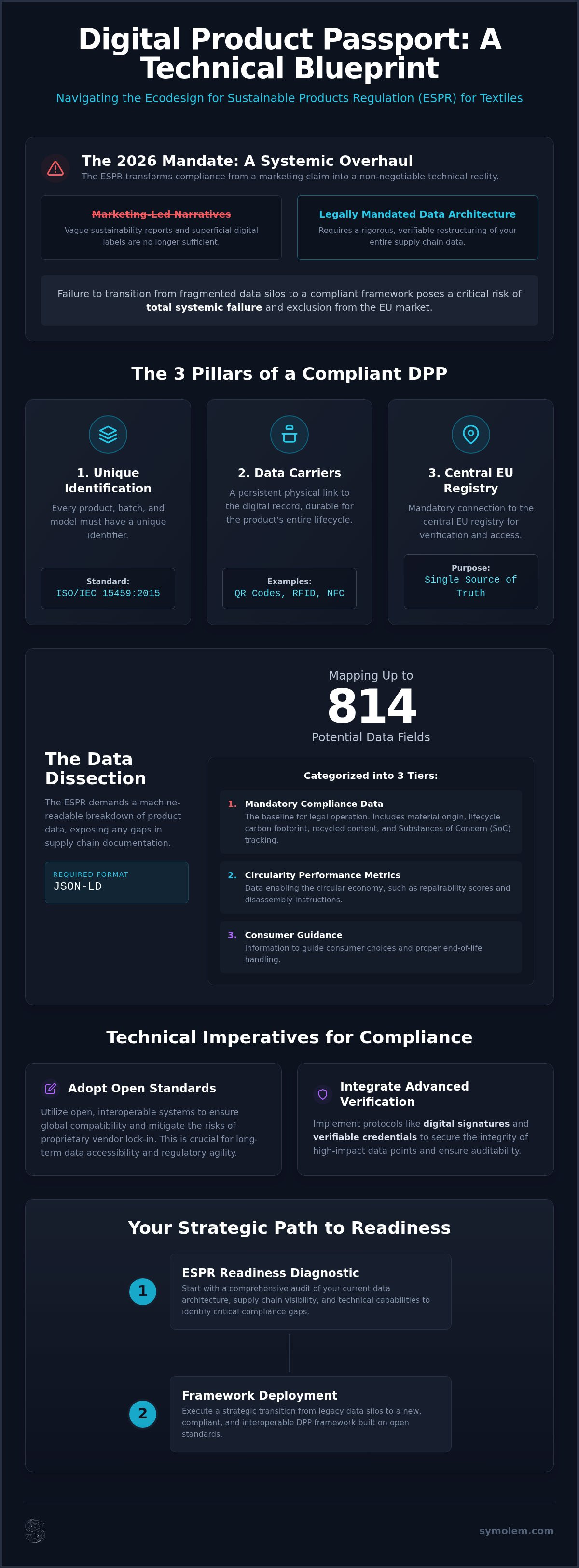
You need a clinical understanding of the Digital Product Passport technical requirements to survive the 2026 shift. This manual provides a technical blueprint for data mapping, enabling you to master the granular specifications and data architecture mandates required for compliance. We'll examine the ISO/IEC 15459:2015 standards for unique identifiers, explore the selection of interoperable systems, and provide a diagnostic path toward full regulatory readiness for the textile sector.
Key Takeaways
- Identify the structural architecture of the DPP as a legally binding record of verified lifecycle data mandated by the ESPR framework.
- Navigate the complex Digital Product Passport technical requirements by mapping 814 granular data fields across compliance, circularity, and consumer guidance categories.
- Adopt open standards and decentralized storage models to ensure global interoperability while mitigating the risks of proprietary vendor lock-in.
- Integrate advanced verification protocols, such as digital signatures and verifiable credentials, to secure the systemic integrity of high-impact data points.
- Execute a strategic transition from legacy data silos to a compliant framework starting with a comprehensive ESPR Readiness Diagnostic.
The Architecture of Transparency: Defining the DPP Technical Scope
Transparency is no longer a choice. It's a technical mandate. Under the Ecodesign for Sustainable Products Regulation (ESPR), specifically Regulation (EU) 2024/1781, the concept of What is a Digital Product Passport? has shifted from a theoretical ideal to a rigid technical framework. A compliant DPP is a structured digital record of verified lifecycle data. It's not a static PDF or a vague sustainability report. It's a dynamic digital twin designed to survive the clinical scrutiny of 2026 regulatory audits. Superficial transparency will fail these audits because it lacks the granular, verifiable data architecture required to prove circularity and regulatory compliance.
To meet the Digital Product Passport technical requirements, brands must align with three core pillars. First, there is the unique identification of products, batches, and models. Second, there are the data carriers that link physical goods to their digital records. Third, there is the mandatory connection to the central EU registry. Without these three components working in systemic harmony, a passport is essentially invalid. This architecture ensures that every stakeholder, from customs officials to recyclers, can access a single, immutable source of truth regarding a product's composition and origin.
The ESPR Regulatory Foundation
The ESPR represents a fundamental shift. We're moving away from voluntary disclosure toward mandatory technical performance. The regulation entered into force on July 18, 2024, but the real pressure arrives in 2026. This is when the first textile-specific delegated acts are expected to take effect. Brands that rely on marketing-led sustainability narratives will find themselves legally exposed. Compliance is now a matter of technical performance, not creative storytelling. You must demonstrate data integrity through every tier of your supply chain or face exclusion from the European market.
Data Carriers and Unique Identifiers
The physical link is often the weakest point in the chain. You must select data carriers that withstand the entire lifecycle of a garment. QR codes, RFID tags, and NFC chips all offer different levels of technical suitability. While a QR code is globally accessible, an RFID tag might be necessary for automated industrial sorting and high-speed recycling infrastructure. These carriers must host a unique product identifier compliant with ISO/IEC 15459:2015. The primary challenge is persistence. If a data carrier cannot survive industrial washing or the rigors of the secondary market, the product effectively loses its legal identity and its circular potential.
Granular Data Requirements: Mapping the up to 236 data points in the UNTP schema
Data management is the new legal frontier. The ESPR doesn't request a summary. It demands a granular dissection of every product placed on the market. Mapping these requirements involves navigating up to 814 potential data points, a task that exposes the structural failures in current supply chain documentation. To meet the Digital Product Passport technical requirements, brands must move beyond static documents. Data must be machine-readable, specifically in JSON-LD format, to allow for automated regulatory reporting and seamless integration into the EU registry. This structural redesign is not optional. It's the price of market entry.
The technical architecture of the DPP categorizes information into three distinct tiers: mandatory compliance data, circularity performance metrics, and consumer guidance. Integrating Substances of Concern (SoC) tracking within this structure is particularly critical. Under the 2026 REACH updates, an SoC is defined as any substance that negatively affects the reuse and recycling of materials. Tracking these requires a diagnostic approach to chemical inventories across the entire production cycle, ensuring that every material input is documented and verified.
Mandatory vs. Voluntary Data Attributes
Essential fields include material origin, lifecycle carbon footprint, and recycled content percentages. These are the baseline for legal operation. While mandatory fields ensure market access, voluntary attributes, such as repairability scores or disassembly instructions, provide the competitive edge in circularity performance. Brands must prioritize securing the mandatory core before attempting to leverage voluntary data for market positioning. Success depends on the stability of the underlying data schema.
Material Composition and Traceability
The technical challenge of mapping DPP data fields for apparel requires visibility into tier-4 suppliers. This involves fiber-level traceability that captures chemical inputs and mechanical processes at the source. Verifying textile sustainability claims for ESPR necessitates a shift from self-declaration to third-party audited technical data. Proprietary data is managed through role-based access; regulators receive the full technical file while consumers access a curated version. For brands struggling with this architecture, an ESPR Readiness Diagnostic is the logical starting point to identify existing data gaps.
Interoperability and Standards: The Engine of Global Compliance
Isolation is a liability. For global textile brands, the Digital Product Passport technical requirements mandate a definitive move away from proprietary, closed-loop systems. Vendor lock-in is a strategic failure that threatens long-term compliance. If your data architecture cannot communicate with the systems of customs authorities, recyclers, and third-party auditors across borders, your market access remains fragile. Open standards are the only insurance against systemic obsolescence. They ensure that data remains portable and functional long after a specific software contract expires.
The architecture must balance the centralized EU registry with decentralized, brand-managed repositories. While the EU registry acts as a centralized index for mandatory metadata, the granular lifecycle data resides in decentralized environments controlled by the economic operator. This hybrid model necessitates a rigorous approach to Digital Product Passport data governance to ensure that records remain immutable, accessible, and synchronized across disparate platforms. GS1 Digital Link serves as the critical bridge in this ecosystem. It transforms a standard data carrier into a web-enabled gateway, allowing a single identifier to point to multiple digital endpoints based on the specific role of the stakeholder accessing it.
GS1 and ISO Standards for Textile Traceability
The Global Trade Item Number (GTIN) is the foundational anchor for the DPP. Within the textile sector, this identifier must be paired with ISO/IEC 15459 standards to ensure unique identification at the batch or individual item level. Cross-border interoperability is not a luxury. It is a functional requirement. If a garment produced in a tier-4 facility cannot be identified and processed by an automated sorting facility in the EU, the circular loop remains broken. These standards provide the common technical language required for global value chain transparency.
Decentralized Data Storage Architectures
Distributed ledger technology (DLT) provides the clinical precision needed for immutable record-keeping. It prevents the retroactive alteration of impact data, which is a key requirement for regulatory trust in 2026. However, storage is only half the battle. You must implement role-based "Right to Access" protocols to manage data sensitivity. Regulators require full technical files; recyclers need disassembly and chemical data; consumers require simplified impact narratives. Managing these permissions requires robust API infrastructures that enable real-time, automated data retrieval by customs authorities during high-stakes border inspections.
Verification and Auditability: Ensuring Data Integrity
Self-declaration is a relic of a less regulated era. In the 2026 regulatory landscape, "trust" is no longer a marketing sentiment; it's a technical byproduct of rigorous verification. The Digital Product Passport technical requirements mandate that high-impact data points, especially those related to recycled content and chemical composition, must be validated by independent third parties. Without this layer of clinical scrutiny, your data architecture is merely a collection of unverified claims that will crumble during a border inspection or a market surveillance audit. Systemic integrity requires that every data point within the passport is traceable to a verifiable source of truth.
Monitoring, Reporting, and Verification (MRV) systems are the primary engines feeding this integrity. These systems convert raw operational data from the factory floor into structured, audit-ready evidence. Discrepancies discovered during an ESPR readiness diagnostic often reveal structural failures in how brands collect and store supplier evidence. If your chain of custody documentation is fragmented or relies on outdated paper certificates, the resulting Digital Product Passport will be legally non-compliant, potentially leading to immediate market exclusion and significant financial penalties.
Digital Signatures and Verifiable Credentials
Verifiable Credentials (VCs), based on W3C standards, provide the technical mechanism for securing supply chain claims. Unlike a static PDF certificate, a VC is a machine-readable digital proof that allows a brand to automatically verify supplier credentials, such as GOTS or GRS status, without manual intervention. This automation reduces the risk of human error and prevents the use of fraudulent certifications. Data persistence in this context refers to the technical and legal obligation to maintain the accessibility and integrity of the digital record for a minimum of 10 years after the product is placed on the market. This ensures that the audit trail remains intact throughout the product's entire lifecycle and beyond.
Supply Chain Evidence and Audit Trails
Mapping the chain of custody requires a diagnostic approach to every node in the value chain. You must integrate Life Cycle Assessment (LCA) data directly into the technical passport structure to provide a granular view of environmental impact. Independent auditors play a critical role here, acting as the final gatekeepers who validate the accuracy of the "Digital Twin" against physical reality. This audit trail must be immutable, providing a clear path from the raw fiber to the finished garment. For brands seeking to secure their data architecture, our Impact Measurement and MRV advisory provides the structural blueprint necessary for long-term regulatory stability.
Strategic Implementation: From Diagnostic to Deployment
Deployment is the final stage of a clinical process, not the first. Most textile brands attempt to solve compliance issues by purchasing software before they have addressed the structural failures inherent in their legacy data systems. This reactive approach is a recipe for technical debt. To meet the Digital Product Passport technical requirements, you must first execute a total transition from fragmented ERP and PLM silos to a unified, machine-readable data architecture. Scaling this infrastructure requires more than a digital label; it requires a fundamental audit of how data is captured, verified, and stored across your tier-1 to tier-4 supply chain.
The challenges of Digital Product Passport implementation are primarily found in the gap between physical reality and digital records. If your internal data remains unmapped and unverified, no amount of sophisticated software will ensure regulatory readiness. This technical passport should be viewed as a strategic catalyst for a broader textile regulation impact on business models. It forces a shift from linear, volume-based production to a circular system where data is the primary asset. C-suite executives must lead this transition through three distinct phases: diagnostic assessment, technical mapping, and full infrastructure deployment.
The Role of ESPR Readiness Diagnostics
Identifying data gaps is the critical first step. You shouldn't invest in compliance software until you understand the specific structural deficiencies within your current reporting systems. A rigorous cost-benefit analysis often reveals that internal data restructuring provides more long-term stability than relying on proprietary, outsourced frameworks that create vendor dependency. This is why choosing a DPP advisory partner for textiles is a strategic mandate. You need an architect to design the framework before you hire the contractors to build it.
Integrating DPP with Circular Business Models
Technical data is the functional fuel for circularity. It enables high-value recycling, repair, and resale by providing the precise material composition and chemical history required by secondary market operators. Crucially, providing verified data can lead to a significant reduction in Extended Producer Responsibility (EPR) fees by proving the durability and recyclability of your products. This creates a direct link between technical integrity and financial performance. To secure your market position, implement a diagnostic-first strategy to ensure your Digital Product Passport technical requirements are met with uncompromising systemic integrity. Our ESPR Readiness Diagnostic is the logical starting point for this transformation.
Architecting Systemic Integrity for 2026
The 2026 deadline is a hard boundary for market access. Brands that fail to master the Digital Product Passport technical requirements face immediate exclusion from the European economic area. This isn't just about digital labeling; it's about structural survival. You've seen how fragmented supply chains and unverified claims create systemic risk. You must now move from diagnostic clarity to full-scale infrastructure deployment. Compliance is a technical mandate that requires precision, not a marketing narrative that relies on vague aspirations.
True compliance requires more than a digital twin. It demands a rigorous, policy-aligned framework that integrates material traceability with immutable audit trails to satisfy the clinical scrutiny of 2026 regulators. As a strategic architect of circular systems, we provide the independent technical advisory and global expertise in circular infrastructure needed to navigate this high-stakes landscape. Don't wait for a regulatory audit to expose your data gaps. Identifying these failures now is the only way to ensure long-term stability.
Secure your regulatory future with an ESPR Readiness Diagnostic.
Establishing systemic integrity today ensures your business remains resilient and competitive in a circular future.
Frequently Asked Questions
What is the minimum technical requirement for a DPP data carrier in textiles?
The minimum requirement is a machine-readable data carrier, such as a QR code or RFID tag, that provides a persistent link to the digital record. This carrier must remain legible and functional throughout the garment's lifecycle, including industrial laundering and recycling processes. It must host a unique product identifier that complies with ISO/IEC 15459:2015 to ensure global recognition and interoperability.
How many data fields are mandatory for apparel under ESPR in 2026?
While specific delegated acts for textiles will finalize the list in 2026, current frameworks identify up to 814 potential data fields. These Digital Product Passport technical requirements cover material composition, chemical substances of concern, and environmental impact metrics. Brands must prepare to map this extensive data set to avoid systemic compliance failures when the regulations take full effect.
Can I use existing PIM systems for Digital Product Passport compliance?
Existing PIM systems are often insufficient for full compliance because they lack the necessary architecture for decentralized data governance and third-party verification. While a PIM can store basic product attributes, it typically cannot handle the complex JSON-LD structures or the immutable audit trails required by the ESPR. You'll likely need to integrate your PIM with a dedicated DPP framework to manage lifecycle data and registry connections.
What technical standards ensure DPP interoperability across the EU?
Interoperability is secured through the adoption of open, non-proprietary standards like GS1 Digital Link and ISO/IEC 15459. These standards ensure that data remains accessible across different software environments and national borders. Without these protocols, your data becomes a proprietary silo that prevents customs authorities and recyclers from accessing the information they need to verify compliance.
How does the DPP handle commercially sensitive supplier information?
Commercially sensitive information is protected through a role-based access control system. The technical architecture allows for different levels of visibility; market surveillance authorities receive the full technical file, while consumers and competitors only access a curated subset of sustainability and circularity data. This ensures transparency without compromising proprietary manufacturing secrets or specific tier-4 supplier relationships.
Who is responsible for the technical maintenance of the DPP data?
The economic operator who places the product on the EU market is legally responsible for the technical maintenance and accuracy of the DPP data. This responsibility includes ensuring the data remains accessible for at least 10 years after the product is sold. Failure to maintain this digital record is a direct violation of the ESPR and can result in immediate market exclusion or significant financial penalties.
What happens if the physical data carrier on a garment is damaged?
If a physical data carrier is damaged, the product effectively loses its digital link, which can obstruct high-value recycling and regulatory verification. The ESPR mandates that carriers must be durable and resistant to typical wear and tear. A broken link doesn't delete the data from the EU registry, but it prevents the physical-to-digital connection required for circularity operations and compliance inspections.
Is blockchain a technical requirement for the Digital Product Passport?
Blockchain is not a technical requirement for the Digital Product Passport, though it's one method for achieving data immutability. The regulation focuses on open standards and machine-readability rather than specific ledger technologies. While Distributed Ledger Technology (DLT) can provide a secure audit trail, the actual Digital Product Passport technical requirements emphasize interoperability and data persistence above any single technological platform.