Digital Product Passport Technical Requirements: A 2026 Compliance Blueprint
Most textile brands treat 2026 as a distant deadline, yet the clinical reality is already here. The era of voluntary sustainability narratives ended on July 16, 2026, with the formal adoption of Commission Implementing Regulation (EU) 2026/1778. Compliance is no longer a marketing choice. It's a rigorous structural mandate that demands absolute data transparency across your entire value chain. You're likely facing the friction of fragmented data from Tier 3 suppliers while weighing the risk of exposing proprietary trade secrets within an open architecture. It's a high-stakes balancing act where technical failure leads to immediate market exclusion.
This blueprint provides the clarity required to master the Digital Product Passport technical requirements before the mandatory deadlines hit. We'll move beyond aspirational goals to provide a diagnostic breakdown of the six harmonised standards, from EN 18216 to EN 18223, that now govern data exchange and interoperability. You'll gain a clear technical roadmap to align your IT infrastructure with EU policy. We'll examine the specific mechanics of the new DPP Registry and the security protocols of prEN 18239 to ensure your compliance strategy is both legally sound and systemically secure.
Key Takeaways
- Identify the legal weight of the 14 July 2026 Implementing Decision and how it transforms harmonised standards into binding technical mandates for the textile sector.
- Master the specific Digital Product Passport technical requirements for system-agnostic data exchange and unique identifier carriers like QR codes and RFID.
- Implement the GS1 Digital Link architecture to ensure end-to-end interoperability between physical textile assets and their mandatory digital twin infrastructure.
- Guard proprietary trade secrets through the tiered visibility and access management protocols established in the latest EN 18239 and EN 18246 security standards.
- Transition from fragmented data silos to a unified compliance roadmap by conducting an ESPR Readiness Diagnostic to map current IT and supply chain gaps.
Table of Contents
- The 2026 Standardisation Milestone: Implementing Decision (EU) 2026/1736
- 8 Pillars of Technical Conformity (EN 18216 to EN 18246)
- Interoperability Architecture: The GS1 Digital Link and API Mandates
- Data Governance, Security, and Business Confidentiality
- Strategic Implementation: From Technical Mapping to Regulatory Readiness
The 2026 Standardisation Milestone: Implementing Decision (EU) 2026/1736
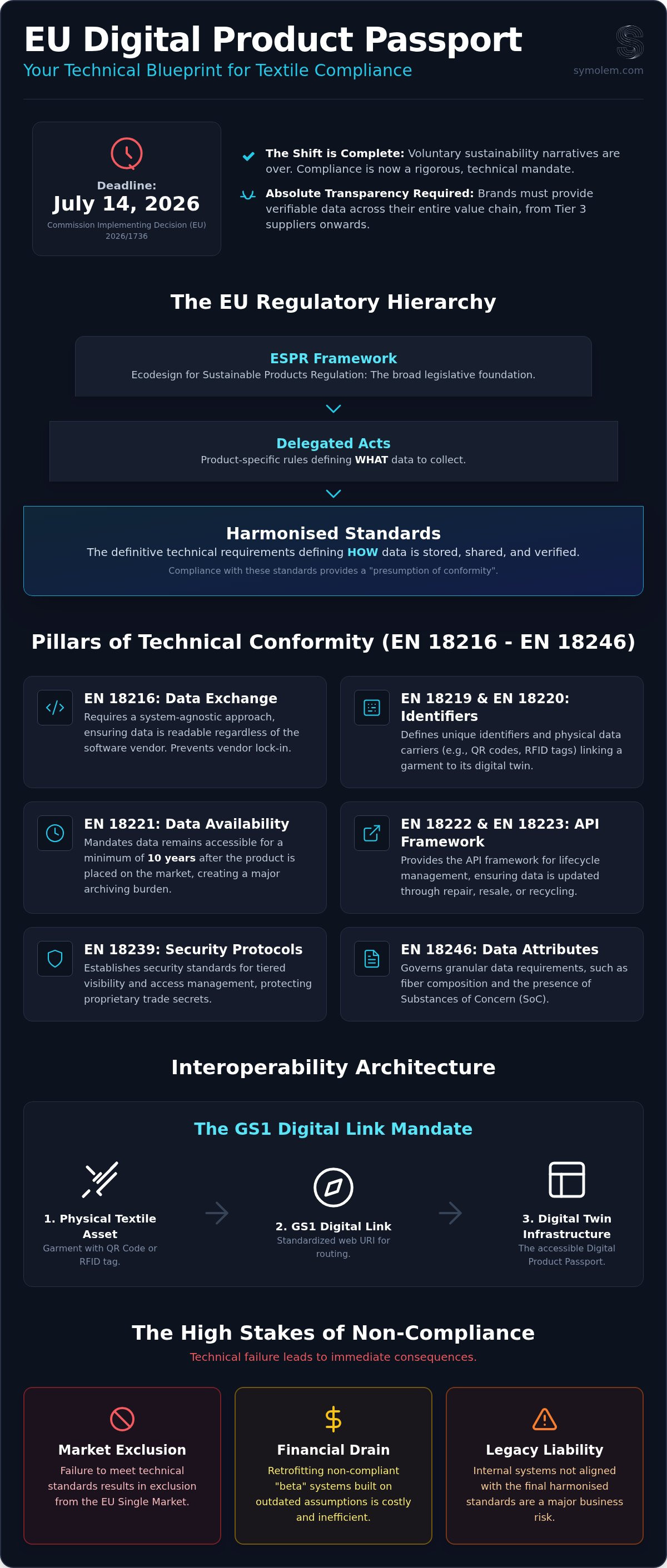
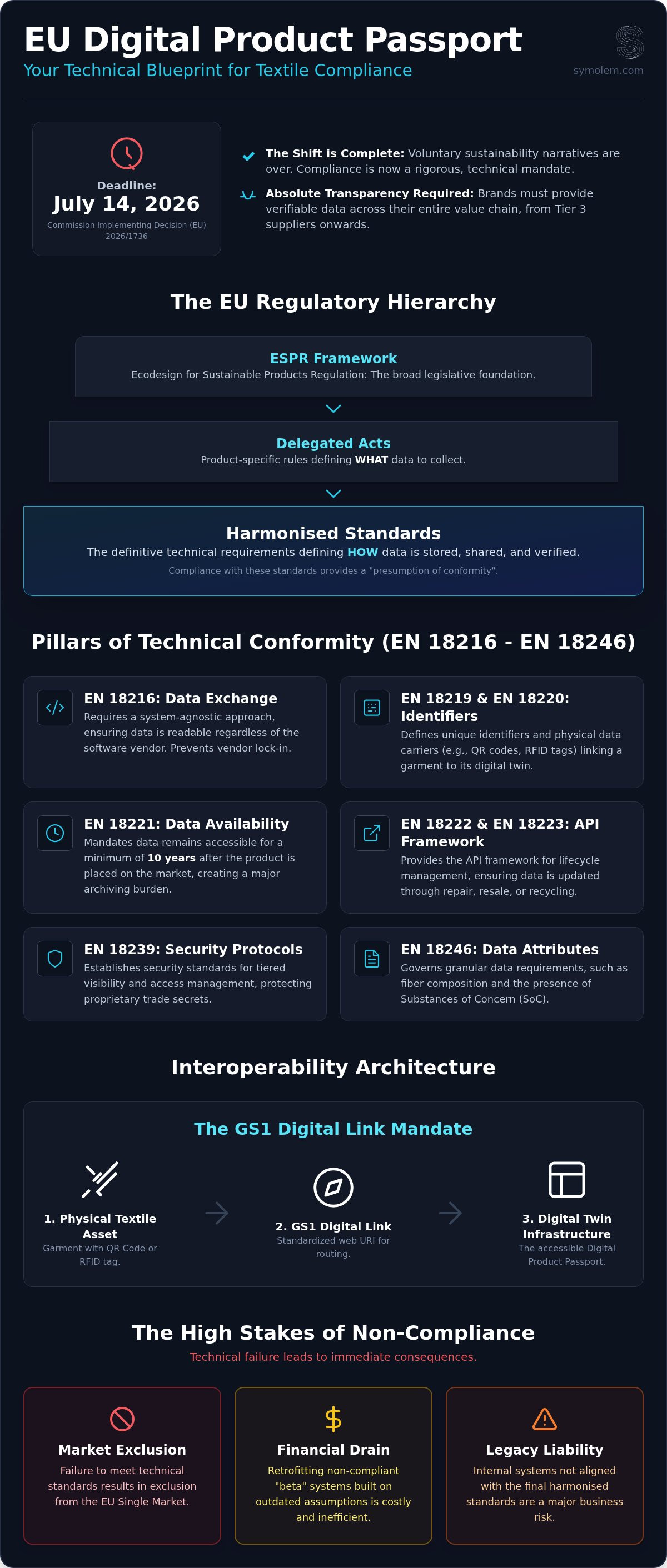
The period of technical speculation is over. On July 14, 2026, the European Commission adopted Implementing Decision (EU) 2026/1736, an action that fundamentally altered the legal landscape for every textile brand operating within the Single Market. This decision officially cited the first six harmonised standards developed by the CEN/CENELEC Joint Technical Committee 24 (JTC 24) in the Official Journal of the European Union. By doing so, the Commission activated the "presumption of conformity" mechanism under Regulation (EU) 1025/2012. This is a critical legal shield. It means that any brand whose Digital Product Passport (DPP) infrastructure aligns with these standards is legally presumed to satisfy the essential requirements of the overarching Ecodesign for Sustainable Products Regulation (ESPR).
The Hierarchy of DPP Regulation
Navigating this landscape requires a clinical understanding of the regulatory stack. The ESPR provides the broad legislative framework, while product-specific Delegated Acts dictate what data must be collected. However, the harmonised standards provide the definitive Digital Product Passport technical requirements for how that data is stored, shared, and verified. Following the 2026 decision, the technical "how-to" is no longer open to interpretation. These standards govern everything from data exchange protocols to the physical carriers used on garments. For the textile sector, the 2026 milestone creates a clear, non-negotiable path toward the mandatory rollout, replacing fragmented internal theories with a unified, EU-wide technical language.
The Risks of Retrofitting Old Architectures
Internal IT teams often mistake early adoption for readiness. If you've built your data architecture based on draft assumptions prior to July 2026, you've likely created a legacy liability. These "beta" systems frequently fail to accommodate the "system-agnostic" reading requirements defined in EN 18216 or the specific API mandates now in force. Retrofitting these flaws is more than a technical hurdle; it's a financial drain that risks total market exclusion. A rigorous audit against the finalized Digital Product Passport technical requirements is the only way to ensure systemic integrity. Without this alignment, your business remains exposed to the clinical precision of EU market surveillance authorities who prioritize documented technical conformity over superficial sustainability narratives.
8 Pillars of Technical Conformity (EN 18216 to EN 18246)
Compliance is not a vague aspiration. It's a technical architecture defined by eight distinct pillars. These standards, harmonised under Implementing Decision (EU) 2026/1736, dictate the operational boundaries of your digital infrastructure. EN 18216 establishes the baseline for data exchange, requiring a system-agnostic approach that ensures information remains readable regardless of the software vendor. EN 18219 and EN 18220 move to the physical layer, defining the unique identifiers and data carriers, such as QR codes and RFID tags, that link a garment to its digital twin. These are the non-negotiable Digital Product Passport technical requirements that prevent vendor lock-in and guarantee market-wide interoperability.
Systemic integrity relies on persistent accessibility. EN 18221 mandates that data remains available for a minimum of ten years after a product is placed on the market, creating a significant archiving burden for brands with high SKU turnover. Meanwhile, EN 18222 and EN 18223 provide the API framework for lifecycle management and system interoperability. These standards ensure that as a product moves through repair, resale, or recycling, its digital passport remains accurate, updated, and accessible to authorized stakeholders. Ignoring these protocols creates a structural failure that no amount of marketing can fix.
Technical Mapping for Textile Attributes
Textile brands face a granular data challenge. You've got to map hundreds of data fields, ranging from fiber composition to the presence of substances of concern (SoC) as required by EN 18246. This process involves mapping DPP data fields for apparel into your existing Product Lifecycle Management (PLM) systems. It's a clinical exercise in data hygiene. Failure to align these fields with the official Digital Product Passport technical requirements results in a broken data chain, rendering the passport invalid and the product non-compliant at the border.
Data Persistence and the 10-Year Rule
Discontinuing a product line doesn't end your legal obligation. EN 18221 requires that technical data persists even if the manufacturer ceases operations or the product is no longer sold. This raises critical questions regarding decentralized versus centralized storage models. While centralized databases offer control, they create single points of failure that may not satisfy the long-term availability mandates of the ESPR. Evaluating your storage scalability is a critical component of a professional ESPR Readiness Diagnostic, ensuring your infrastructure can support a decade of data integrity without escalating costs.
Interoperability Architecture: The GS1 Digital Link and API Mandates
Interoperability is the end-to-end communication requirement of the ESPR. It's not optional. Without it, the "passport" is just a siloed data set that fails to meet legal mandates. The GS1 Digital Link serves as the primary resolver. It connects the physical textile product to its digital twin via a standardized web URI. This ensures that any stakeholder, from regulators to recyclers, can access the data without proprietary software. These Digital Product Passport technical requirements are designed to dismantle the data silos that currently plague the apparel industry, replacing them with a transparent, unified infrastructure.
API mandates under EN 18222 define how this data is searched, retrieved, and managed throughout its lifecycle. It's about more than just passive reading; it's about active synchronization. When a garment is repaired or resold, the digital record must reflect that change to maintain systemic integrity. This requires a seamless connection between your brand's internal data architecture and the EU DPP Registry, which officially became operational on July 20, 2026. The registry doesn't store the full passport data; instead, it acts as a central lookup service that manages access permissions and verifies user identities according to the strict rules established in Commission Implementing Regulation (EU) 2026/1778.
Building the Interoperable Stack
Semantic interoperability ensures that Platform A understands the data structure and context of Platform B without manual intervention. This is only possible through the adoption of open, international standards that provide the common technical vocabulary required by the Digital Product Passport technical requirements. By implementing the GS1 Digital Link, brands can significantly reduce long-term implementation costs and avoid the crippling technical debt associated with proprietary "walled gardens." This standard provides a clinical, diagnostic method for encoding product identifiers like GTINs into a web-based format that is both machine-readable for automated sorting and human-navigable for consumer transparency.
Registry Integration and Issuer Credentials
Managing the challenges of Digital Product Passport implementation requires a robust strategy for real-time registry synchronization. You must clearly distinguish between the high-level metadata stored by the European Commission and the granular, proprietary data hosted on your own secure servers. Technical requirements for issuer credentials ensure that only verified, authorized entities can register passports in the central system. This creates a verifiable chain of trust that is essential for regulatory auditability, preventing fraudulent sustainability claims while ensuring that every digital twin remains anchored to a legitimate physical product.
Data Governance, Security, and Business Confidentiality
Transparency is not a license for industrial espionage. While the ESPR mandates unprecedented levels of data disclosure, it simultaneously requires technical safeguards to protect proprietary trade secrets. The finalization of EN 18239 on September 16, 2026, provided the industry with the definitive framework for access rights management. This standard ensures that Digital Product Passport technical requirements don't compromise your competitive advantage. It establishes a tiered visibility model where data is only accessible to parties with a verified "need to know," effectively walling off sensitive Tier 2 and Tier 3 supplier identities from public view while keeping them available for regulatory audit.
Systemic trust requires more than just access control; it demands data authentication. EN 18246 addresses this by defining the protocols for preventing fraudulent "green" claims through secure asset binding. By utilizing digital signatures and verifiable credentials, brands can anchor their sustainability data to a tamper-proof digital record. This clinical approach to data integrity eliminates the "trust me" narrative of traditional marketing, replacing it with a verifiable chain of custody. These security protocols aren't merely IT hurdles. They're the structural defense mechanisms that protect your brand from the legal and reputational fallout of non-conformity.
Tiered Access and Stakeholder Permissions
Technical implementation of Role-Based Access Control (RBAC) is the cornerstone of a functional DPP. You must distinguish between the "public" layer, accessible to consumers via a GS1 Digital Link, and the "restricted" layer reserved for market surveillance authorities and recyclers. A consumer might see fiber composition and care instructions, while a regulator requires deep-dive data on substances of concern and supply chain mapping. Managing this data integrity across a global textile value chain requires a diagnostic precision that most legacy ERP systems simply cannot provide without significant structural realignment.
Security as a Strategic Moat
Data authentication serves as the ultimate antidote to greenwashing litigation. In an era of clinical regulatory scrutiny, the ability to prove the origin and impact of every fiber is a high-stakes business imperative. Implementing digital signatures ensures that once data is registered in the DPP, it cannot be altered without detection. This level of rigor is essential for verifying textile sustainability claims for ESPR and maintaining market access. To ensure your security protocols meet the 2026 mandates, schedule an ESPR Readiness Diagnostic to identify vulnerabilities in your current data architecture.
Strategic Implementation: From Technical Mapping to Regulatory Readiness
Implementation is not an IT project. It is a structural survival strategy. The transition from fragmented spreadsheets to a machine-readable, interoperable architecture requires a methodical approach that prioritizes systemic integrity over short-term software fixes. You must move beyond theoretical compliance to conduct a clinical ESPR Readiness Diagnostic. This process identifies the specific gaps between your current Product Lifecycle Management (PLM) data and the eight harmonised standards now cited in the Official Journal. Without this diagnostic baseline, any attempt to meet Digital Product Passport technical requirements will likely result in expensive technical debt and eventual market exclusion.
The 2026 decision framework for building versus buying has shifted. In-house development offers control, yet it carries the immense burden of maintaining alignment with evolving delegated acts and security protocols like EN 18246. Selecting a vendor requires a diagnostic rigor that verifies their claims against the CEN/CENELEC JTC 24 standards. A 5-phase roadmap—comprising audit, mapping, infrastructure alignment, pilot testing, and full-scale deployment—is the only reliable path to ensuring your technical infrastructure reflects the textile regulation impact on business models. This alignment transforms data from a compliance cost into a strategic asset for circularity.
The Symolem Implementation Framework
Our framework treats compliance as a diagnostic exercise in value chain engineering. We map your current data fields against the eight mandatory standards, identifying exactly where Tier 2 and Tier 3 data silos break the chain of custody. This includes a rigorous policy advisory component to navigate the increasing divergence between EU mandates and post-Brexit UK requirements. We don't just facilitate data entry; we model the long-term ROI of transparency. By building a stable data architecture today, you ensure that your business remains resilient against the clinical scrutiny of future market surveillance authorities.
The Path to 2027: Immediate Next Steps
The clock is ticking toward the first mandatory deadlines. You must initiate a technical pilot based on EN 18216 to test system-agnostic reading capabilities across your primary product lines. Auditing your supply chain for data readiness is no longer a peripheral task; it's a core operational requirement. Waiting for the final textile-specific delegated act to begin your technical transition is a strategic failure that leaves your market access at risk. Secure your position in the European market by initiating a Symolem Compliance Diagnostic to bridge the gap between technical standards and business reality.
Securing Market Access through Systemic Integrity
Compliance is a binary outcome. You either meet the 14 July 2026 harmonised standards or you face immediate exclusion from the European market. By mastering the Digital Product Passport technical requirements, you move beyond superficial sustainability narratives toward a stable, machine-readable data architecture. It's time to recognize that technical conformity is not an IT checkbox but a fundamental realignment of your value chain. From the interoperability of the GS1 Digital Link to the security protocols of EN 18239, every layer of your infrastructure must now withstand clinical regulatory scrutiny.
The path toward 2027 requires a level of diagnostic rigor that generalist consultants cannot provide. Symolem acts as a strategic architect, providing independent advisory specialized in global textile value chain infrastructure. We possess the expertise to mapping up to 236 data points in the UNTP schema, ensuring your digital twins are anchored in verifiable reality rather than aspirational claims. Request an ESPR Readiness Diagnostic to identify your structural vulnerabilities before they become legal liabilities. You can transform this regulatory mandate into a strategic moat that secures your brand's future in a circular economy.
Frequently Asked Questions
What are the 8 harmonised standards for the Digital Product Passport?
The eight harmonised standards include EN 18216 for data exchange, EN 18219 and 18220 for identifiers and carriers, and EN 18221 for data storage. These are supported by EN 18222 and 18223 for lifecycle APIs and interoperability, alongside EN 18239 and 18246 for access rights and authentication. Together, they constitute the clinical framework for Digital Product Passport technical requirements. Following these pillars ensures a presumption of conformity under EU law.
Does the Digital Product Passport require blockchain technology?
Blockchain is not a legal mandate for DPP implementation. The European Commission prioritizes interoperability and system-agnostic reading over specific ledger technologies. Your architecture must focus on the data persistence and accessibility requirements defined in EN 18216. While decentralized ledgers are an optional tool for ensuring data integrity, they're not a substitute for the structural alignment required by the harmonised standards. Systemic transparency is the goal, regardless of the underlying database.
How does the DPP handle business confidentiality and trade secrets?
Confidentiality is managed through tiered visibility and Role-Based Access Control (RBAC) protocols defined in EN 18239. This standard ensures that sensitive supplier data remains restricted to market surveillance authorities while consumers only see public-facing sustainability metrics. This clinical separation of data layers prevents industrial espionage. It allows brands to meet transparency mandates without exposing proprietary trade secrets or Tier 3 supplier identities to competitors or the general public.
What is the role of the GS1 Digital Link in DPP compliance?
The GS1 Digital Link acts as the standardized web URI that bridges physical textile products and their digital twins. It replaces traditional, siloed barcodes with a machine-readable link that any stakeholder can access via a standard web browser. This open architecture is essential for meeting Digital Product Passport technical requirements related to interoperability. It ensures your data remains accessible throughout the product's lifecycle without requiring proprietary software or vendor-specific applications.
How long must DPP data be stored and who is responsible for it?
Data must be stored and accessible for a minimum of ten years after a product is placed on the market according to EN 18221. The economic operator, typically the manufacturer or importer, holds ultimate responsibility for this persistence. Even if a product line is discontinued, the digital record must survive. This mandate requires a robust archiving strategy that accounts for potential software obsolescence and the long-term costs of maintaining data hosting infrastructure.
Is the UK adopting the same technical requirements as the EU DPP?
The UK is not currently adopting identical mandates, though any brand exporting to the EU must comply with the full suite of ESPR requirements. This divergence creates a complex compliance landscape for global brands navigating different circularity goals. While the UK explores its own frameworks, the EU's harmonised standards remain the dominant technical benchmark for international trade. Navigating these overlapping mandates requires a diagnostic approach to ensure your infrastructure satisfies the most rigorous standards.
What happens if our current ERP/PLM systems are not interoperable?
Non-interoperable systems represent a critical structural failure that leads to immediate market exclusion. If your ERP or PLM cannot communicate via the mandated APIs, your product cannot legally enter the EU market. You don't necessarily need a total system overhaul, but you do need an integration layer that maps your internal data to the harmonised standards. This technical mapping is a core component of a professional compliance diagnostic to identify and bridge infrastructure gaps.
Who is the "Responsible Operator" for DPP technical compliance?
The Responsible Operator is the economic entity that places the product on the EU market. This is usually the manufacturer for EU-based brands or the importer for goods produced abroad. This entity is legally liable for the accuracy of the data and the technical conformity of the passport. They must ensure that the digital twin remains anchored to the physical product and that all mandatory data fields are populated according to the latest delegated acts.