Circular Textile Value Chain Strategy: Navigating the 2026 Regulatory Mandate
As of July 19, 2026, the era of disposal as a business model for large textile enterprises has officially ended. The EU ban on destroying unsold goods isn't a suggestion; it's a structural ultimatum that renders the traditional linear model legally and economically obsolete. You're likely grappling with the reality of opaque supply chain data and the staggering costs of recovery infrastructure while facing impending legal penalties for non-compliance. It's a high-stakes environment where superficial sustainability narratives no longer offer protection.
This article delivers a definitive circular textile value chain strategy to move your operations from linear fragility to high-integrity circular systems. We'll establish a clear roadmap for ESPR readiness, provide a framework for costing circular infrastructure, and detail the technical integration of the Digital Product Passport, including the mapping of 814 mandatory data fields. By meticulously auditing the systemic requirements of the 2026 mandate, we'll transform regulatory pressure into a clinical blueprint for structural resilience and continued market access.
Key Takeaways
- Transition from aspirational CSR to a clinical, legally mandated framework driven by the 2026 EU ban on the destruction of unsold textiles.
- Develop a robust circular textile value chain strategy by prioritizing technical durability and mono-material sourcing to facilitate high-integrity fiber recovery.
- Evaluate circularity as a structural investment rather than a cost center by utilizing precise infrastructure costing for collection, sorting, and chemical regeneration.
- Ensure systemic transparency by mapping the 814 Digital Product Passport data fields required for mandatory ESPR verification.
- Initiate a high-stakes diagnostic audit to identify structural gaps in your current value chain and establish a roadmap for regulatory readiness.
Table of Contents
- Defining the Circular Textile Value Chain Strategy for 2026
- Mapping the Four Pillars of a Strategic Circular Framework
- The Economics of Circularity: Infrastructure Costing and ROI
- Digital Product Passports: The Nervous System of Circular Strategy
- Strategic Implementation: From Diagnostic to Circular Integration
Defining the Circular Textile Value Chain Strategy for 2026
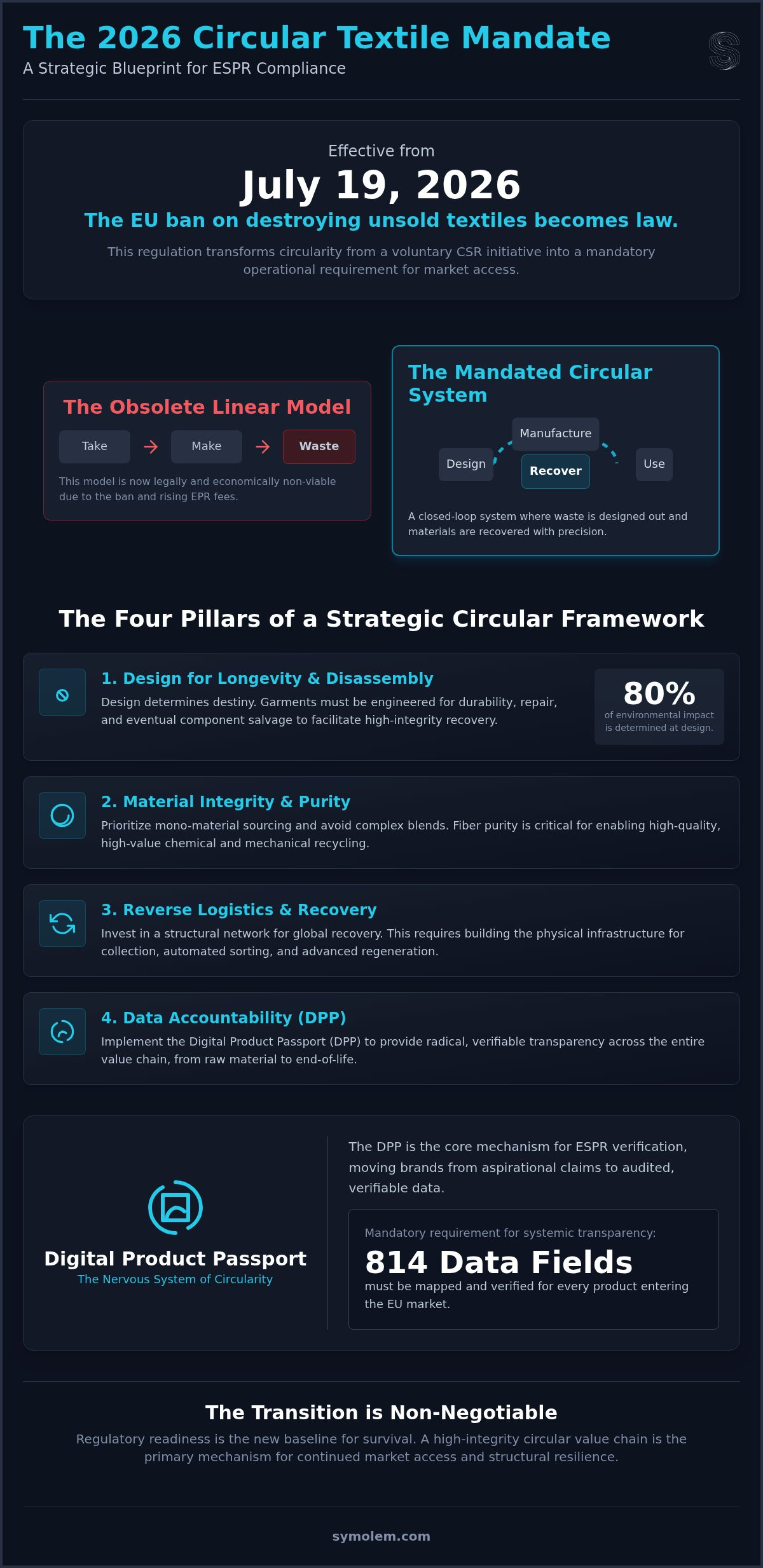
Circularity is a clinical restructuring of industrial logic. It is a closed-loop system where waste is designed out of the product lifecycle and materials are recovered with technical precision. While Circular Fashion was once framed as a voluntary pillar of Corporate Social Responsibility (CSR), the 2026 regulatory landscape has transformed it into a mandatory operational requirement. A high-integrity circular textile value chain strategy now serves as the primary mechanism for legal market access in the EU and UK. Linear models, defined by the "take-make-waste" trajectory, face imminent economic obsolescence as rising Extended Producer Responsibility (EPR) fees internalize the cost of environmental externalities.
Success requires a three-pillared foundation:
- Circular Design: Engineering products for longevity, disassembly, and fiber purity.
- Technical Recovery: Building the physical infrastructure for collection, sorting, and chemical regeneration.
- Data Transparency: Implementing the Digital Product Passport (DPP) to verify every material claim.
The Regulatory Catalyst: ESPR and EPR in 2026
The Ecodesign for Sustainable Products Regulation (ESPR) is the architect of this shift. It mandates that products entering the EU market meet strict durability and repairability standards, effectively outlawing low-quality disposability. Simultaneously, EPR frameworks are shifting end-of-life financial burdens directly onto producers. By July 19, 2026, large enterprises will be legally prohibited from destroying unsold textiles. This isn't just a policy change; it's a total reconfiguration of how value is retained within the supply chain. Regulatory readiness is no longer a competitive advantage. It's the baseline for survival.
Systemic Integrity Over Aspirational Narratives
Fashion has long relied on superficial sustainability storytelling. These narratives frequently collapse under clinical scrutiny because they lack structural data support. Moving forward, incremental improvements are insufficient to meet the radical transparency required by the 2026 mandates. A systemic audit is the only way to identify value chain leaks where material and economic value are currently lost. Brands must move away from marketing-led sentiment and toward a circular textile value chain strategy rooted in diagnostic precision. True integrity is found in the verification of 814 mandatory data fields, not in a well-crafted press release. This transition demands a move from aspirational goals to audited, verifiable infrastructure.
Mapping the Four Pillars of a Strategic Circular Framework
Circularity is not a peripheral sustainability initiative. It's a fundamental reconfiguration of the industrial architecture. To execute a viable circular textile value chain strategy, brands must anchor their operations in four structural pillars: design longevity, material integrity, reverse logistics, and data accountability. Each pillar serves as a critical checkpoint, ensuring that material value remains within the economic loop rather than leaking into landfills. This systemic approach is the only defense against the financial risks introduced by the EU Strategy for Sustainable and Circular Textiles.
Design as the Strategy's Foundation
Design determines destiny. Approximately 80% of a product's environmental footprint is locked in during the initial design phase. We're seeing a shift from aesthetic-driven development toward technical engineering that prioritizes modularity and disassembly. Garments must be constructed to be taken apart, allowing for the salvage of high-value components. This level of foresight requires a rigorous ESPR Readiness Diagnostic to align creative output with durability mandates. Without this alignment, products are designed for future liability.
Infrastructure Design for Global Recovery
Global production far outpaces local recovery capabilities. Most brands operate with a massive gap between their production volumes and their physical capacity to reclaim materials. Building a circular textile value chain strategy requires investing in reverse logistics that transcend borders. This involves establishing collection hubs and sorting facilities capable of pre-processing textiles for chemical regeneration. Automated sorting technologies, utilizing near-infrared spectroscopy, are no longer optional; they're the prerequisite for scaling. If you're unsure of your current capacity, a professional Circular Economy Strategy Development can help map the necessary infrastructure requirements.
Material sourcing must pivot toward mono-materials. Blended fibers represent a technical failure in a circular system because they complicate the recovery process. By prioritizing chemically recyclable fibers, brands ensure their "waste" becomes a feedstock for the next production cycle. This loop is held together by data accountability. Systems must track material flows from fiber extraction to post-consumer recovery, providing a verifiable audit trail. This data-driven integrity is the nervous system of the circular framework.
The Economics of Circularity: Infrastructure Costing and ROI
Circularity is not a philanthropic endeavor. It's a strategic capital allocation designed to mitigate the terminal risks of the linear economy. For too long, the industry has viewed the transition as a cost center, ignoring the escalating financial penalties associated with regulatory non-compliance. A high-integrity circular textile value chain strategy redefines these expenditures as necessary infrastructure investments that secure long-term profitability. By internalizing the recovery process, brands move from paying for disposal to investing in material equity.
Establishing a closed-loop system requires a granular breakdown of recovery costs. These include decentralized collection logistics, automated high-precision sorting, industrial cleaning, and chemical fiber regeneration. The 'True Cost' model reveals a stark fiscal reality: the capital required for circular infrastructure is often lower than the cumulative burden of Extended Producer Responsibility (EPR) fees and the total loss of material value. Under the 2026 mandates, eco-modulation will reward compliant brands with significantly lower fees, effectively subsidizing those who have built robust recovery systems while penalizing those tethered to the status quo.
Cost-Benefit Analysis of Recovery Systems
Secondary raw material markets offer a hedge against the volatility of virgin material prices. As global resource scarcity intensifies, the ability to reclaim and re-integrate high-purity fibers becomes a critical economic advantage. A detailed Cost-Benefit Analysis of Circular Textile Models demonstrates how diagnostic-led strategies identify hidden inefficiencies in the linear chain. By capturing this lost value, brands transform their waste streams into reliable feedstock pipelines, reducing their reliance on unpredictable global commodities.
Mitigating Regulatory Risk Through Investment
Infrastructure investment is a form of legal insurance. By July 19, 2026, the ban on the destruction of unsold textiles will force large enterprises to find viable alternatives for excess inventory. Failure to do so results in severe legal penalties and the total loss of product value. A proactive circular textile value chain strategy stabilizes supply chains against global resource volatility by internalizing material loops. This isn't just about compliance; it's about building a resilient economic foundation that can withstand the structural shocks of a resource-constrained world. Companies that fail to map these costs now will find themselves financially exposed when the 2026 mandate takes full effect.
Digital Product Passports: The Nervous System of Circular Strategy
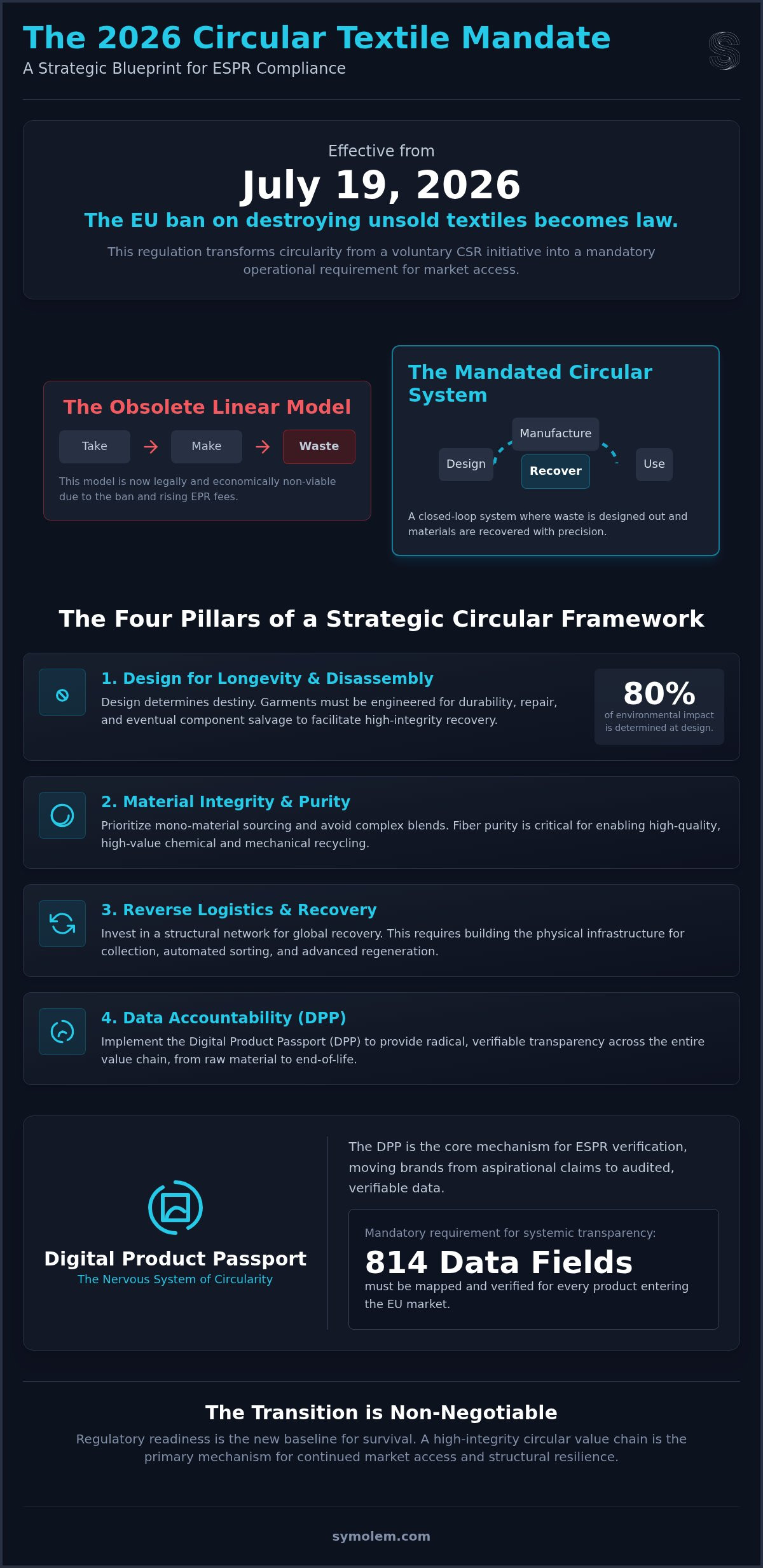
Data is the enforcement mechanism of the 2026 mandate. The Digital Product Passport (DPP) serves as the mandatory verification tool for the Ecodesign for Sustainable Products Regulation (ESPR), effectively bridging the gap between a physical garment and its digital identity. Without this structural link, any circular textile value chain strategy lacks the evidentiary basis required for legal market access. It's the system through which material claims are audited, verified, and transmitted across the global value chain. This ensures that every stakeholder, from customs officials to recyclers, has access to the technical truth of the product.
Technical implementation requires the meticulous mapping of 814 possible data fields. This is not a superficial exercise in storytelling; it's a rigorous accounting of fiber origin, chemical inputs, and manufacturing processes. Verifiable credentials ensure data integrity remains intact as products move through secondary markets. This precision allows for high-purity fiber recovery, preventing the material degradation that currently limits recycling efforts. To ensure your data architecture is compliant, you can utilize our Digital Product Passport (DPP) Frameworks for professional technical mapping.
Technical Implementation of DPP Frameworks
Mapping supplier data to standardized EU digital registries requires a diagnostic approach to global governance. The Challenges of Digital Product Passport Implementation are often rooted in the fragmentation of multi-tier supply chains. You must eliminate data silos and implement interoperable protocols to ensure a circular textile value chain strategy can function at scale. This isn't a task for generalist consultants. It requires a technical architect who understands the granular requirements of EU policy and the complexities of global textile operations.
Leveraging Data for Circular Optimization
DPP data serves as an optimization engine that extends far beyond mere compliance. It informs end-of-life decisions regarding repair, resale, and chemical regeneration by providing an immutable material profile. This data also underpins Impact Measurement and MRV, allowing brands to quantify their circularity with clinical precision. As consumers gain access to this transparency, brand loyalty will naturally gravitate toward products with documented durability. Data integrity becomes a market differentiator, rewarding brands that prioritize structural reality over aspirational narratives.
Strategic Implementation: From Diagnostic to Circular Integration
Implementation is a clinical exercise in structural realignment. It requires a departure from the fragmented, reactive approaches of the past in favor of a methodical, five-stage integration process. A robust circular textile value chain strategy isn't built through incrementalism; it's forged through the deliberate dismantling of linear inefficiencies and the construction of high-integrity recovery systems. This process moves beyond the theoretical, focusing instead on the granular mechanics of material and data flows.
The first phase demands a high-stakes ESPR readiness diagnostic. This audit identifies the specific compliance gaps that threaten market access under the 2026 mandate. Once these vulnerabilities are mapped, brands must identify the physical infrastructure requirements of their global value chain. This involves locating the specific geographic points where collection, sorting, and pre-processing facilities must be established to ensure material recovery. The third stage involves technical data mapping for DPP and MRV systems, populating the 814 mandatory data fields with verifiable, audited information. Following this, business models must be redesigned to capture economic value from repair, resale, and recycling loops. Finally, a continuous audit cycle must be implemented to maintain systemic integrity as EU and UK policies continue to evolve.
The Role of Independent Advisory
Internal sustainability teams are frequently constrained by legacy operational silos. They often lack the diagnostic precision and clinical distance required to identify deep-seated structural failures within a global supply chain. Independent advisory provides the necessary third-party scrutiny to challenge established norms and expose value chain leaks. Symolem positions itself as the technical and strategic architect for this transition, prioritizing truth and verification over comfortable, aspirational narratives. We provide the intellectual rigor needed to build systems that survive rigorous regulatory scrutiny.
Conclusion: The Strategic Mandate for 2026
The 2026 deadlines represent a terminal point for the linear textile model. Restructuring for circularity is now a business model imperative that dictates whether a brand retains the legal right to operate within the EU and UK. This is a high-stakes transition that requires immediate, decisive action to secure material flows and data transparency. Waiting for further clarity is a strategy for obsolescence. You must act now to ensure your infrastructure and data systems are capable of meeting the coming structural ultimatum. Engage Symolem for your ESPR Readiness Diagnostic to begin the transition toward a resilient, high-integrity future.
Securing Operational Continuity in a Post-Linear Economy
The 2026 regulatory mandate represents a structural ultimatum for the global textile industry. You must transition from aspirational narratives to a high-integrity circular textile value chain strategy that prioritizes technical durability, precise infrastructure costing, and the meticulous mapping of 814 mandatory data fields. This isn't a sustainability exercise. It's a clinical restructuring of your global operations to ensure continued market access. By internalizing material loops and verifying every material claim through the Digital Product Passport, you transform regulatory pressure into systemic resilience.
Symolem provides the expert-led diagnostic frameworks and deep technical knowledge of EU textile policy required to navigate this transition. We offer an independent, high-integrity advisory that moves beyond superficial compliance to build a robust strategic architecture. Secure your regulatory future with a Symolem ESPR Readiness Diagnostic and lead the shift toward a high-integrity, circular future.
Frequently Asked Questions
What is a circular textile value chain strategy?
A circular textile value chain strategy is a clinical restructuring of industrial operations designed to eliminate waste and recover material value. It moves beyond superficial recycling by engineering products for disassembly and establishing the physical infrastructure required for high-purity fiber regeneration. This strategy ensures that material flows remain within a closed loop; effectively decoupling business growth from virgin resource extraction while securing compliance with impending EU and UK mandates.
How does ESPR compliance affect circularity strategy in 2026?
ESPR compliance transforms circularity from a voluntary initiative into a mandatory legal requirement for market access. By July 19, 2026, large enterprises are prohibited from destroying unsold textiles; a directive that necessitates immediate structural shifts in inventory management and recovery systems. These regulations mandate specific durability and repairability standards; forcing brands to move away from low-quality disposability toward high-integrity systems that prioritize product longevity and material transparency.
What are the primary costs associated with circular infrastructure?
Primary costs include the establishment of decentralized collection logistics; the acquisition of automated sorting technologies utilizing near-infrared spectroscopy; and industrial cleaning and chemical regeneration processes. These expenditures represent a fundamental shift in capital allocation from disposal to material equity. Infrastructure costing must account for the full technical lifecycle of a garment; ensuring that the investment in recovery systems is weighed against the escalating financial burden of non-compliance and EPR fees.
How do Digital Product Passports integrate into a circular strategy?
Digital Product Passports serve as the mandatory verification tool that links physical garments to their technical data profiles. They integrate into a circular textile value chain strategy by providing a standardized framework for mapping 814 mandatory data fields; covering fiber origin, chemical inputs, and disassembly instructions. This data-driven transparency ensures that recyclers and regulators have access to the technical truth; facilitating efficient material recovery and ensuring the integrity of circular claims.
Can small fashion brands afford a circular transition?
Strategic circularity is a business imperative for brands of all sizes; though the financial burden varies by operational scale. Small brands often face high per-unit recovery costs; yet they can mitigate these through diagnostic-led efficiency and collaborative infrastructure models. While medium-sized enterprises have until 2030 to comply with specific destruction bans; the immediate pressure for data transparency and durability from retail partners makes an early transition a critical defensive strategy for market survival.
What is the difference between EPR and ESPR in textiles?
EPR focuses on the financial burden of a product's end-of-life; requiring producers to pay for waste management through modulated fees. In contrast; ESPR mandates the technical design and transparency requirements that products must meet to enter the market. While EPR internalizes the cost of disposal; ESPR enforces durability and the implementation of Digital Product Passports. Together; they form a regulatory pincer that makes linear business models economically and legally unviable.
How do you measure the success of a circular textile strategy?
Success is measured through clinical data points rather than aspirational narratives. Key metrics include high-purity material recovery rates; the successful mapping of all mandatory DPP fields; and the reduction of modulated EPR fees. Brands must utilize Impact Measurement and MRV systems to provide a verifiable audit trail of their circular operations. A successful strategy is evidenced by the seamless integration of recovered fibers back into production cycles without material degradation.
Why is infrastructure costing critical for circularity ROI?
Infrastructure costing is the only way to determine the true economic viability of a circular model against the cost of regulatory non-compliance. Without precise costing for collection and sorting; brands cannot accurately assess the ROI of secondary raw material markets or the benefits of eco-modulated fees. This financial mapping identifies hidden inefficiencies in the linear chain; allowing leaders to treat circularity as a structural investment that secures supply chain resilience against global resource volatility.