
Circular Textile Infrastructure in Emerging Markets
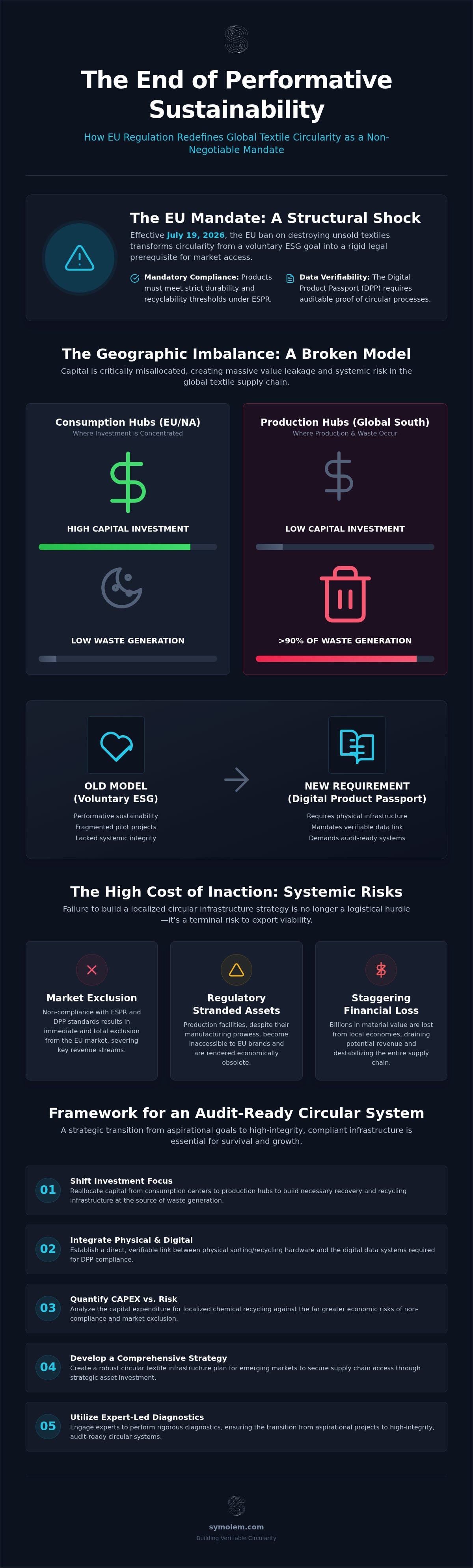
The era of performative sustainability has ended. Since the July 19, 2026, EU ban on the destruction of unsold textiles took effect, circularity has shifted from a voluntary ESG metric into a rigid legal prerequisite for market entry. For production hubs across the global south, the absence of a comprehensive circular textile infrastructure strategy for emerging markets is no longer a logistical hurdle; it's a terminal risk to export viability. Centralized recycling models have consistently failed to deliver the necessary scale, necessitating a shift toward localized, verifiable recovery systems that integrate directly with the now-live EU Digital Product Passport registry.
You understand that current capital allocation is often squandered on fragmented pilot projects that lack the systemic integrity required for long-term ESPR compliance. This article analyzes the structural shift from centralized investment to localized infrastructure in global production hubs to secure your position in the EU market. We provide a clear framework for scaling recovery systems, unpacking the economic mechanics of localized recycling and the diagnostic rigor required for immediate regulatory readiness in a post-mandate landscape.
Key Takeaways
- Shift investment focus from consumption centers to production hubs to eliminate the structural failures of current textile recovery models.
- Recognize how the Digital Product Passport (DPP) mandates a direct, verifiable link between physical sorting infrastructure and regulatory data compliance.
- Quantify the CAPEX requirements for localized chemical recycling against the rising economic risks of non-compliance and market exclusion.
- Develop a comprehensive circular textile infrastructure strategy for emerging markets to secure supply chain access through strategic asset investment.
- Use expert-led diagnostics to transition from aspirational sustainability projects to high-integrity, audit-ready circular systems.
The Geographic Imbalance: Why Scaling Circular Textile Infrastructure Must Shift to Production Hubs
Circularity is a matter of industrial engineering, not marketing sentiment. To meet the 2026 mandates, firms must deploy a robust circular textile infrastructure strategy for emerging markets that moves beyond superficial pilot programs. This infrastructure comprises the physical hardware of advanced sorting and chemical recycling plants, coupled with the digital architectures required for material recovery and recirculation. Without these systems, the transition to a circular economy remains a theoretical exercise. The industry's current trajectory is flawed because it prioritizes investment in consumption markets while ignoring the structural realities of the global supply chain.
The linear "take-make-waste" model is now a legal liability. Under the Ecodesign for Sustainable Products Regulation (ESPR), brands are accountable for the entire lifecycle of their products, meaning that a lack of recovery infrastructure in production countries translates directly into non-compliance. Shifting capital to emerging markets is a strategic necessity for supply chain stability. It's the only way to ensure that materials remain within the value chain rather than leaking into landfills or informal waste streams. A proactive circular textile infrastructure strategy for emerging markets must address this capital gap to prevent the total collapse of EU-bound export channels.
Concentration of Capital vs. Production Reality
Capital is currently misallocated. While circular investment is heavily concentrated in North America and Europe, these regions are far removed from the primary points of waste generation. Data indicates that over 90% of textile waste generation and production occurs in emerging markets, yet these regions receive only a fraction of the necessary infrastructure funding. This geographic imbalance creates massive "leakage" in the value chain. Valuable post-industrial and post-consumer feedstock is lost daily because local recovery systems are either non-existent or technically insufficient to handle complex fiber blends.
Systemic Risks of Under-invested Value Chains
Under-investment creates a cascade of systemic risks. A lack of local infrastructure leads to immediate non-compliance with EU import standards, as brands cannot provide the verifiable data required for the Digital Product Passport. In hubs like Bangladesh, Vietnam, and Türkiye, the economic cost of material loss is staggering; it effectively drains billions in potential value from the local economy. This neglect leads to the emergence of "regulatory stranded assets." These are production facilities that, despite their manufacturing prowess, become effectively inaccessible to the EU market because they cannot meet the rigorous circularity criteria defined by 2026 mandates.
Regulatory Catalysts: How ESPR and DPP Mandate Global Infrastructure Scaling
Regulation is no longer a peripheral concern for global apparel brands. It's the primary architect of supply chain survival. The Ecodesign for Sustainable Products Regulation (ESPR) has transformed voluntary sustainability into a clinical mandate for physical infrastructure. Under the EU Strategy for Sustainable and Circular Textiles, products must meet strict durability and recyclability thresholds before they even reach a port of entry. This shift requires a comprehensive circular textile infrastructure strategy for emerging markets to ensure that the up to 236 data points in the UNTP schema required for compliance aren't just empty metrics but are backed by verifiable material recovery systems. Compliance is a binary outcome; you're either integrated into the new regulatory architecture or you're excluded from the market.
ESPR as a Global Infrastructure Mandate
The July 19, 2026, ban on the destruction of unsold textiles serves as a structural shock to existing logistics. Large companies can't simply discard inventory; they must process it. This volume necessitates localized testing labs and recovery facilities within production countries to handle recirculation at the source. Brands that fail to build these assets face immediate market exclusion and heavy financial penalties. Understanding the business case for ESPR compliance is essential for mapping the structural economics of these 2026 requirements. The mandate forces a transition where production hubs must evolve from simple assembly points into sophisticated recovery nodes capable of meeting EU-standard chemical and mechanical recycling benchmarks.
The Digital Product Passport (DPP) Data Requirement
Data without physical verification is a liability. The Digital Product Passport (DPP) forces a level of transparency that only automated, IoT-enabled sorting facilities can provide. You can't track material flows or verify recycled content percentages through manual spreadsheets or self-reported audits. Physical infrastructure in emerging markets acts as the primary data generator for the 814 mandatory fields. Without localized sensors and blockchain-integrated recovery systems, brands will struggle with the challenges of Digital Product Passport implementation. The DPP registry, live as of July 2026, requires clinical precision in reporting, making physical recovery infrastructure the only viable source of truth for global value chains.
Extended Producer Responsibility (EPR) schemes are evolving into the primary funding mechanism for these global systems. These fees aren't just taxes; they're capital intended to scale localized recovery assets. A robust circular textile infrastructure strategy for emerging markets leverages these funds to de-risk the transition from linear to circular production. It's a clinical necessity to audit your current positioning before the 2027 enforcement window closes. You might consider an ESPR readiness diagnostic to identify exactly where your infrastructure gaps will trigger regulatory failures and block market access.
The Structural Economics of Circular Textile Infrastructure Investment
Circularity is an economic calculation. It's not a philanthropic gesture. The CAPEX for advanced sorting and chemical recycling facilities in production hubs represents a significant upfront hurdle, yet this must be measured against the terminal cost of market exclusion. A robust circular textile infrastructure strategy for emerging markets requires a granular understanding of these structural economics. Brands must move beyond high-level estimates to analyze the "true cost" of textile recovery, which includes the mitigation of landfilling fees and the avoidance of non-compliance penalties that can reach double-digit percentages of annual turnover. This is the baseline for any cost-benefit analysis of circular textile models.
The financial architecture of these projects is complex. Traditional bankability is often hampered by perceived risks in emerging economies, making the UNEP FI Report on Financing Circularity a critical reference for understanding how to de-risk these assets. Investment must shift from superficial sustainability projects to hard industrial assets that provide a measurable ROI through material recovery and regulatory compliance. If the infrastructure isn't bankable, the strategy isn't viable.
Infrastructure Costing and Modeling in Production Hubs
ROI in circularity is driven by proximity. Building recovery facilities near manufacturing centers reduces logistics costs and carbon footprints, creating a more efficient closed-loop system. Modeling these facilities requires a deep dive into local energy costs, feedstock availability, and regulatory avoidance. Strategic advisory plays a clinical role here; it's the bridge between high-level policy and the physical implementation of cost-effective infrastructure. Manufacturers must evaluate the long-term stability of these models against the volatile costs of virgin raw materials and the rising price of carbon credits.
Addressing the Informal Economy and Labor Integration
The informal waste sector is a structural reality in emerging markets. It handles the vast majority of waste collection, yet it exists outside the formal regulatory framework. Integration is a necessity, not an elective. Formalization requires significant investment in social auditing, health and safety upgrades, and digital tracking to ensure that material flows meet EU due diligence standards. These costs are often overlooked in initial CAPEX projections. Under new EU laws, labor rights are inextricably linked to circularity. A facility that recovers 100% of materials but fails on human rights is a non-compliant asset that will be blocked from the value chain.
Strategic De-risking: Frameworks for Financing Circular Assets Abroad
Investment is the pivot point of the transition. Brands must stop viewing circularity as a discretionary cost center and start treating it as a structural prerequisite for supply chain stability. As 2026 mandates approach, the focus must shift from superficial corporate social responsibility (CSR) initiatives to strategic asset investment. This transition requires a clinical focus on securing long-term market access through the development of recovery assets in production hubs. Implementing a circular textile infrastructure strategy for emerging markets requires more than just capital; it requires a sophisticated de-risking framework that aligns private investment with public development goals.
Securing these assets involves navigating complex financial landscapes. Brands can utilize specific financing models for circular textile infrastructure to mitigate the risks associated with building physical recovery systems in volatile markets. Without a structured approach to capital allocation, circular projects often suffer from misaligned incentives and insufficient scale, leading to systemic failure and regulatory exposure.
Leveraging Blended Finance and Strategic Partnerships
Capital risk is the primary barrier to infrastructure scaling. Blended finance offers a solution by combining public development capital from institutions like the IFC or World Bank with private brand investment. This structure reduces the risk profile for commercial lenders and attracts the necessary volume of capital to high-growth production hubs. Offtake agreements play a critical role here. By guaranteeing the purchase of recycled content, brands provide the predictable revenue streams required to ensure the ROI of new facilities. Engaging in strategic advisory for circular fashion is essential for brands to navigate these partnerships and ensure that their investment aligns with both local production realities and EU legal standards.
Verification Rigor and MRV Systems
An investment is only as valuable as the data it produces. Monitoring, Reporting, and Verification (MRV) systems are the digital backbone of circular infrastructure. These systems provide the clinical, diagnostic precision required to avoid greenwashing and legal liability under the ESPR. Impact measurement isn't a secondary task; it's the primary mechanism for proving compliance. Brands must prioritize verifying textile sustainability claims for ESPR to ensure that every metric reported in the Digital Product Passport is backed by physical reality. Failure to implement rigorous verification leads to "data debt," where the cost of correcting inaccurate claims far exceeds the initial investment in MRV infrastructure.
To secure your position in the 2026 landscape, you must move from planning to execution. You can schedule a circular economy strategy development session to begin mapping your infrastructure investments against upcoming regulatory deadlines.
Implementation Roadmap: Building Verifiable Circularity with Symolem
Circularity isn't a story you tell; it's a system you build. The 2026 mandates have exposed the fragility of global value chains that rely on opaque reporting and fragmented pilot projects. To survive the enforcement window, brands must transition from aspirational narratives to verifiable, systemic integrity. Symolem bridges the gap between high-level EU policy and the physical implementation of recovery assets in production countries. We provide the structural design needed to ensure your supply chain isn't just compliant on paper but is physically capable of meeting the rigorous material metabolism required by the ESPR.
The Diagnostic-Led Approach to Investment
Capital misallocation is the greatest threat to circularity. Investing in advanced sorting or chemical recycling without a prior audit of your technical gaps is a recipe for systemic failure. This is why we prioritize ESPR readiness diagnostics as the foundational step in any infrastructure roadmap. This diagnostic-led process ensures that your circular textile infrastructure strategy for emerging markets is grounded in technical reality rather than marketing hope. We map the 814 mandatory DPP data fields directly to the physical capabilities of your production hubs, identifying exactly where hardware upgrades or digital tracking systems are required to prevent market exclusion.
Future-Proofing the Global Value Chain
The 2030 vision is a fully transparent, circular global textile network. Localized infrastructure in emerging markets is the only way to achieve this. By building recovery assets at the point of production, brands create long-term economic resilience against future regulatory shifts and resource scarcity. This isn't just about meeting immediate deadlines; it's about securing your supply chain for the next decade. Symolem provides the strategic advisory needed to navigate infrastructure costing and compliance frameworks in complex jurisdictions where the informal economy and lack of recovery assets often hinder progress.
The window for reactive planning has closed. To secure your market access, you must move toward structural design and localized investment immediately. Symolem acts as your technical architect, providing the diagnostic rigor required to scale recovery systems with clinical precision. Ensure your circular textile infrastructure strategy for emerging markets isn't just a document but a functioning industrial reality. Consult with Symolem to audit your infrastructure costing and build a compliant, verifiable value chain that survives the 2026 strategic mandate.
Securing Market Access through Structural Integrity
The window for transition is closing. By 2026, the absence of a verifiable circular textile infrastructure strategy for emerging markets will result in systemic exclusion from the EU market. We've established that the shift from centralized investment to localized recovery is the only path to meeting ESPR mandates. Success requires more than just capital; it demands technical mapping for 814 DPP data fields and specialized infrastructure costing for global manufacturers. You must move beyond the superficial and embrace clinical, diagnostic-led investment to protect your export viability. Relying on legacy models will only lead to regulatory stranded assets and lost market share.
The path forward is defined by structural design and expert advisory on EU textile policy and ESPR compliance. Brands that act now to formalize their recovery systems will gain a decisive competitive advantage in a transparent global value chain. It's a high-stakes transition, but the rewards are a resilient, compliant, and future-proofed operation. You have the framework; now you must execute the implementation with precision and speed.
Secure your global value chain with an ESPR Readiness Diagnostic from Symolem.
Frequently Asked Questions
How much investment is needed for circular textile infrastructure in emerging markets?
Billions in capital are required to close the global infrastructure gap. While the International Finance Corporation (IFC) has mobilized over $2 billion for circular projects since 2015, specific pilot programs like the Morocco initiative suggest that scaling a single market's recycling capacity can require upwards of $1.9 billion in private investment. A comprehensive circular textile infrastructure strategy for emerging markets must account for these massive capital requirements to prevent systemic export failures.
Why is circular infrastructure investment concentrated in Europe instead of production hubs?
Capital currently flows to consumption markets due to perceived lower risk and proximity to regulatory bodies. This creates a structural failure where investment is decoupled from the actual points of waste generation. Brands often prioritize Western recycling facilities to satisfy domestic stakeholders, neglecting the reality that over 90% of textile waste generation and production occurs in emerging markets where recovery systems are most needed.
What role does the Digital Product Passport (DPP) play in infrastructure investment?
The Digital Product Passport acts as the digital verification layer for physical recovery systems. It requires the technical mapping of up to 236 data points in the UNTP schema to prove a product's material composition and circularity. Without localized infrastructure to generate this granular data, the EU DPP registry, live as of July 2026, becomes an insurmountable barrier to entry rather than a tool for transparency.
How can fashion brands de-risk investment in emerging market textile recovery?
De-risking requires the clinical use of blended finance and offtake agreements to guarantee revenue for new facilities. By partnering with development banks to reduce capital risk and committing to long-term purchases of recycled content, brands can stabilize the ROI of offshore assets. This shift from discretionary CSR to strategic asset investment is essential for securing supply chain access under 2026 mandates.
What are the main barriers to scaling circular textile infrastructure in Asia and Africa?
Primary barriers include fragmented waste collection, a lack of advanced sorting technology, and insufficient energy grids for chemical recycling. Many regions lack the industrial hardware required to process complex fiber blends at scale. Additionally, the absence of a clear circular textile infrastructure strategy for emerging markets often leads to capital misallocation in projects that fail to meet rigorous EU standards.
How does EU ESPR regulation impact textile manufacturers in emerging markets?
The Ecodesign for Sustainable Products Regulation (ESPR) forces manufacturers to adopt strict durability and recyclability standards or face market exclusion. The July 19, 2026, ban on the destruction of unsold textiles means manufacturers must integrate recovery systems directly into their production hubs. It's a binary shift from being a simple assembly point to becoming a sophisticated node in a circular value chain.
Is the informal waste sector a risk or an opportunity for circular investment?
The informal sector is a structural opportunity that requires formalization to mitigate legal and social risk. While these workers handle the majority of waste collection in emerging hubs, their lack of health, safety, and data standards creates compliance gaps. Integrating them through social auditing and digital tracking is the only way to meet EU due diligence and circularity requirements.
What is the ROI of investing in localized textile recycling facilities?
ROI is primarily driven by the avoidance of non-compliance penalties and the reduction of logistics costs. While circular production processes can be 20-30% more expensive than linear models, the cost of being blocked from the EU market is terminal. Localized facilities provide a measurable return by securing secondary raw materials and ensuring continued access to high-value consumption markets.