Circular Fashion Business Models: The 2026 Strategic Framework for Regulatory Compliance
The fashion industry's reliance on linear extraction is a terminal strategy. By 2026, the Ecodesign for Sustainable Products Regulation (ESPR) will transform circular fashion business models from a marketing aspiration into a rigid legal mandate. Many organizations currently face a state of operational paralysis, overwhelmed by the granular requirements of 814 distinct data fields for Digital Product Passports and the daunting capital expenditure required to overhaul legacy systems. This friction is not merely a logistical hurdle; it's a symptom of a systemic failure to align corporate infrastructure with the emerging European regulatory landscape.
You likely recognize that the window for voluntary transition is closing, leaving your brand exposed to significant regulatory risk. This article provides a rigorous roadmap for integrating circularity into your core operations, moving beyond superficial sustainability narratives to achieve true systemic integrity. We'll unpack the structural and regulatory mechanics required to master this transition, demonstrating how to leverage the Digital Product Passport as a tool for revenue generation rather than a mere compliance checkbox.
Key Takeaways
- Deconstruct the 2026 ESPR mandate to transition your operations from voluntary sustainability targets to legally enforceable structural requirements.
- Evaluate the scalability and systemic integrity of different circular fashion business models, specifically comparing rental, resale, and repair frameworks.
- Map the up to 236 data points in the UNTP schema required for Digital Product Passports to ensure your supply chain data meets upcoming European regulatory standards.
- Calculate the economic impact of circular infrastructure by auditing the costs of collection, sorting, and recovery against potential revenue streams.
- Use a diagnostic framework to audit your organization's readiness for circularity and establish clear KPIs for governance and reporting.
Table of Contents
- The Paradigm Shift: From Voluntarism to Regulatory Mandate
- Structural Archetypes: Deconstructing Circular Revenue Streams
- The Data Backbone: Digital Product Passports (DPP) as an Enabler
- Infrastructure Economics: Costing the Circular Transition
- Executing the Pivot: A Diagnostic Framework for Readiness
The Paradigm Shift: From Voluntarism to Regulatory Mandate
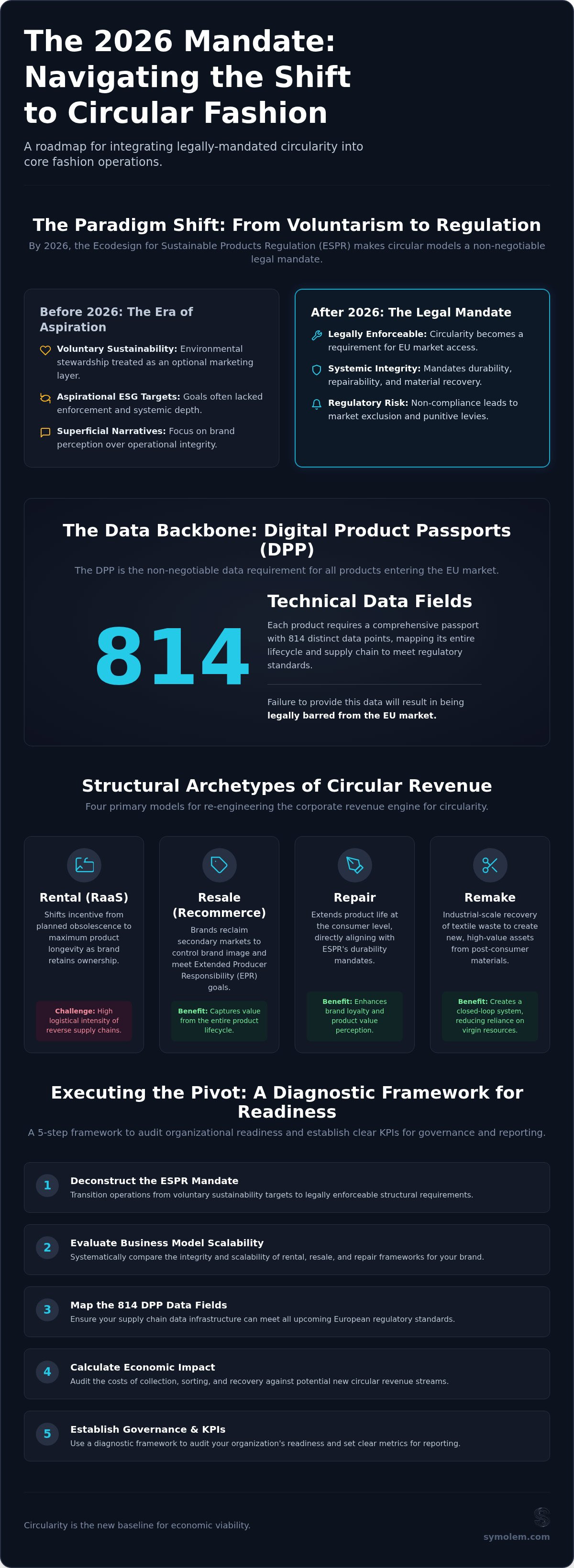
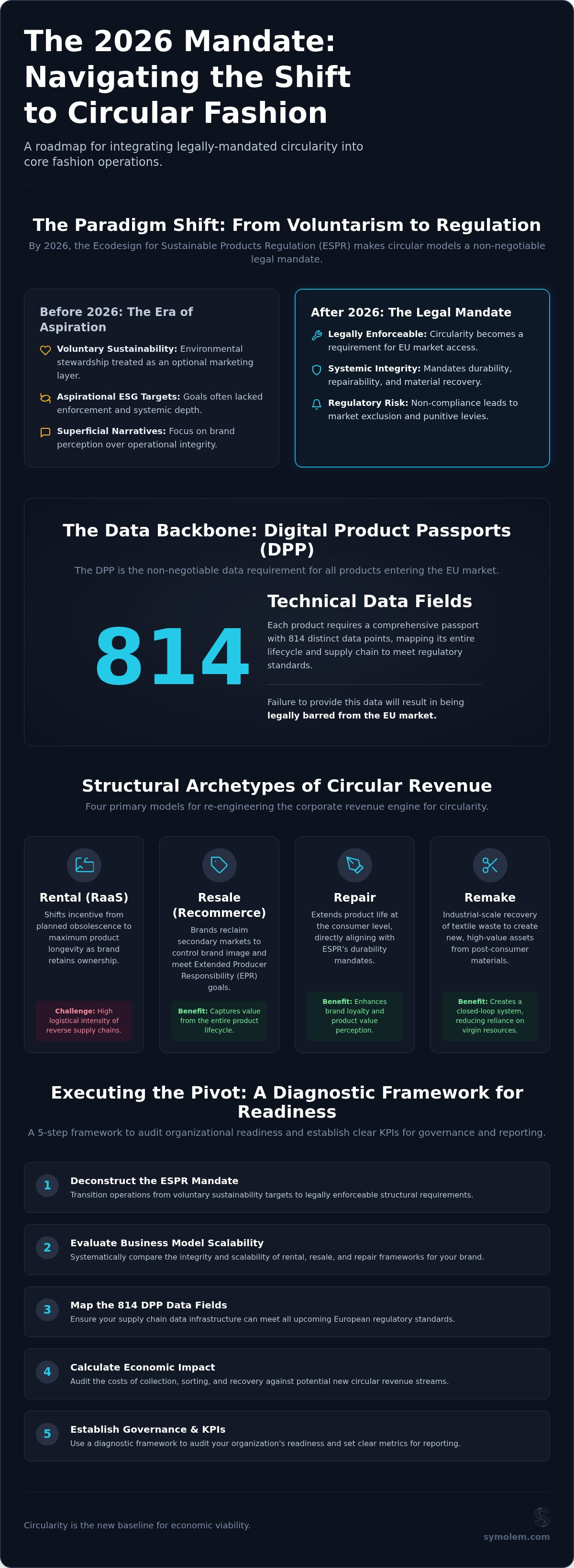
The era of voluntary sustainability is dead. For decades, the fashion industry treated environmental stewardship as an optional marketing layer, a series of aspirational ESG targets that lacked both enforcement and systemic depth. This paradigm is collapsing. By 2026, the Ecodesign for Sustainable Products Regulation (ESPR) will codify circular fashion business models as the only viable pathway for market access within the European Union. This shift redefines product value from a purely transactional metric to a longitudinal assessment of durability, repairability, and material recovery. The transition moves the industry away from vague promises toward a framework of legally mandated accountability. This isn't a soft-focus evolution but a hard pivot toward systemic integrity that treats material waste as a design flaw rather than an inevitability.
The Legal Architecture of Circularity
The EU sustainability legislation for fashion establishes a new hierarchy of accountability that global brands can't afford to ignore. Linear "take-make-waste" systems are now financial liabilities, as Extended Producer Responsibility (EPR) frameworks internalize the costs of end-of-life management that were previously externalized to the public. Responsibility has migrated from the consumer's disposal habits to the brand's structural design. If a product can't be recovered, recirculated, or recycled within a closed-loop system, it becomes a stranded asset subject to punitive levies and regulatory friction. This isn't a suggestion; it's a hard limit on how value is extracted from global value chains. Brands that fail to adapt will find their legacy infrastructure becoming an anchor rather than an asset.
Circularity as Risk Management
Ignoring these frameworks isn't just an ethical failure; it's a strategic risk that invites market exclusion. Brands that fail to audit their supply chains against the up to 236 data points in the UNTP schema of the Digital Product Passport (DPP) will find themselves legally barred from the EU market by 2026. Regulatory readiness audits are the only mechanism to identify these vulnerabilities before they manifest as catastrophic operational disruptions. Circular business models represent a systemic response to resource scarcity and legislative pressure, designed to decouple economic growth from finite material consumption through regenerative infrastructure. Transitioning to these models is a matter of institutional survival in a landscape where compliance is the new baseline for economic viability. Brands must move from superficial narratives to clinical, diagnostic precision in their operations to ensure long-term stability.
Structural Archetypes: Deconstructing Circular Revenue Streams
Circularity is a structural re-engineering of the corporate revenue engine. It demands a transition from high-volume throughput to high-utilization cycles. Circular fashion business models manifest in four primary archetypes: Rental, Resale, Repair, and Remake. Each model carries distinct regulatory burdens and operational requirements under the 2026 framework. While repair extends product life at the consumer level, remaking involves industrial-scale recovery of textile waste to create new high-value assets. Transitioning to these models requires more than a pilot project; it necessitates a total audit of the product lifecycle to ensure each cycle remains economically and legally viable.
Rental and Subscription Models (RaaS)
Rental-as-a-Service (RaaS) fundamentally aligns with the durability mandates of the ESPR. When a brand retains ownership, the incentive shifts from planned obsolescence to maximum product longevity. However, the scalability of RaaS is often throttled by the logistical intensity of reverse supply chains. Managing high-frequency sanitation, quality control, and redistribution requires a level of operational precision that most linear systems don't possess. Brands must decide if the recurring revenue of a subscription model justifies the increased complexity of decentralized inventory management and the associated carbon footprint of constant transit.
Resale and Recommerce Integration
Recommerce is no longer a peripheral activity for third-party platforms. Brands are now reclaiming their secondary markets to satisfy navigating EPR for textiles requirements. By controlling the resale loop, organizations can capture lost value while simultaneously gathering the longitudinal data required for Digital Product Passports. Authentication is the critical barrier here. Without a robust verification system, brand equity is vulnerable to dilution in the secondary market. White-label resale solutions offer a low-friction entry point, but long-term compliance requires a deeply integrated, proprietary data architecture. To identify which archetype fits your current operational capacity, engaging in a professional ESPR Readiness Diagnostic is a necessary first step.
Moving from niche upcycled collections to industrial-scale recovery is the final frontier of circularity. This requires a shift from artisanal rework to automated sorting and disassembly technologies. It is here that the true economics of circular fashion business models are tested, as the cost of recovery must remain lower than the cost of virgin material extraction to ensure economic viability. The successful brand of 2026 will be one that treats textile waste not as a liability to be managed, but as a feedstock to be harvested through sophisticated, data-driven infrastructure.
The Data Backbone: Digital Product Passports (DPP) as an Enabler
The Digital Product Passport (DPP) is not an optional digital twin. It is the foundational architecture upon which all circular fashion business models must be built. Without a standardized, interoperable data protocol, the transition from linear to circular systems remains a theoretical exercise rather than an operational reality. The DPP serves as the definitive record of a product's material composition, manufacturing provenance, and lifecycle history, providing the granular visibility required to manage complex reverse supply chains. Mapping the up to 236 data points in the UNTP schema is a strategic compliance necessity that demands a clinical approach to supply chain auditing and data integration.
Technical Requirements for DPP Implementation
Success requires addressing the challenges of Digital Product Passport implementation with technical rigor. Organizations must ensure data interoperability across a global textile value chain that's historically opaque and fragmented. This isn't just about software; it's about establishing a secure garment provenance through the integration of blockchain and IoT technologies. These tools provide the immutable verification needed to track a product from its initial fiber extraction through multiple cycles of resale and eventual material recovery, ensuring that data remains accurate and accessible to all stakeholders in the ecosystem.
Transparency and MRV (Monitoring, Reporting, Verification)
Verifiable data is the only defense against the rising tide of greenwashing litigation. The process of verifying textile sustainability claims for ESPR protects brands by anchoring marketing narratives in empirical evidence. This intersection of the DPP and the Green Claims Directive creates a high-stakes environment where every claim must be backed by a rigorous Monitoring, Reporting, and Verification (MRV) framework. Building a verifiable chain of custody for recycled materials becomes a legal imperative, ensuring that secondary raw materials meet the same quality and safety standards as virgin inputs. Compliance data, when handled with diagnostic precision, transforms from a regulatory burden into a powerful tool for establishing uncompromising consumer trust.
Accurate Life Cycle Assessments (LCA) are impossible without this level of data granularity. Static estimates are no longer sufficient to satisfy the diagnostic scrutiny of EU regulators. By leveraging real-time data from the DPP, brands can move toward dynamic impact measurement that reflects the actual utilization and longevity of their products. This shift enables a more sophisticated understanding of resource efficiency, allowing organizations to optimize their circular fashion business models for both environmental integrity and economic performance. The data backbone doesn't just support compliance; it provides the insights necessary to disrupt established industry norms and build a more resilient, system-centric business model.
Infrastructure Economics: Costing the Circular Transition
Circularity is an economic re-engineering project. The historical model of externalizing end-of-life costs is being systematically dismantled by the imposition of Extended Producer Responsibility (EPR) fees, which force brands to account for every gram of textile waste they generate. This shift transforms waste from a secondary environmental concern into a primary line item on the balance sheet. Transitioning to circular fashion business models requires a clinical understanding of the costs associated with collection, sorting, and high-purity material recovery. These operational expenses often exceed the cost of virgin material extraction in the short term, creating a "valley of death" for brands that fail to model their transition with fiscal rigor.
Cost-Benefit Analysis of Circular Models
Executing a cost-benefit analysis of circular textile models is a strategic mandate for the 2026 fiscal year. Brands must evaluate the long-term ROI of product durability against the immediate costs of frequent replacement and disposal. This analysis isn't merely about sustainability; it's about optimizing working capital and inventory management. A garment that stays in a revenue-generating loop through three rental cycles or two resale events provides a higher margin than a single-use item subject to EPR levies. To navigate these fiscal complexities, brands should secure a professional Circular Economy Strategy Development partner to audit their transition costs and ensure long-term profitability.
Scaling Recovery Infrastructure
Individual brands cannot solve the infrastructure deficit in isolation. The capital expenditure required for textile-to-textile chemical recycling and automated sorting hubs necessitates collaborative investment frameworks. We're seeing a shift toward shared infrastructure where multiple brands utilize centralized recovery centers to achieve the economies of scale required for material circularity. This is particularly critical in emerging markets where the lack of formal waste management systems creates a significant barrier to entry. Infrastructure is the bottleneck of circularity, requiring strategic costing rather than just design. Without a robust physical network to handle the reverse flow of materials, even the most sophisticated circular fashion business models will collapse under their own logistical weight.
Modeling the cost of this transition requires moving beyond superficial estimates. It demands a diagnostic approach to every stage of the value chain, from the energy consumption of chemical recovery to the labor costs of manual disassembly. Brands that successfully navigate these economics will do so by treating circularity as a structural investment in resource security. Those that view it as a discretionary expense will find themselves increasingly marginalized by both regulatory pressure and the rising cost of finite virgin inputs. The 2026 landscape rewards brands that build stability through systemic integration and cost-effective infrastructure design.
Executing the Pivot: A Diagnostic Framework for Readiness
Strategy without execution is a regulatory liability. The transition to circular fashion business models requires a clinical assessment of existing operational gaps rather than a reliance on aspirational sustainability reports. It's not enough to set long-term targets; you must codify circular KPIs into your corporate governance to ensure systemic accountability at every level of the organization. This execution begins with a rigorous 5-step process: auditing material flows to identify leakage, mapping supply chain nodes for transparency, assessing data infrastructure for DPP compatibility, modeling the financial impact of EPR fees, and finally, integrating these metrics into board-level reporting. This structured approach ensures that circularity is treated as a core business function rather than a peripheral marketing initiative.
The ESPR Readiness Diagnostic
An ESPR readiness diagnostic represents the essential first step in this structural transformation. It identifies exactly where your global supply chain falls short of the 2026 mandates, highlighting specific regulatory risks that could lead to immediate market exclusion. This diagnostic doesn't just list failures; it provides a definitive roadmap for Digital Product Passport readiness. By identifying data silos and technical barriers early, brands can build the necessary architecture to handle the up to 236 data points in the UNTP schema required for compliance, ensuring that every product entering the EU market is fully verified and legally sound.
Strategic Advisory and Implementation
Independent policy advisory is critical because the legal landscape is constantly evolving. Transitioning from high-level strategy development to granular technical execution requires a partner who understands the mechanics of global value chains and the nuances of emerging regulations. Symolem provides the strategic rigor necessary to navigate these complexities, moving beyond superficial narratives to build resilient, compliant infrastructure. We act as the technical and strategic architect for brands that prioritize systemic integrity over short-term fixes. To secure your brand's future and ensure long-term economic viability in the European market, you should engage Symolem for a comprehensive circularity diagnostic today.
Conducting a gap analysis is the only way to prevent catastrophic operational disruption as the 2026 deadline approaches. This analysis must be clinical and uncompromising, stripping away marketing hyperbole to reveal the structural reality of your operations. Brands that embrace this diagnostic rigor will find themselves positioned as leaders in the new circular economy, while those that delay will face the high cost of reactive compliance. The pivot to circularity is a high-stakes imperative that rewards those who build for stability, verification, and systemic integration.
Codifying Systemic Integrity for the 2026 Mandate
The 2026 regulatory deadline represents a structural limit on the linear economy. We've deconstructed how legal mandates like the ESPR necessitate an immediate pivot toward circular fashion business models, requiring organizations to replace high-volume extraction with high-utilization cycles and verifiable data backbones. Success in this landscape hinges on your ability to map 814 distinct data fields and model the fiscal impact of recovery infrastructure before market exclusion becomes a reality. This isn't a task for generalists; it requires diagnostic precision and a deep understanding of global policy shifts.
Symolem operates as an independent advisory firm specializing in textile circularity and policy. We provide expert frameworks for mapping technical data fields and a proven methodology for costing circular infrastructure globally. By moving beyond superficial narratives, you can build a resilient business model that thrives under regulatory scrutiny. Secure your 2026 regulatory standing with a Symolem ESPR Readiness Diagnostic. The path to compliance is complex, but rigorous structural design ensures your brand's long-term economic viability.
Frequently Asked Questions
What are the main EU regulations driving circular fashion in 2026?
The Ecodesign for Sustainable Products Regulation (ESPR) and the revised Waste Framework Directive (WFD) are the primary drivers. These regulations mandate durability and repairability while imposing Extended Producer Responsibility (EPR) across the EU. Organizations must also align with the Corporate Sustainability Reporting Directive (CSRD) to ensure their circularity metrics are auditable. Failure to comply with these interlocking frameworks results in immediate market exclusion and punitive financial penalties.
How does a Digital Product Passport (DPP) impact my business model?
The DPP transforms your business model from an opaque linear chain into a transparent, data-driven ecosystem. It acts as a digital twin that records a product's entire lifecycle, enabling secondary revenue streams through resale and rental. By providing granular material data, it allows for more efficient recovery and recycling processes. This transparency isn't just a compliance requirement; it's a structural tool for optimizing resource utilization and building long-term brand equity.
What is the difference between EPR and ESPR for fashion brands?
EPR is a financial mechanism, while ESPR is a design and data mandate. Extended Producer Responsibility (EPR) internalizes the end-of-life costs of textile waste by charging fees based on product volume and material type. Conversely, the Ecodesign for Sustainable Products Regulation (ESPR) sets the physical standards for how products are designed and manufactured. Both are essential components of circular fashion business models that aim to decouple growth from resource extraction.
Can circular business models be profitable for fast-fashion companies?
Profitability in a circular framework requires a total departure from high-volume, low-quality production. Fast-fashion entities must pivot toward durability and repairability to avoid the escalating costs of EPR levies and regulatory friction. While the initial capital expenditure for infrastructure is high, the recurring revenue from rental and resale models offers a more stable financial trajectory. Profitability is no longer found in volume alone but in the high utilization of existing assets through circular fashion business models.
What data fields are required for textile DPP compliance?
Compliance requires mapping 814 distinct technical data fields across the supply chain. These include fiber composition, chemical usage, manufacturing provenance, and end-of-life instructions. Every garment must carry a unique identifier that links to this centralized database, ensuring that recyclers and consumers have access to accurate material information. Mastering this data granularity is a strategic imperative that necessitates a clinical approach to supply chain auditing and technical integration.
How do I start a circularity gap analysis for my organization?
A gap analysis begins with a clinical audit of your current material flows and data infrastructure. You must compare your existing operational capacity against the specific requirements of the ESPR and DPP frameworks. This process identifies critical vulnerabilities in supply chain transparency and material recovery. Engaging in a professional ESPR Readiness Diagnostic is the most effective way to establish a baseline and develop a rigorous roadmap for systemic transformation.
What are the costs associated with Extended Producer Responsibility (EPR)?
EPR costs manifest as eco-modulated fees that vary based on the recyclability and durability of your products. Brands that continue to produce non-recyclable, low-durability items will face significantly higher levies than those utilizing circular design principles. These fees are designed to fund the national collection and sorting infrastructure required for textile recovery. Integrating these costs into your fiscal modeling is essential for maintaining economic viability in a regulated market.
How does circularity help in meeting Green Claims Directive requirements?
Circularity provides the empirical evidence required to support environmental claims. The Green Claims Directive prohibits vague sustainability narratives, demanding instead that every statement be backed by third-party verified data. By utilizing the Digital Product Passport and rigorous MRV frameworks, brands can provide a transparent chain of custody for their materials. This diagnostic precision eliminates the risk of greenwashing litigation and ensures that all sustainability communications are legally defensible.