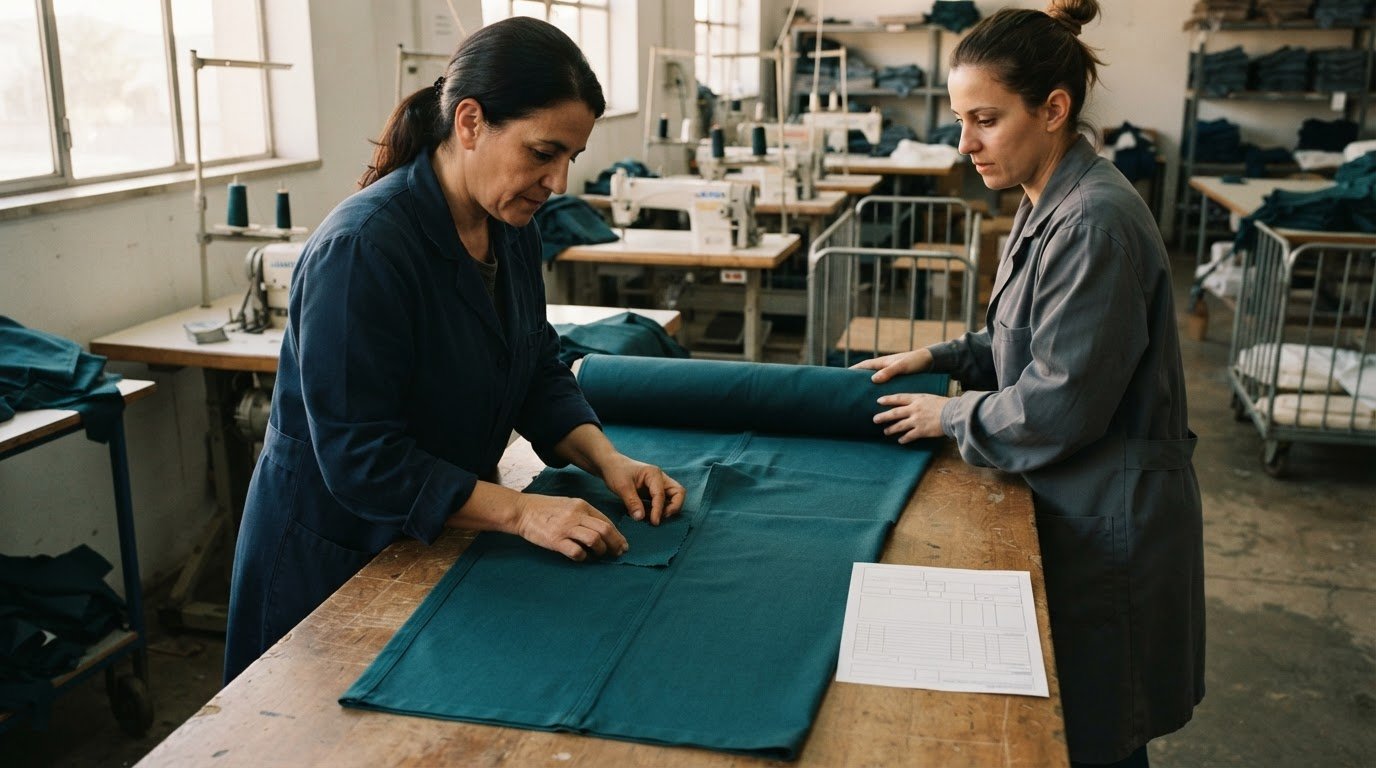
The key areas of fashion brand compliance risk management
A compliance file is only as strong as the supply-chain evidence behind it. A fashion product compliance file brings together product safety, environmental impact, material origin, chemical test results and worker-welfare records, rather than treating each as a separate reporting task.
That means looking beyond the finished garment and its direct supplier. Material origin, processing, chemical test results and worker-welfare records all affect whether a brand can substantiate its claims and respond to retailer scrutiny. Each record must be accurate, linked to the right product and retrievable when needed.
This article explains the main records a product file may contain, from safety and environmental evidence to supplier documents and records that may support a Digital Product Passport. It shows where product evidence can be incomplete or disconnected, what a file needs to bring together, and how to organise records without mistaking a document collection for a complete product compliance file.
Key Takeaways
- Map the supplier tiers involved in a garment and identify the product evidence needed to support compliance. The European Union’s Empowering Consumers Directive has applied since 27 September 2026.
- Record which materials and processes are relevant to each garment, so the evidence required for product records can be identified.
- Monitor sourcing relationships to identify where supplier evidence is missing, rather than relying on occasional checks.
- Document responsibilities for obtaining and retaining supplier evidence, so product claims and compliance decisions can be substantiated.
- Treat product traceability as an evidence system: reliable product records support transparency and future Digital Product Passport requirements.
Table of Contents
1. Fashion product safety and supplier-tier visibility
Product safety starts with the garment, but the evidence starts upstream. A finished shirt may combine fibre from a spinning mill in India, dyeing at a facility in Turkey and sewing at a factory in Portugal. If a test report covers a different colourway or material composition, it may not support the product being placed on sale. Evidence checks must connect each product to its components, processes, suppliers and records.
For US textile labels, establish the applicable requirements for fibre content, origin and care information before production. Check that label details match the garment’s actual composition and the records linked to its purchase order. For US apparel safety and chemical controls, identify the product-specific rules, then link each material, trim and finish to relevant test evidence. Construction, intended wearer and chemical treatments shape the assessment; a general supplier declaration cannot replace product-level evidence.
Market access adds another layer. The European Union’s General Product Safety Regulation, numbered 2023/988, must be accounted for by apparel businesses exporting to the EU. The Empowering Consumers Directive has applied since 27 September 2026, according to the European Union. These obligations sit alongside product-specific checks, so a single “compliant” label cannot establish that every market requirement has been met.
Supplier visibility must extend beyond direct factories. A Tier 1 cut-make-trim site may not know the origin of a fibre bought through a mill, or the chemical inputs used by a separate dyeing house. Map supplier relationships by material and process, then record who holds each document, which product it covers and when it was issued. This makes gaps visible before a missing origin record or unsuitable test report disrupts a shipment.
Audits, scorecards and certifications help structure oversight, but they answer different questions. An audit can assess a factory’s controls; a scorecard can track recurring findings; a certification can support a specific claim or process. None automatically proves that a particular garment meets every safety requirement. For example, a strong social audit at a factory in Portugal does not establish the chemical safety of fabric dyed in Turkey.
A UFLPA-related concern can arise when cotton origin cannot be traced through intermediaries, while worker-welfare evidence may be missing for a subcontracted facility not listed among approved suppliers. For cotton origin checks, record the supplier relationships, the documents held for each stage and any gaps in the chain from the fibre to the garment. This makes it possible to identify where origin evidence is missing and which supplier must provide it.
For US apparel, establish the applicable textile-label requirements for fibre content, origin and care information, and ensure the label matches the garment and its records. Identify product-specific safety and chemical rules, then link each material, trim and finish to relevant product-level test evidence. Assess construction, intended wearer and chemical treatments instead of relying on a general supplier declaration.
Environmental impacts and resource use
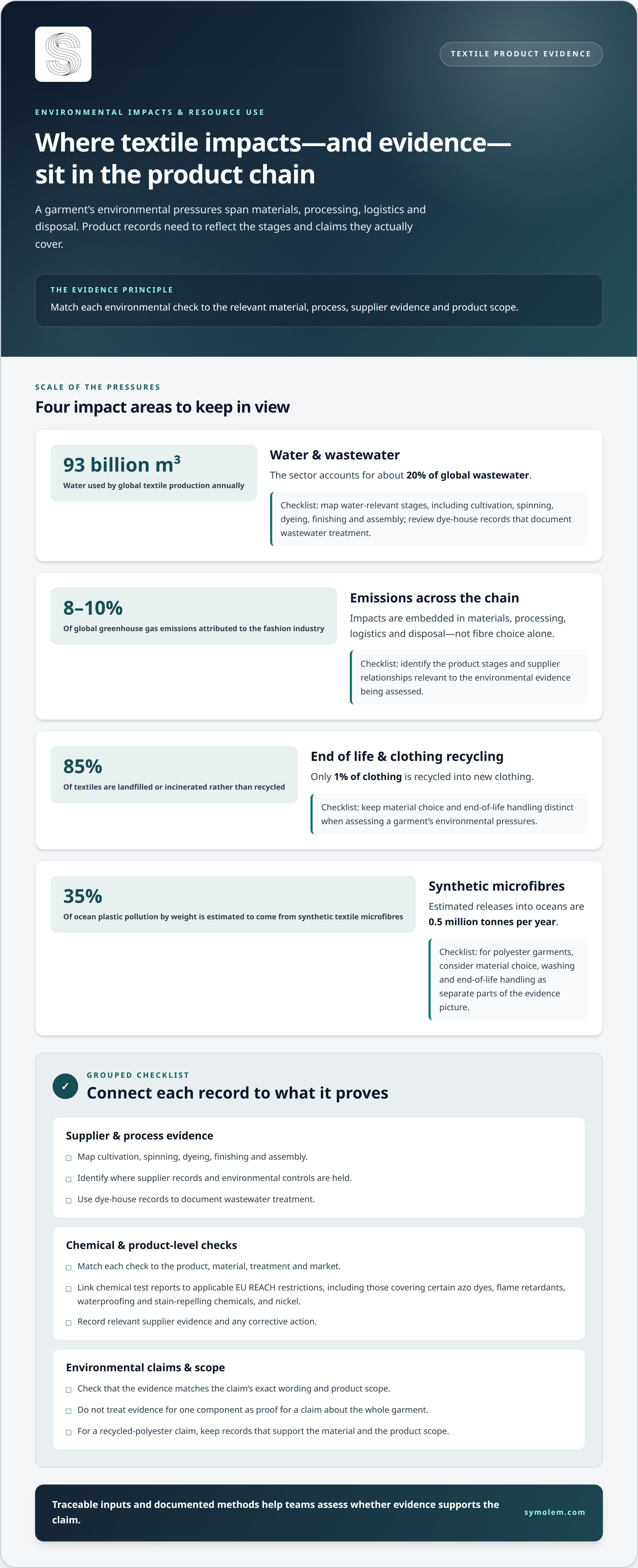
Environmental exposure is embedded in materials, processing, logistics and disposal. A garment’s footprint cannot be assessed from its fibre label alone: cultivation, spinning, dyeing, finishing and assembly each involve distinct resource demands. Mapping these stages helps identify where evidence is needed and where environmental risks may arise across global supply chains.
The scale is material. Global textile production uses about 93 billion cubic metres of water annually, while the sector accounts for about 20% of global wastewater. The fashion industry contributes about 8-10% of global greenhouse gas emissions. These figures make water use, wastewater treatment and emissions relevant operational issues, not abstract sustainability themes.
Resource use also extends beyond production. An estimated 85% of textiles are landfilled or incinerated rather than recycled, and only 1% of clothing is recycled into new clothing. Synthetic textile microfibres are estimated to account for about 35% of ocean plastic pollution by weight; releases into oceans are estimated at 0.5 million tonnes per year. For a polyester garment, material choice, washing and end-of-life handling therefore connect to different environmental pressures.
Supplier evidence can identify where environmental controls need review. For example, records from a dyeing house can document wastewater treatment, while chemical test reports can show whether apparel and trims meet applicable EU REACH restrictions, including those covering certain azo dyes, flame retardants, waterproofing and stain-repelling chemicals, and nickel. Requirements depend on the product, material, treatment and market, so teams should match each check to the relevant supplier evidence and corrective action.
Environmental claims require evidence that matches their precise wording, product scope and supply-chain records. Claims such as “recycled”, “lower impact” or “responsibly sourced” may be difficult to substantiate if the evidence covers only one component while the claim refers to the whole garment. For example, a brand sourcing recycled polyester from a spinning mill in India needs records that support the claimed material and product scope. Traceable inputs and documented methods help teams assess whether the evidence supports the claim.
Fast-fashion brands may need to manage evidence across rapid range turnover, high material throughput and compressed purchasing cycles. Luxury brands may need to substantiate claims about premium fibres, leather origin or craftsmanship. Direct-to-consumer brands control their own claims and customer communications, but still rely on upstream suppliers for supporting evidence.
A product-level evidence review can trace a fibre from its source through wet processing, assembly and packaging, recording relevant resource data and unresolved gaps at each stage. For example, a sourcing team can compare fibre records from a spinning mill in India with processing information from a dyeing house in Turkey and assembly records from a CMT factory in Portugal. This helps teams assign accountable owners and retain records to support claims and purchasing decisions.
3. Cotton-origin evidence for UFLPA
A supplier’s name alone does not establish the origin of cotton in a finished product. A review of the relevant records can map the commercial relationship, including supplier identity, ownership information, production locations, material origins and transaction records. Compare those details with the product’s sourcing records, and record any discrepancies or missing information before sourcing decisions proceed.
For US fashion businesses, the Uyghur Forced Labor Prevention Act (UFLPA) is a key law affecting fashion and cotton supply chains. Evidence needs to connect a finished product to its material origin and the entities involved at each stage. If a sourcing record identifies a spinning mill but not the cotton source, record that evidence gap and assess its significance.
Fashion brands need to identify which US rules apply to their products and operations. Requirements depend on the product, its materials, intended use and sales markets. For a cotton product, organise the relevant sourcing records by product category and market, and link each requirement to evidence, an accountable owner and a review trigger.
Reviewing records by supplier, country, material, product line or evidence type can make repeated gaps easier to identify. For example, if several styles rely on cotton from one source while origin documents remain incomplete, the shared dependency becomes visible. That information supports prioritised follow-up rather than isolated case handling.
Review cotton-origin evidence at scheduled intervals and when relevant records change. Supplier changes, revised bills of materials or new transaction records can prompt reassessment. Record the finding, its source, affected products and decision so later audits can follow the reasoning. This creates a usable control trail, not just a collection of alerts.
When a sourcing record changes, assess which product categories, markets and supplier records may be affected. Compliance professionals can check relevant legal updates through regulatory sources, trade associations and legal support, then identify whether evidence requirements need to be updated. Communicate any revised requirements to the suppliers responsible for the affected records.
Incomplete cotton-origin records can have operational consequences, but the outcome depends on the applicable rule and circumstances. Exposure can include shipment disruption, corrective work, lost orders or retailer delisting. Document the issue, its evidence and the proposed response so decisions are based on a clear record rather than incomplete supplier assurances.
4. Chemical test report controls for textile buyers
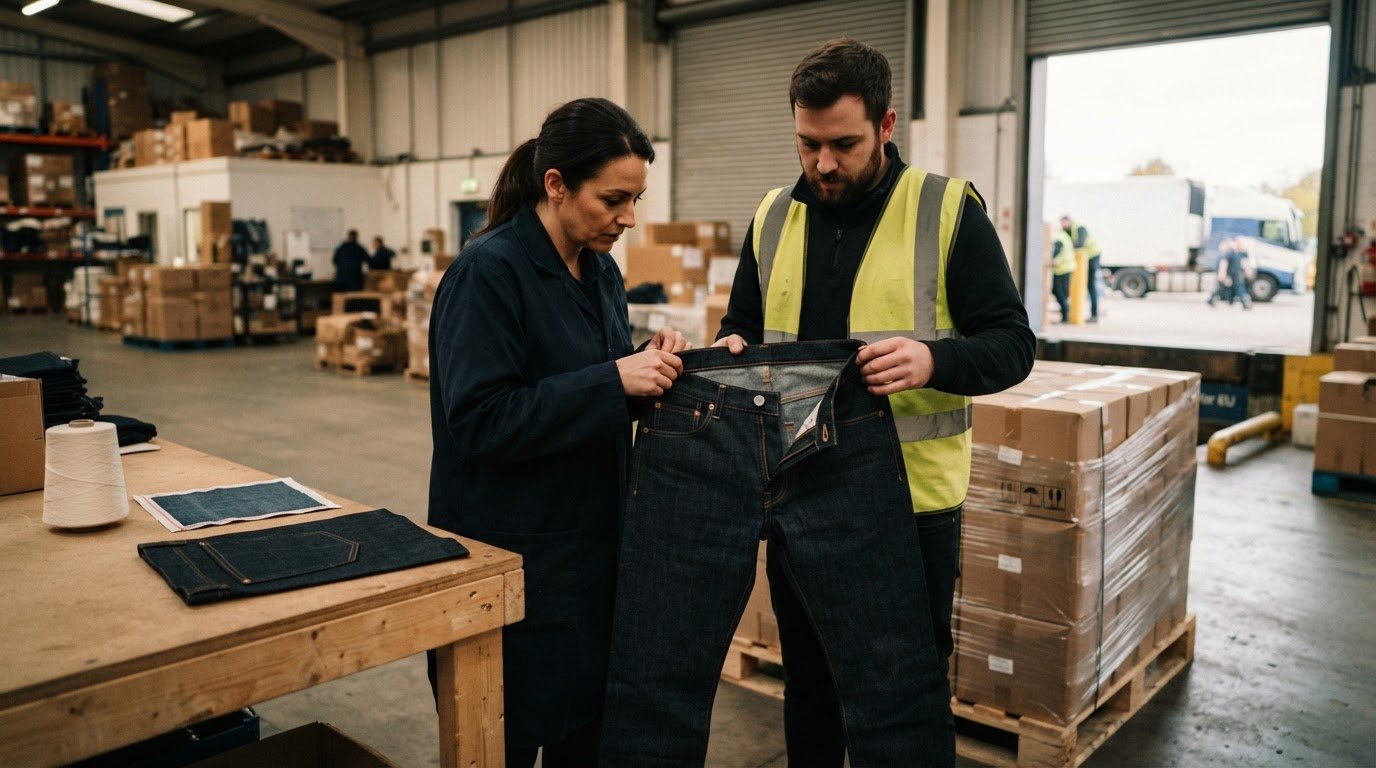
A chemical test report process should connect product specifications, supplier records and purchasing decisions. Start by identifying which materials and products require reports, and which suppliers hold the relevant evidence. For a textile brand selling garments in Europe and the United States, this means linking each report to the correct material, production location and product. Each request needs an owner, evidence source and follow-up route.
Prioritisation comes before expansion. A review can rank the 5 to-10 biggest evidence gaps by product impact, order timing and report coverage. For example, a sourcing team may distinguish a missing report for a garment’s main fabric from one covering a minor trim. The resulting priorities guide supplier follow-up and purchasing decisions, instead of treating every gap as equally urgent.
Supplier follow-up should establish which test reports are available and what products or materials they cover. A spinning mill in India may hold reports for yarn, while a dyeing house in Turkey may hold records for treated fabric. The work includes checking document scope, identifying missing evidence and recording the outcome, rather than treating an unrelated report as proof for the product.
Supplier requests should specify what evidence is needed and why. A request to a fabric supplier can identify the relevant material, production location, test report and response deadline. If a subcontractor performs dyeing, the record should show how that site and its material connect to the product. Clear expectations make follow-up more targeted and reveal where responsibility or information breaks down.
Report review needs a consistent evidence pathway. Match each report to its material, product scope and supplier, then flag mismatches for review before purchase approval. For instance, a report covering a different fabric composition should not be treated as evidence for the garment under review. This process connects product approval to supplier documentation and makes missing or out-of-scope evidence visible.
Governance determines whether controls persist. A cross-functional procedure can assign supplier requests to sourcing, product specifications to product teams and report review to compliance teams. Internal reviews can then check whether records support purchasing decisions and whether follow-up has been completed. For example, a report received from a dyeing house should be linked to the relevant fabric and product records, not remain isolated in an email folder.
Effective controls produce a usable evidence trail: product requirement, accountable owner, supplier test report, scope check, follow-up and recorded outcome. Textile buyers can use this structure to respond to retailer requests and direct follow-up where material gaps remain. It turns report collection into a defined operating process, embedding evidence checks in sourcing and product approval.
5. Verifying textile transaction certificates
A transaction certificate can support a claim that a particular shipment of textile goods meets a specified certification requirement. Its value depends on whether the document relates to the goods being purchased, rather than simply naming a supplier or product type. Buyers should check the certificate against the order and shipment records before relying on it as evidence.
Product descriptions are a common pressure point. A certificate may refer to a broad product category, while an order contains specific styles, colours or fibre compositions. If the document does not identify the relevant goods clearly, the buyer may be unable to establish that it covers the items being listed or shipped. Differences should be resolved with the supplier before the certificate is accepted.
Shipment details also require attention. The certificate should be checked against available commercial documents, including the supplier, quantities and shipment references. For example, a certificate provided by a spinning mill in India may not establish coverage for finished garments shipped by a CMT factory in Portugal. The evidence needs to connect to the transaction under review.
Document dates and status can affect whether a certificate is relevant to an order. Buyers should confirm that the certificate applies to the goods and transaction in question, and ask the issuer or supplier to clarify any missing or inconsistent details. A certificate from an earlier order should not be treated as evidence for a later shipment without confirmation that it covers those goods.
Supplier changes can create further gaps. If a dyeing house in Turkey or another processing supplier changes, the buyer should check whether the certificate still relates to the relevant production and goods. Any replacement document should be reviewed against the order records, rather than filed as a substitute without checking its scope.
Clear handling procedures help prevent unsupported documents from passing into buying and listing processes. Teams should record which goods a certificate covers, note unresolved discrepancies and retain the version used for the purchasing decision. If a supplier corrects a document, the revised version should be distinguishable from the earlier copy.
The practical test is whether the transaction certificate can be matched to the specific goods and shipment being assessed. Checking that connection before approval helps buyers identify missing evidence early and gives suppliers a clear basis for resolving document gaps.
Symolem
Symolem helps fashion businesses organise compliance evidence for products and supply chains. When supplier records are missing, its specialists retrieve chemical test reports, fibre-origin documents, transaction certificates and packaging weights across Tier 1-3. Where worker-welfare or human-rights evidence is needed, auditable evidence packs support due diligence.
For retailers and marketplaces, Symolem-ID screens third-party brand ranges before purchase orders are signed. For product records intended to support Digital Product Passports, Symolem audits and verifies evidence, then assigns a Verification ID for transfer to a chosen provider. This work helps teams address specific evidence gaps against EU ESPR technical standards and UNTP data protocols.
Contact Symolem to discuss compliance evidence challenges affecting your products, suppliers or retail decisions.
Make compliance evidence part of the decision process
Supplier evidence checks need clear ownership and a route from missing document to recorded action. Build that connection into purchasing and product approval rather than treating it as a separate reporting exercise. This helps ensure evidence gaps are identified before unresolved issues become commercial obstacles.
Retailers and marketplaces can screen third-party brand compliance before committing to a purchase order. Screen third-party brand compliance before signing the PO. Explore Symolem-ID or run a free product scan.
Fashion brands can get support when supplier evidence or social accounting requires specialist work. Need to retrieve missing Tier 1-3 supplier evidence or substantiate social accounting for retail stockists? Take the 5-minute Free Assessment or Book an Advisory Consultation.
Frequently Asked Questions
What labour and supply chain due diligence rules apply to fashion brands?
Relevant rules can include the EU Corporate Sustainability Due Diligence Directive (CSDDD), Germany’s Supply Chain Due Diligence Act (LkSG) and the US Uyghur Forced Labor Prevention Act (UFLPA). Which rules matter depends on the brand’s markets, operations and supply relationships. A useful assessment maps those relationships, identifies where human-rights or forced-labour evidence is needed, and records how concerns are evaluated and addressed.
What information should a transaction certificate provide for textile products?
A transaction certificate records information about a specific shipment or transaction, including the products and parties involved. For cotton apparel, it can help connect a product to material-origin records and the suppliers involved in its production. Brands should check that the certificate details match the relevant purchase and shipment records. Missing or inconsistent information may need to be followed up with the supplier before the evidence is shared with a retailer or customs.
How can a fashion brand retrieve missing transaction certificates from suppliers?
Start by identifying the products and transactions for which certificates are required, then trace the relevant suppliers and document owners. A spinning mill in India or a dyeing house in Turkey may hold records that are not available from the garment factory. Set out the missing information clearly and request the supporting documents from each party. Specialist evidence retrieval can help organise responses and record any gaps for follow-up.
What supplier records can support verification of apparel material origin?
Relevant records can include transaction certificates, fibre-origin documentation and supplier records linking materials to products. Check that product descriptions, quantities and parties are consistent across the documents. For instance, a brand can compare the material details in a certificate with records from its supplier and the finished product specification. Organised, auditable evidence can help answer retailer or customs requests about where apparel materials came from.
What are the U.S. requirements for product safety, chemicals, and restricted substances in apparel?
Identify the applicable U.S. product-specific safety and chemical rules, then link each material, trim and finish to relevant product-level test evidence. Assess construction, intended wearer and chemical treatments; a general supplier declaration is not a substitute.
Frequently Asked Questions
Talk to a consultant
Have a question about how this applies to your brand?
Ask Lavinia Fernandes directly. Tell us your products and markets and you get a straight answer on what applies and what to do first.