Fashion Supply Chain Compliance Verification: What Data to Check
A digital product passport cannot repair a missing test report. Product compliance checks should confirm that the report identifies the relevant material or product, records the test method and results, and can be linked to the garment being sold. Without that evidence, a product record cannot substantiate its compliance information.
This matters when a garment passes through multiple suppliers, countries and processing stages. For example, a brand may need to match a fabric test report from a dyeing house in Turkey to the fabric used by a CMT factory in Portugal. A report that names a different material, or cannot be tied to the relevant product, leaves a gap retailers may need to resolve before approving a purchase order. This article explains what to check in supplier test reports and how retailers and fashion brands can identify missing or mismatched evidence.
Key Takeaways
- Supplier identity records are useful only when names, locations and certifications can be linked to the facilities and products they cover.
- Clear reporting expectations and reduced duplicate requests can make supplier data collection more reliable and manageable.
- Secure digital platforms can structure access to supplier evidence while supporting controlled sharing across supply-chain relationships.
- Evidence gaps often sit beyond the direct supplier, so retrieval may need to reach Tier 1-3 for test reports, fibre origins, transaction certificates and packaging weights.
- Retailers and marketplaces can screen third-party brand ranges before purchase orders, while brands can use specialist support to retrieve missing records.
Table of Contents
Supplier identity, location, and certification data
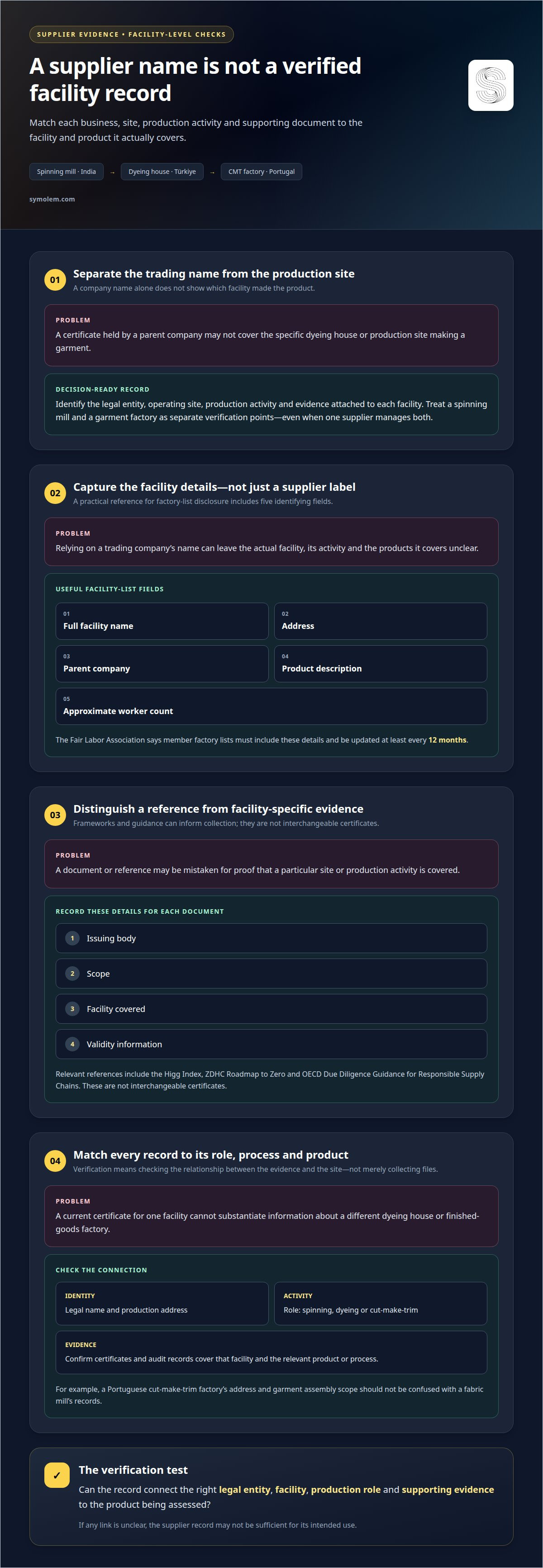
Supplier records must identify the legal entity, operating site, production activity and evidence attached to each facility. A spinning mill in India and a garment factory in Portugal are separate verification points, even when one supplier manages both.
Supplier Identity and Certification Records
Supplier identity and certification records connect a named business and facility to its location, activities and supporting documents. This distinction matters because a certificate held by a parent company may not cover the specific dyeing house or production site making a garment.
The Fair Labor Association says member factory lists must include the facility’s full name, address, parent company, product description and approximate worker count. Members must update that information at least every 12 months. Those fields provide a practical baseline for checking whether a facility’s identity and details are current, rather than relying on a trading company’s name alone.
Certifications and audit references answer different questions. Relevant references include the Higg Index, ZDHC Roadmap to Zero and OECD Due Diligence Guidance for Responsible Supply Chains. These frameworks and guidance documents are not interchangeable certificates. For each document, record the issuing body, scope, facility covered and validity information.
Data Quality and Honest Reporting
Good data quality means supplier statements are complete, consistent and tied to the correct facility and product. A current certificate for a spinning mill, for example, cannot substantiate a claim about a different dyeing house or finished-goods factory.
Reporting incentives shape what suppliers disclose. If a factory expects every identified gap to trigger an immediate commercial penalty, it may have reason to downplay problems. When buyers distinguish transparent reporting from unresolved non-compliance, suppliers have a clearer incentive to disclose and address issues. A corrective-action record should capture the finding, responsible party, evidence of progress and closure decision.
Duplicate requests can undermine data quality. A dyeing house in Turkey might receive separate questionnaires from a brand, retailer and audit programme, each asking for the same site address or certificate. A shared, permission-controlled record can reduce repeated collection while preserving the date, source and version of each document.
Supplier Evidence Collection and Verification
Supplier evidence collection is the structured capture and review of facility-level information and documents. Verification depends on matching each document to the right legal entity, site, process and product, not simply accumulating files.
A practical document review checks the supplier’s legal name and production address, its role, such as spinning, dyeing or cut-make-trim, and whether certificates and audit records cover that facility. For example, a Portuguese cut-make-trim factory’s address and garment assembly scope should not be confused with a fabric mill’s records.
The Fair Labor Association provides a reference for factory-list disclosure: its members were required to make Tier 1 factory lists public by March 2022 and update them at least every 12 months. The same principle helps buyers assess whether a facility record is current, identifiable and sufficiently detailed for its intended use.
Interoperability makes records usable across systems. A supplier name, facility address, certification scope and document date should retain consistent meaning when shared between a brand’s sourcing system and a retailer’s onboarding process. The Higg Index, ZDHC Roadmap to Zero and OECD guidance can help structure collection, but the underlying evidence still needs a clear source and facility match.
Social compliance audits have limits. They provide evidence about a defined scope and point in time, not continuous proof of every workplace practice. Document review and site access can also leave gaps. A completed audit record, for example, does not by itself show that corrective actions remain effective after the visit.
Professional monitoring can connect audit findings to corrective actions and later evidence. A specialist can categorise issues, assign responsibility, review supporting records and assess whether the documented response addresses the original finding. For a factory in India, this means linking the finding, response evidence and closure rationale to the same facility record.
Evidence collection costs include supplier staff time, translation, document retrieval and repeated buyer-specific formats. A shared data structure can reduce duplicate entry, while a clearly defined evidence request helps suppliers understand what to submit and why. Each item is more useful when its source, facility, scope and review status are recorded.
For fashion supply chain compliance verification, a supplier list is only the starting point. A decision-ready record links each site to its production role, relevant evidence and any open corrective actions, giving buyers a basis for assessing supplier information.
Digital platforms and secure supplier data sharing
A digital platform can turn scattered supplier files into structured, permission-controlled evidence. Its value depends on defined data fields, clear ownership and controlled access, not simply putting spreadsheets online. For a garment made with fabric from a Turkish dyeing house and assembled in Portugal, each partner needs to share records against the right facility and product. Otherwise, the platform can centralise errors as efficiently as evidence.
Start with a defined data model. Identify the records needed for a product, the supplier responsible for each one and the facility each document covers. A cotton shirt might link its bill of materials to a spinning mill, fabric processor and cut-make-trim factory. Consistent identifiers for products, facilities and documents make these relationships easier to follow across a brand’s sourcing platform and a retailer’s onboarding system.
Next, set access by role. A spinning mill in India may need to submit fibre-origin documents, while a retailer needs to review relevant evidence without editing the source file. A platform should allow administrators to define who can submit, view, amend or approve each record. This limits unnecessary disclosure between commercial partners and helps preserve responsibility for the information supplied.
Secure sharing also requires a record of changes. For each uploaded certificate or test report, retain its source, submission date, facility scope and version history. If a supplier replaces a document, keep the previous version distinguishable from the current one. That history helps a reviewer understand which evidence supported a product decision at a particular point.
Data should travel with its meaning. A field labelled “factory” may refer to a legal entity, production site or subcontractor, depending on the system. Define terms before collection and align them with recognised structures such as the UN Transparency Protocol (UNTP). The Global Textiles Transparency Governance Playbook for Shared Data Systems was published in October 2024, underscoring the sector’s focus on governed shared data.
Interoperability matters when brand, supplier and retailer systems use different formats. A platform can map common fields, such as facility name, address, material composition and certificate scope, while preserving the original supplier record. For example, a dyeing house in Turkey should not need to re-enter the same address for each brand partner. Mapping should not blur the distinction between a supplier declaration and third-party evidence.
Then test the exchange across a defined part of the supply chain. A brand could pilot a digital platform with one garment category and a small group of partners, such as an Indian spinning mill, a Turkish dyeing house and a Portuguese cut-make-trim factory. The pilot can show whether each party understands the fields, whether file formats transfer correctly and where access permissions prevent legitimate review. Expand only after resolving those operational problems.
Supplier participation depends on the burden involved. Repeatedly requesting the same certificate through separate portals creates duplicate work and inconsistent versions. A shared submission process can reduce repetition if suppliers know which buyer partners can see each record and why. For a factory completing an ethical practices disclosure, clear field definitions and a focused evidence request are more actionable than a broad, open-ended questionnaire.
Data quality needs controls within the workflow. A platform can flag missing fields, expired document dates or mismatches between a certificate’s named site and the facility record. These flags identify issues for review; they do not prove a supplier’s statement is true. A human reviewer still needs to assess the scope and source, including whether a test report relates to the fabric used in the specific garment.
Disclosure rules should distinguish sensitive commercial information from evidence needed for a specific decision. A supplier may share a document with a brand’s compliance team without making it visible to every partner in the chain. Record the purpose and recipient of each disclosure, then restrict access when that purpose no longer applies. This supports collaboration while limiting unnecessary exposure of supplier records.
Digital systems also need to work beyond a pilot. Assign responsibility for maintaining product and facility identifiers, resolving disputed records and reviewing access when supplier relationships change. If a brand replaces its Portuguese cut-make-trim factory, the platform should preserve the former site’s historical records while linking new production to the replacement facility. This prevents a current supplier record from obscuring where earlier garments were made.
The practical test is whether a platform lets a reviewer follow evidence from product to source, with permissions and document history intact. For a garment, that means distinguishing the mill’s material record, the dye house’s process evidence and the assembly factory’s production information. A connected system supports better-informed decisions, but it cannot correct inaccurate submissions or evidence that does not match the product.
Symolem’s Tier 1-3 Regulations Data Retrieval Advisory
Symolem’s Tier 1-3 Regulations Data Retrieval Advisory helps fashion brands close evidence gaps that internal teams cannot resolve through routine supplier requests. The work is useful when a stockist’s review is stalled, product records cannot be substantiated, or sourcing staff lack capacity to pursue documentation across several supplier relationships. It focuses on obtaining and organising evidence, not replacing the supplier’s responsibility to provide it.
The engagement starts with the product or range under review and the records already available. Symolem identifies missing evidence, the supplier or production stage likely to hold it, and how the gap affects the product record. This creates a defined retrieval scope instead of sending broad, repeated requests to every supplier in the chain.
Supplier follow-up is often the difficult part. A brand may have a contact at its finished-goods manufacturer but no direct route to the mill, processor or material trader holding the relevant record. Symolem pursues those requests across Tier 1-3, clarifies what evidence is being sought and follows the chain of responsibility until records can be assembled for review.
The advisory covers chemical laboratory test reports, fibre-origin documentation, transaction certificates and packaging weights. Each document is handled according to its purpose and connection to the product record. For example, a test report must be considered in relation to the material or product it covers. Retrieving a file without establishing that connection leaves the underlying evidence question unresolved.
Requests can reveal a mismatch rather than a simple absence. A supplier may submit a document under a different product reference, facility name or material description from the one the brand uses internally. Symolem can pursue clarification and organise the resulting information so the record reflects what the evidence supports, while keeping unresolved discrepancies visible for the brand’s decision-makers.
This work is especially relevant when a retailer or customs team requests supporting documents on a short commercial timeline, or when a sourcing team is managing evidence requests alongside production responsibilities. Symolem offers a human-led way to pursue records that software cannot obtain by itself. Suppliers remain responsible for providing source evidence; retrieval support does not transfer that responsibility or guarantee that every requested record exists.
Once records have been gathered, their practical value lies in how they are organised and linked to the product. A brand can distinguish documents received from those still outstanding, identify which supplier provided each item and understand where each record applies. That structure helps teams respond to evidence requests with a coherent file rather than an unconnected collection of attachments.
Retailers and marketplaces have a different decision point: whether a third-party product range should pass screening before a purchase order is signed. Symolem-ID screens brand ranges against 50+ global textile regulations in seconds and returns a per-SKU status of Cleared, Blocked or Missing Evidence. These statuses inform pre-purchase-order review; they are screening results, not regulatory approval or a guarantee of compliance.
For a buying team, a Missing Evidence status identifies a product record needing attention before a purchasing decision. A Blocked status indicates that a line has not passed the screening gate, while Cleared describes the result for the record assessed. These screening results are not a regulatory approval or a guarantee of compliance. The platform does not take over the retailer’s legal responsibilities or eliminate risk; it provides a structured screening point before an order is placed.
The two services address different operational needs. Regulations Data Retrieval is for brands that need human-led pursuit of missing evidence across their supplier network. Symolem-ID is for retailers and marketplaces screening third-party ranges before purchase. A business may need one or the other, depending on whether its immediate obstacle is missing source documentation or a pre-order decision on a product range.
For product records being prepared for a Digital Product Passport provider, Symolem verifies and organises supporting evidence, then assigns a Verification ID that can feed the chosen provider or a retail onboarding system. Symolem does not build or issue consumer-facing passport applications. Its role is evidence verification and record preparation; the selected provider handles the consumer interface.
Social evidence has a different scope from product-document retrieval. When a brand needs auditable information on worker welfare, fair wages or human rights due diligence, Symolem’s Social Accounting & Due Diligence Advisory addresses these matters through human-led audits and evidence packs. This distinction helps brands direct each requirement to the right workstream instead of treating every compliance gap as a document-retrieval task.
Retailers and marketplaces can Explore Symolem-ID or run a free product scan to screen third-party brand compliance before signing the PO.
Fashion brands needing to retrieve missing Tier 1-3 supplier evidence or substantiate social accounting for retail stockists can Take the 5-minute Free Assessment or Book an Advisory Consultation.
Frequently Asked Questions
What evidence should support a garment’s fibre composition?
Fibre composition evidence should match the product and the material used in production. A review can compare the bill of materials (BOM), supplier specifications and relevant test reports, checking that fibre percentages and product details are consistent. For a blended-fibre garment, a mismatch between the BOM and a test report should be recorded and resolved before the product record is approved. A supplier declaration alone may not establish that the finished item matches the stated composition.
What should a retailer check in a textile test report before approving a product?
Check that the report identifies the tested material or product, the relevant test and its result, and that the details correspond to the SKU under review. A report for a different colour or fabric may not support the product being approved. If a dyeing house in Turkey supplies a new colourway, the retailer should confirm whether the existing report covers that material and treatment. Unmatched or missing reports should be resolved before the purchase order is signed.
How can a brand check whether a test report covers a substituted fabric?
Compare the report’s sample description and supplier details with the revised BOM and purchase records. A substitution made after testing can mean the report no longer supports the material used in production. For example, if a spinning mill in India supplies a replacement yarn, the brand should check whether the report covers that yarn rather than relying on the original fabric’s results. Record any gap and request evidence for the substituted input.
What should be checked on an organic textile transaction certificate?
Check that the certificate identifies the transaction and products being claimed, and that its quantities and supplier details align with the relevant commercial records. The document should relate to the goods used for the order, not simply to a supplier’s general certification status. If a certificate covers a larger shipment, reconcile the quantity allocated to the brand’s purchase. Unexplained differences should be resolved before making an origin or material claim.
What does fashion product compliance verification cover?
Fashion product compliance verification assesses whether a product record is supported by relevant evidence for the market and purpose under review. This includes examining the record’s scope, identifying inconsistencies and distinguishing evidence from supplier statements that still need assessment. A useful review also clarifies who owns an unresolved item and which decision it affects. It does not transfer legal responsibility or constitute regulatory approval.
What evidence can support a supplier labour and human rights review?
A specialist can examine how a supplier’s stated practices correspond with available evidence about workers and workplaces. Depending on the review scope, this may include wage records, recruitment documentation, grievance procedures and responses to previously identified concerns. Interviews and workplace observations can add context to documents. Findings should distinguish evidence reviewed from issues requiring follow-up, helping brands assess risk without treating a policy statement as proof of practice.
How can a brand resolve inconsistent fibre-origin documents?
Compare supplier declarations with commercial records, production information and material descriptions for the relevant product. Check that each document relates to the same input and transaction, and note any substitutions or processing changes that may affect the claim. If records from a supplier and a spinning mill in India conflict, keep the discrepancy visible and request supporting evidence rather than resolving it through assumption.
What does a professional fashion supplier compliance audit involve?
A professional audit defines its scope before reviewing evidence, then evaluates relevant documents and supplier practices against that scope. Depending on the assignment, the reviewer may sample records, interview responsible personnel, observe workplace conditions and document findings with supporting evidence. The report should distinguish confirmed observations from corrective actions still in progress, allowing the business to track whether responses address the original issue.
Frequently Asked Questions
Talk to a consultant
Have a question about how this applies to your brand?
Ask Lavinia Fernandes directly. Tell us your products and markets and you get a straight answer on what applies and what to do first.