The Strategic Business Case for Digital Product Passports in Fashion: 2026 Mandate
Compliance with the Ecodesign for Sustainable Products Regulation (ESPR) isn't a bureaucratic hurdle; it's a structural audit of a brand's right to operate within the European market. For too long, the apparel industry has relied on opaque global value chains and fragmented data silos that prioritize short-term margins over systemic integrity. You likely recognize that the current model is failing under the weight of impending 2026 deadlines and regulatory ambiguity. The business case for digital product passports in fashion extends far beyond avoiding punitive fines; it represents a fundamental shift toward technical transparency and verified accountability.
This article provides an uncompromising look at why Digital Product Passports (DPPs) are the essential infrastructure for commercial resilience. You'll discover a strategic framework for DPP investment that mitigates regulatory risk while driving operational efficiency through precise data mapping. We'll unpack the mechanics of the 2026 mandate, moving past superficial sustainability narratives to address the clinical realities of global value chain reconstruction and the necessity of an ESPR readiness diagnostic.
Key Takeaways
- Establish why the 2026 ESPR mandate converts Digital Product Passports into a prerequisite for EU market entry rather than an optional sustainability feature.
- Examine the technical infrastructure of DPPs, focusing on how lifecycle data mapping from raw materials to recycling creates a clinical system of verification.
- Quantify the business case for digital product passports in fashion by analyzing how automated data flows mitigate risk and facilitate profitable circular business models.
- Map the transition from fragmented data to operational efficiency through a structured ESPR Readiness Diagnostic that identifies systemic gaps across your global value chain.
- Determine why strategic policy alignment and diagnostic frameworks are more critical for long-term resilience than the mere procurement of compliance software.
Table of Contents
- The 2026 Regulatory Mandate: Why ESPR Compliance is Non-Negotiable
- Unpacking the Digital Product Passport: From Data Fields to Business Intelligence
- Building the Business Case: Strategic ROI Beyond Regulatory Avoidance
- The Operational Roadmap: Mapping Data and Infrastructure for DPP Readiness
- Navigating the Transition: Symolem’s Strategic Advisory for DPP Frameworks
The 2026 Regulatory Mandate: Why ESPR Compliance is Non-Negotiable
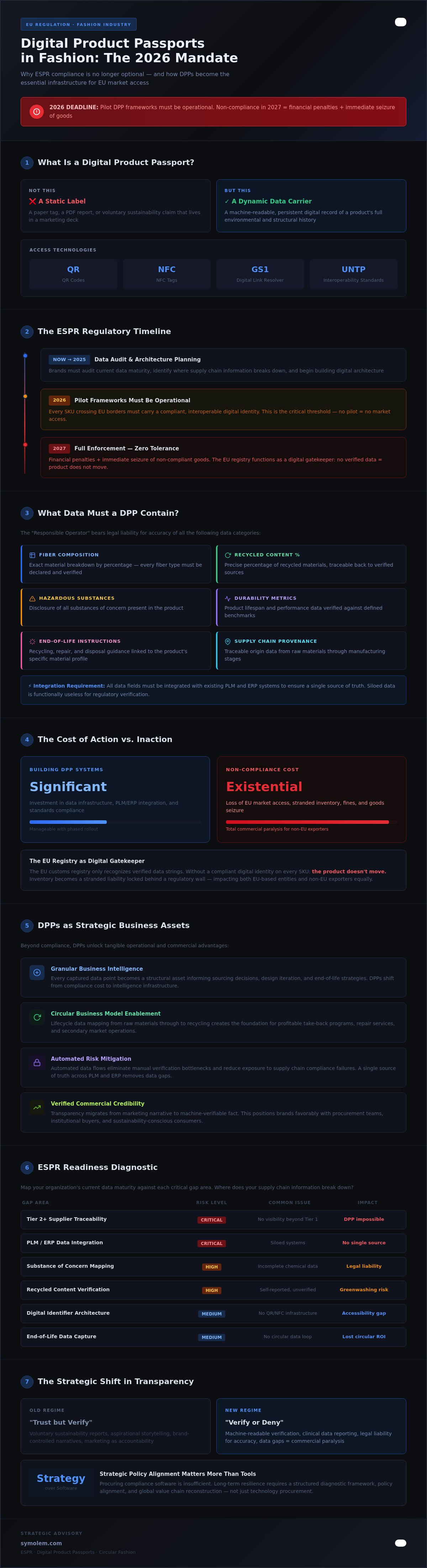
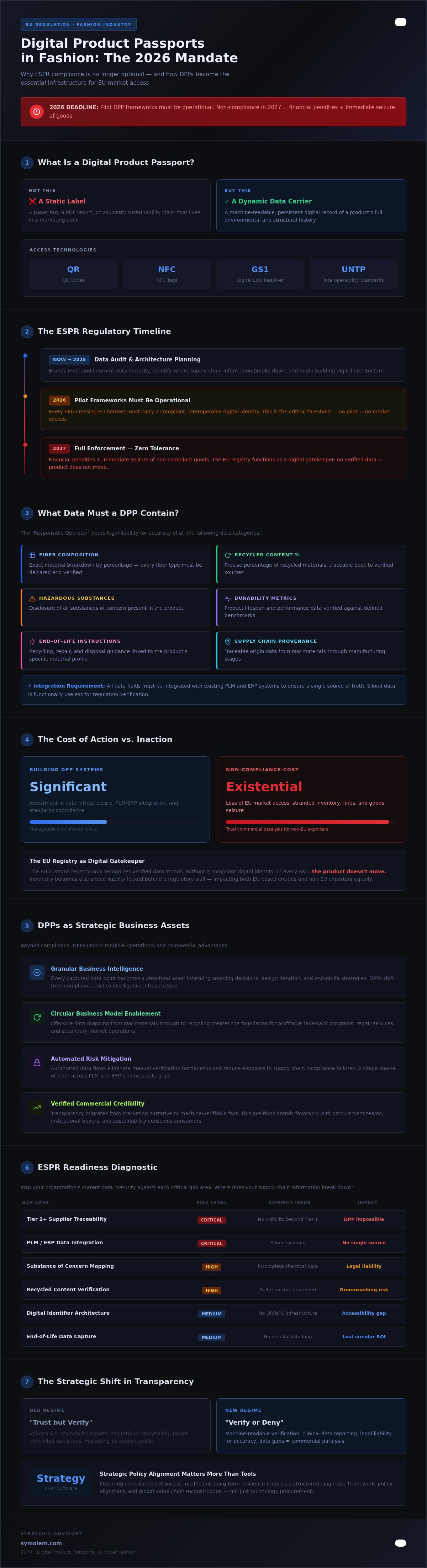
The Ecodesign for Sustainable Products Regulation (ESPR) has effectively terminated the era of voluntary sustainability reporting. Market entry is no longer a matter of brand prestige; it's a technical verification event. Under the 2026 mandate, the Digital Product Passport (DPP) serves as a persistent, machine-readable record of a product's environmental and structural history. This shift transforms transparency from a marketing asset into a hard-coded operational requirement. Brands failing to internalize the business case for digital product passports in fashion face more than just reputational damage. They face systemic exclusion from the world's largest single market.
The Legal Anatomy of the DPP
The legal architecture of the DPP is defined by delegated acts that specify precise data requirements for textiles. It's not a suggestion. The "Responsible Operator" within the supply chain bears the legal liability for the accuracy of this data, which encompasses material composition, recycled content percentages, and the presence of hazardous substances. 2026 is the critical threshold. By then, pilot frameworks must be operational to ensure that every SKU crossing EU borders carries a compliant, interoperable digital identity. Inertia carries a heavy price; financial penalties and the immediate seizure of non-compliant goods will define the 2027 landscape for those who treat these deadlines as flexible.
Market Access and Regulatory Risk
The EU registry functions as a digital gatekeeper at customs. If the data doesn't exist, the product doesn't move. This creates an immediate risk of stranded inventory for both EU-based entities and non-EU brands exporting into the region. Without a robust digital architecture, your inventory becomes a liability, locked behind a regulatory wall that recognizes only verified data strings. The business case for digital product passports in fashion centers on this reality: compliance is the only mechanism for preserving market access. We're moving from a regime of "trust but verify" to "verify or deny," where data gaps result in total commercial paralysis.
This transition demands a strategic shift from aspirational storytelling to clinical data reporting. The cost of building these systems is significant, yet it's eclipsed by the cost of being locked out of the European economy. Brands must audit their current data maturity now. Understanding where your supply chain information breaks down is the primary step in mitigating the legal and financial risks that'll become unavoidable by 2027.
Unpacking the Digital Product Passport: From Data Fields to Business Intelligence
A Digital Product Passport is not a static label. It's a dynamic data carrier that utilizes technologies like QR codes, NFC, and the GS1 Digital Link resolver to bridge the gap between physical products and their digital twins. This architecture ensures that information remains accessible and interoperable throughout the product's entire lifecycle. By moving beyond the physical tag, the business case for digital product passports in fashion shifts from mere compliance to the acquisition of granular business intelligence. Every data point captured becomes a structural asset that informs sourcing, design, and end-of-life strategies.
Technical Requirements for Apparel
The technical core of a DPP involves mapping essential attributes such as fiber composition, substances of concern, and durability metrics. These aren't isolated data points. They must be integrated directly with existing PLM and ERP systems to ensure a single source of truth across the organization. Achieving this requires adherence to global frameworks like the UNTP digital product passport standards, which facilitate interoperability between different stakeholders in the value chain. Without these standards, data remains siloed and functionally useless for regulatory verification or circular operations. Brands that prioritize these technical foundations early can leverage policy and regulatory advisory to align their infrastructure with impending legal requirements.
Data Governance and Security
Transparency doesn't necessitate the abandonment of proprietary trade secrets. Effective DPP frameworks utilize verifiable credentials and decentralized identifiers to manage data permissions, ensuring that sensitive sourcing information is only visible to authorized entities while public-facing data remains transparent. Protecting this data requires a methodical approach to governance that addresses both security and long-term persistence. If the digital record disappears before the product reaches the end of its life, the compliance chain breaks. Systems must be designed for permanence, ensuring that data remains accessible for decades to support repair, resale, and eventual recycling processes.
The transition to a data-driven model requires more than just technical implementation; it demands a cultural shift toward radical accountability. Data integrity is the only currency that matters in a regulated circular economy. When every material claim is backed by a verifiable digital trail, the risk of greenwashing vanishes, replaced by a system of clinical precision that rewards structural integrity over superficial marketing claims.
Building the Business Case: Strategic ROI Beyond Regulatory Avoidance
The business case for digital product passports in fashion is frequently reduced to a defensive maneuver against EU penalties. This is a narrow, risk-averse perspective that ignores the structural advantages of data-driven infrastructure. Beyond mere survival, DPPs eliminate the "transparency tax," which is the compounding cost of manual data collection, redundant third-party audits, and the persistent friction of fragmented supply chain communication. By automating these data flows, brands transition from reactive compliance to proactive operational control, identifying systemic bottlenecks and ESG vulnerabilities before they manifest as commercial failures. It's a fundamental shift from managing garments to managing high-fidelity information.
The Economics of Textile Recovery
Extended Producer Responsibility (EPR) schemes are rapidly increasing the financial burden on brands for the end-of-life management of their products. Digital Product Passports lower these costs by providing the precise material composition data required for high-fidelity sorting and recycling. Without this digital record, textile recovery remains an expensive, manual guessing game that results in downcycling and a significant loss of material value. Verified data also unlocks the residual value of products in second-hand markets, where technical provenance is a prerequisite for premium resale. For a deeper dive into these financial mechanics, review Symolem's cost-benefit analysis of circular textile models. This framework demonstrates how data integrity directly correlates with the recovery of capital from what was previously considered waste.
Compliance vs. Strategic ROI
There is a stark divide between "Minimum Viable Compliance" and strategic implementation. Checking the box for the 2026 mandate might satisfy a customs officer, but it does nothing to improve long-term margins or operational agility. Strategic implementation involves building a persistent data asset that reduces the long-term cost of verification and annual reporting cycles. Rigorous, machine-readable data also improves investor relations by replacing vague ESG claims with audited, technical proof points that withstand clinical scrutiny. In an age of extreme regulatory and consumer scrutiny, the ability to transition from "greenwashing" to "green-proving" is a critical differentiator for capital allocation and market stability. Those who invest in infrastructure rather than just labels will see a reduction in audit fees and a significant increase in systemic reliability.
This is not a project for the marketing department. It's a structural mandate for the C-suite. When you treat the DPP as a strategic asset, you aren't just complying with a regulation; you're building the data foundation for a resilient, circular, and ultimately more profitable enterprise.
The Operational Roadmap: Mapping Data and Infrastructure for DPP Readiness
Operationalizing the business case for digital product passports in fashion requires a methodical departure from legacy data management. It's a structural transformation that cannot be solved by simply purchasing a software license. Success depends on a five-step execution model that prioritizes data integrity over superficial implementation. The process begins with an ESPR Readiness Diagnostic to identify the critical data gaps within your current value chain. This diagnostic serves as a clinical audit, revealing where information flows break down between internal departments and external partners.
Following the diagnostic, brands must execute comprehensive stakeholder mapping to align design, sourcing, and IT departments toward a unified data architecture. Supplier engagement follows, necessitating the establishment of standardized protocols for data collection that move beyond annual surveys into real-time verification. A pilot implementation on a single product line allows for the stress-testing of these data flows before scaling the framework into the core product lifecycle. This phased approach de-risks the transition, ensuring that the infrastructure is resilient enough to handle the complexities of global apparel production.
Mapping DPP Data Fields for Apparel
Navigating the 814+ potential data fields required for textiles is the most significant hurdle for global brands. These fields range from basic material composition to granular details regarding substances of concern and durability testing results. Brands must prioritize mandatory attributes defined by the latest delegated acts while maintaining the flexibility to incorporate voluntary data that adds commercial value. Collecting this information from Tier 3 and Tier 4 suppliers requires a technical bridge that legacy systems often lack. It involves mapping every touchpoint of the garment's journey, ensuring that data is not just collected, but verified at the source to prevent regulatory rejection at the point of entry.
Infrastructure and Costing
Estimating the Digital Product Passport cost involves evaluating the total cost of ownership across the entire value chain. Brands must decide between building in-house capabilities or utilizing third-party providers for data hosting and carrier technology. However, the true cost lies in continuous data maintenance and the regular auditing of supplier inputs to ensure ongoing compliance. Budgeting for these operational realities is essential for long-term survival. If you're ready to identify your structural vulnerabilities, the first step is to commission an ESPR Readiness Diagnostic to map your path toward 2026 compliance.
Navigating the Transition: Symolem’s Strategic Advisory for DPP Frameworks
Software is a tactical choice; strategy is a structural imperative. Many fashion enterprises are currently rushing toward procurement, mistakenly believing that a SaaS license constitutes a compliance roadmap. This is a fundamental failure of perspective. A software tool can only process the data it is given, yet most brands lack the technical mapping required to extract high-fidelity information from deep-tier suppliers. Symolem positions itself as the strategic architect in this landscape, providing the intellectual rigor necessary to bridge the gap between abstract EU policy and granular operational implementation.
The business case for digital product passports in fashion shifts from a defensive regulatory shield to a proactive engine for market leadership when grounded in strategic policy alignment. Our diagnostic-led approach identifies the specific structural failures in your value chain, allowing for the construction of a data framework that satisfies the ESPR mandate while anticipating the next wave of regulation. The Green Claims Directive and evolving Extended Producer Responsibility (EPR) requirements will soon demand even higher levels of verified transparency. Brands that fail to build these foundational systems now will find themselves perpetually reactive, struggling to maintain market access as the regulatory threshold continues to rise.
Expert DPP Implementation for Fashion
Mapping technical data requirements is a clinical exercise in supply chain forensics. Symolem assists brands in navigating this complexity by developing bespoke circularity frameworks that align with specific EU mandates. We move beyond generalities to address the technical nuances of material durability, recycled content verification, and substances of concern reporting. Our consultancy services for textile circularity strategy ensure that your DPP implementation is not an isolated compliance project but a core component of a resilient business model. We don't just suggest a path; we map the technical infrastructure required to walk it.
Securing Your Competitive Advantage
The 2027 enforcement milestones will separate market leaders from those facing systemic obsolescence. Moving from defensive compliance to offensive market leadership requires an uncompromising commitment to data integrity. By internalizing the business case for digital product passports in fashion, your brand secures its right to operate while gaining unprecedented visibility into global operations. This transparency is the only viable path to commercial resilience. It's a shift from managing garments to managing verified data assets. To begin the transition from regulatory risk to structural stability, Schedule your ESPR Readiness Diagnostic with Symolem today.
Securing Market Resilience in the 2026 Landscape
The 2026 mandate acts as a structural filter. It separates enterprises with technical integrity from those still tethered to opaque legacy models. The business case for digital product passports in fashion has evolved from a theoretical discussion into a hard prerequisite for commercial survival. By internalizing these requirements now, brands move beyond the threat of regulatory exclusion and toward a model of verified, data-driven resilience. This transition isn't just about avoiding penalties; it's about building the infrastructure for a circular economy that rewards precision over narrative.
Symolem acts as a strategic architect in this complex environment. As independent policy experts and specialists in textile circularity economics, we deliver the strategic frameworks for global compliance that simple software solutions lack. We help you map the mechanics of your value chain to ensure that every data field meets clinical standards of verification. Don't wait for 2027 to discover your structural vulnerabilities. Secure your market access with a Symolem ESPR Readiness Diagnostic. The path to systemic stability is open to those who prioritize rigorous preparation today.
Frequently Asked Questions
What is the primary purpose of a Digital Product Passport in fashion?
The primary purpose of a Digital Product Passport is to provide a persistent, machine-readable record of a product's environmental and structural history. This ensures that every item entering the market has a verifiable identity that captures data from raw material sourcing through to end-of-life. It acts as a digital gatekeeper, facilitating transparency across global value chains while providing the foundational data required for circular business models like repair and recycling.
Does the ESPR and DPP mandate apply to UK brands selling in the EU?
Yes, the ESPR and DPP mandate applies to any brand placing products on the EU market, regardless of where their headquarters are located. UK-based brands must comply with these technical requirements to maintain market access. Failure to provide a compliant passport at the point of entry will result in customs rejection and potential legal penalties. This makes the business case for digital product passports in fashion a critical survival factor for international exporters.
What are the specific data requirements for textile Digital Product Passports?
Specific data requirements for textiles include fiber composition, recycled content percentages, and the presence of hazardous substances. Brands must also document durability metrics and repairability instructions. These technical attributes are defined by delegated acts under the ESPR framework. Current estimates suggest that brands may need to manage over 814 potential data fields to ensure full regulatory alignment and technical interoperability across their global supply chains.
How much does it cost to implement Digital Product Passports for a fashion brand?
Implementation costs vary based on supply chain complexity and current data maturity. Expenses typically include technical data mapping, carrier technology integration, and ongoing data maintenance. Symolem doesn't provide fixed price points because costs depend on the specific structural gaps identified during a diagnostic. Brands should evaluate the total cost of ownership against the risk of market exclusion, treating this as a critical infrastructure investment rather than a simple compliance fee.
When is the deadline for fashion brands to comply with DPP regulations?
The critical deadline for fashion brands to comply with the initial wave of DPP regulations is 2026. This is when the first delegated acts for textiles are expected to become enforceable. Enforcement milestones in 2027 will likely see stricter customs controls and immediate penalties for non-compliance. Brands that haven't established their data frameworks by 2026 risk immediate commercial paralysis and the inability to sell inventory within the European Union.
Can DPPs help fashion brands comply with Extended Producer Responsibility (EPR)?
Digital Product Passports are essential for complying with Extended Producer Responsibility (EPR) schemes. They provide the precise material data required for efficient textile sorting and recovery. Without this digital record, brands face higher EPR fees because recyclers cannot easily verify fiber content. By providing clinical data on product composition, DPPs lower the financial burden of end-of-life management and unlock the residual value of textile waste through verified recovery channels.
What is the difference between a QR code and a Digital Product Passport?
A QR code is merely a data carrier; it's the physical bridge to the passport. The Digital Product Passport itself is the underlying data architecture that contains the product's entire lifecycle history. While the QR code or NFC tag provides the link, the DPP encompasses the verified data strings, decentralized identifiers, and interoperable protocols required by EU law. One is the access point, while the other is the systemic record of truth.
How should fashion brands handle proprietary supplier data in a DPP?
Handling proprietary data requires a structured governance framework that utilizes verifiable credentials. Brands can meet transparency mandates without exposing trade secrets by using tiered access permissions. This allows regulators to see necessary compliance data while keeping sensitive sourcing details restricted to authorized parties. Managing these permissions is a core component of developing robust Digital Product Passport (DPP) Frameworks that protect competitive advantage while ensuring full legal and systemic integrity.