
Digital Product Passports in the UAE: A Practical Guide
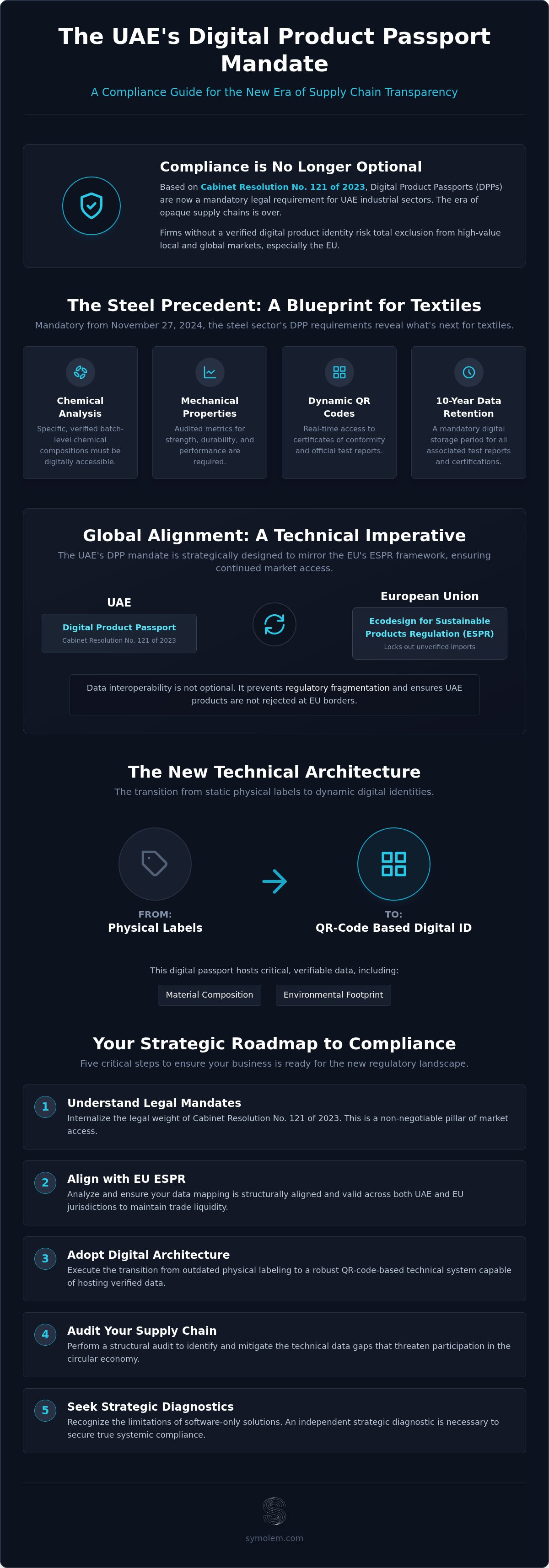
Compliance is no longer a voluntary badge of corporate social responsibility. It's a hard requirement for market access. The mandatory rollout of Digital Product Passports for UAE industrial sectors, beginning with steel and rapidly pivoting toward textiles, signals a permanent end to the era of opaque supply chains. Firms that treat this as a localized administrative hurdle risk total exclusion from high-value global markets, particularly as the EU’s Ecodesign for Sustainable Products Regulation (ESPR) prepares to lock its gates against unverified imports.
You likely recognize that the technical complexity of mapping hundreds of data fields across fragmented jurisdictions is a massive operational burden. This guide analyzes the systemic shift in UAE regulatory policy to provide a definitive roadmap for compliance. We'll unpack the critical implementation steps for the textile and industrial sectors, align local data requirements with EU ESPR standards, and establish the structural framework necessary to maintain trade liquidity in an increasingly audited global economy.
Key Takeaways
- Understand the legal weight of Cabinet Resolution No. 121 of 2023 and why Digital Product Passports for UAE are now a mandatory pillar of industrial market access.
- Analyze the structural alignment between UAE digital IDs and the EU ESPR framework to ensure your data mapping remains valid across multiple jurisdictions.
- Transition from physical labeling to a QR-code-based technical architecture capable of hosting verified material composition and environmental footprint data.
- Execute a structural audit of your supply chain to identify and mitigate the technical data gaps that threaten your participation in the circular economy.
- Recognize the limitations of software-only solutions and the necessity of an independent strategic diagnostic to secure systemic compliance.
The Emergence of the UAE Digital Product Passport Mandate
The UAE regulatory landscape has undergone a definitive structural shift. Digital Product Passports for UAE are no longer a theoretical projection or a voluntary sustainability goal. They're a codified legal requirement. Cabinet Resolution No. 121 of 2023 serves as the foundational legal instrument for this transition, establishing a mandatory digital identity system designed to track industrial products across their entire lifecycle. This move positions the UAE as a regional pioneer in the Gulf, deliberately aligning its industrial base with the EU's Digital Product Passport (DPP) framework. This isn't an exercise in ethical sentiment. It's a strategic maneuver to ensure that UAE-produced goods remain compatible with global trade standards, particularly as the "Net Zero by 2050" initiative demands verifiable, granular transparency to maintain market access.
Regulatory Drivers: MoIAT and the Circular Economy
The Ministry of Industry and Advanced Technology (MoIAT) acts as the primary architect of this digital infrastructure. It has moved beyond the soft-focus narratives of sustainability to implement a rigid system of digital verification. This transition from voluntary reporting to mandatory digital audits is a central pillar of the UAE Circular Economy Policy 2021-2031. Under this policy, every product must eventually possess a secure, immutable record of its origin and environmental impact. The shift is diagnostic and clinical. It treats supply chain data as a critical business asset that must be audited and verified with the same precision as financial records. For manufacturers, the implication is clear: if you can't verify the data, you can't participate in the market.
The Steel Precedent: A Blueprint for Textiles
Steel was the logical pilot sector for the UAE's digital mandate. As of November 27, 2024, steel reinforcement bars and billets must carry dynamic QR codes that link to specific product datasets. These requirements aren't superficial. They include:
- Chemical Analysis: Specific batch-level chemical compositions.
- Mechanical Properties: Verified strength and durability metrics.
- Dynamic QR Codes: Real-time access to certificates of conformity and test reports.
- Data Retention: A mandatory 10-year digital storage period for all test reports.
The steel implementation provides the exact technical blueprint for the upcoming textile sector expansion. While a specific date for textiles hasn't been finalized, the UAE’s focus on "Green Manufacturing" suggests that Digital Product Passports for UAE will soon require textile producers to map similar data points, ranging from fiber origin to chemical processing. Firms that wait for the formal textile deadline will find themselves technically insolvent in a market that demands immediate, verified data transparency.
Structural Alignment: UAE DPP vs. EU ESPR Frameworks
Regulatory isolation is a fast track to market obsolescence. The UAE’s move to mandate digital IDs is a calculated response to the European Union's Ecodesign for Sustainable Products Regulation (ESPR). By mirroring the EU’s structural requirements, the UAE ensures its industrial output remains liquid in the world’s most regulated markets. This alignment is codified in UAE Cabinet Resolution No. (121) of 2023, which provides the legal architecture for Digital Product Passports for UAE. Without this synchronization, manufacturers face "regulatory fragmentation." This is a state where mismatched data fields between jurisdictions create insurmountable barriers to entry and inflate the cost of technical mapping.
Mutual recognition isn't a diplomatic nicety; it's a technical imperative. For UAE-based textile and industrial manufacturers, the path to compliance requires rigorous ESPR readiness diagnostics. This process identifies where local production data fails to meet international verification standards. It prevents the catastrophic scenario where a product is certified in Dubai but rejected in Brussels due to insufficient data mapping. Organizations must prioritize a systemic audit of their data infrastructure to ensure they don't fall behind the 2026 compliance curve.
Data Interoperability and Global Standards
Systemic integrity depends on a unified language of verification. This requires strict adherence to ISO 9001 and ISO 14001, combined with the UAE’s Emirates Conformity Assessment Scheme (ECAS). These frameworks aren't redundant. They're complementary layers of an auditing system that ensures material claims are immutable. By utilizing GS1 standards for data carriers, the UAE ensures its digital passports are readable across global supply chains. This interoperability is the only defense against the data silos that currently plague the textile sector.
Timeline Synchronisation for 2026-2027
The window for preparation is closing. While the EU’s textile DPP deadline is set for 2027, the UAE’s rapid adoption in the steel sector suggests an accelerated rollout for other high-impact industries. 2026 is the critical year for structural data auditing. Waiting for a final mandate is a strategic failure. Firms must begin addressing the challenges of Digital Product Passport implementation immediately to avoid being locked out of the 2027 trade cycle. Conducting a structural audit now is the only way to mitigate the risk of market exclusion.
Technical Architecture and Data Mapping Requirements
Static labels are an obsolete technology. The transition to Digital Product Passports for UAE necessitates a complete overhaul of product identification, moving from physical tags to a dynamic, QR-code-based digital architecture. These codes don't merely point to a static website; they serve as a secure gateway to a granular dataset that must be maintained for a mandatory period of 10 years. This data retention requirement, as established by the Ministry of Industry and Advanced Technology (MoIAT), ensures that product information remains accessible throughout the entire lifecycle, facilitating future recycling and reuse. To guarantee the immutability of this information, the technical foundation must rely on decentralized identifiers (DIDs) or blockchain layers, preventing the retroactive alteration of environmental or material claims.
Data integrity is the only defense against greenwashing. The mandatory data fields for the UAE mandate include precise material composition, batch-specific environmental footprints, and verified geographical origin. Manufacturers must treat these fields not as optional disclosures but as audited technical specifications. Failing to secure the veracity of this data through robust storage protocols leads to systemic failure during regulatory audits, potentially resulting in the suspension of trade licenses or market exclusion.
Mapping the 814 DPP Data Fields for Textiles
Textile supply chains are notoriously fragmented, often involving dozens of intermediaries across multiple continents. Mapping the 814 potential data fields required for full compliance is a monumental technical task. Symolem’s diagnostic approach prioritizes auditing the most critical data points first, separating them from secondary fields that may not yet be mandatory under current UAE regulations but are essential for EU alignment. A primary obstacle in this process is verifying textile sustainability claims for ESPR, which requires high-fidelity data from the raw material stage through to finished garment. Without a clinical audit of these data gaps, manufacturers cannot guarantee that their digital passports will withstand international scrutiny.
ECAS and MOIAT Certification Integration
The Emirates Conformity Assessment Scheme (ECAS) is the technical gatekeeper for product entry in the UAE. Securing a mandatory Digital Product ID requires the seamless integration of ECAS certification data into the DPP framework. This isn't a one-time event. It's a recurring requirement for every product batch. Automating this reporting process is the only way to maintain operational efficiency while meeting MoIAT’s rigorous standards. By embedding material test results directly into the digital identity of a product, firms can ensure that their compliance status is verified in real time, reducing the administrative friction associated with manual certification renewals.
Strategic Roadmap for Textile Implementation in the UAE
Strategy is the only antidote to regulatory chaos. The rollout of Digital Product Passports for UAE requires a methodical, five-stage execution plan that moves from internal diagnostics to national registry integration. This isn't a software installation; it's a structural realignment of the supply chain. Success requires a transition from anecdotal sustainability claims to verified, batch-level datasets that meet both local and international scrutiny. To achieve this, manufacturers must follow a rigid sequence of technical milestones:
- Step 1: Structural Audit. Evaluate the current state of supply chain transparency to establish a data baseline and identify fragmented records.
- Step 2: Technical Data Mapping. Quantify the precise gap between existing internal records and the up to 236 data points in the UNTP schema required for global ESPR alignment.
- Step 3: MRV Protocol Implementation. Establish rigorous Monitoring, Reporting, and Verification systems to track material flows and environmental impact in real time.
- Step 4: Third-Party Verification. Secure independent audits of environmental compliance data to ensure the immutability of all product claims.
- Step 5: Registry Integration. Finalize the upload of verified product identities into the MoIAT digital infrastructure to secure market access.
Phase 1: Diagnostic and Gap Analysis
The first 90 days of implementation are technically decisive. During this diagnostic period, firms must identify the systemic blind spots that exist within Tier 2 and Tier 3 supplier networks. These deeper tiers often lack the digital maturity to provide the high-fidelity data required for compliance. Analyzing the textile regulation impact on business models allows leadership to justify the initial capital expenditure as a necessary investment in market longevity rather than a mere administrative cost. Failing to resolve these data gaps early results in catastrophic delays during the final MoIAT certification phase.
Phase 2: Infrastructure Costing and Modeling
Transparency carries a measurable economic weight. Infrastructure costing must account for the granular mapping of material flows and the long-term storage of technical dossiers. A rigorous cost-benefit analysis of circular textile models reveals that while data mapping increases short-term overhead, it mitigates the ruinous risk of market exclusion and batch rejection. Resources must be allocated for the mandatory 10-year data retention period, ensuring that the technical architecture remains secure and accessible under audit conditions. Firms must secure their technical foundations by engaging a Policy and Regulatory Advisory specialist to map these complex data requirements before they trigger compliance failures.
Beyond Transparency: Symolem’s Diagnostic for Regulatory Readiness
Software alone is a superficial fix. It cannot bridge the chasm between raw supply chain chaos and the immutable data requirements of Digital Product Passports for UAE. A digital dashboard without a verified data foundation is merely a liability. Symolem functions as an independent strategic architect, moving beyond the limitations of generic SaaS solutions to build the technical and legal scaffolding required for systemic compliance. We don't just provide a platform; we provide the diagnostic rigor necessary to ensure that every material claim is defensible under international audit. This clinical approach treats regulatory readiness as a structural engineering challenge rather than a simple IT update.
The "ESPR Readiness Diagnostic" serves as the primary instrument for this transition. It identifies the precise failure points in a manufacturer’s current data architecture, allowing for the targeted remediation of supply chain blind spots. By mapping technical data fields with surgical precision, Symolem ensures that UAE market leaders are prepared for the transition from voluntary reporting to mandatory digital verification. This process moves the organization from a defensive posture to one of structural stability, where compliance is a byproduct of operational excellence.
Independent Advisory vs. SaaS Solutions
Standard SaaS platforms often rely on self-reported data from suppliers who lack the technical capacity for high-fidelity reporting. This creates a cycle of unverified information that collapses under the scrutiny of MoIAT or EU regulators. Symolem’s approach prioritizes clinical, diagnostic precision by mapping the up to 236 data points in the UNTP schema required for global value chains. This involves navigating textile EPR 2026 compliance frameworks alongside DPP mandates to create a unified regulatory strategy. We prioritize systemic integrity over marketing narratives, ensuring that your data mapping is built on verified material reality rather than aspirational estimates. This independent scrutiny is the only way to guarantee that your digital passports will withstand a rigorous audit.
Securing Your Position in the 2026 Global Market
The stakes for the UAE textile sector are absolute. Ignoring the digital ID mandate isn't a cost-saving measure; it's a slow-motion exit from the global market. Digital Product Passports for UAE act as a "green passport," providing the verified credentials necessary to navigate the increasingly protectionist trade environment of the EU and North America. Market leaders use our strategic frameworks to transform compliance from a reactive burden into a proactive competitive advantage. By establishing a high-fidelity data infrastructure now, you insulate your business against future regulatory shocks and secure your position as a trusted partner in the circular economy. The window for structural realignment is narrow. Contact Symolem for a Strategic DPP Diagnostic to audit your regulatory readiness before the 2026 implementation cycle begins.
Securing Market Liquidity in the Era of Digital Verification
Compliance is no longer a peripheral concern. It is the fundamental architecture of future trade. The transition toward Digital Product Passports for UAE represents a permanent structural shift that mandates high-fidelity data mapping across every tier of the textile supply chain. Manufacturers must move beyond superficial sustainability narratives to establish a verified, immutable record of material composition and environmental impact. Failure to align with these emerging standards doesn't just invite regulatory fines. It risks total exclusion from the world's most lucrative markets.
Symolem provides the diagnostic rigor required to navigate this complex policy landscape. As an independent advisory firm specializing in textile circularity, we offer expert-led diagnostics for global brands. Our team specializes in mapping over 800 DPP technical data fields, ensuring your internal systems align perfectly with both EU and UAE regulatory requirements. By auditing your supply chain today, you secure the trade liquidity necessary for tomorrow’s circular economy. It's time to transform your regulatory burden into a strategic asset. Request a Strategic ESPR and DPP Readiness Diagnostic to begin your structural realignment. This is the path to a resilient, transparent, and globally compliant industrial future.
Frequently Asked Questions
Is the Digital Product Passport mandatory for all sectors in the UAE?
The mandate is currently sector-specific. Cabinet Resolution No. 121 of 2023 established the Digital Product Passport for UAE specifically for the steel industry, targeting reinforcement bars and billets. While not yet universal, the framework is designed for systemic expansion into other high-impact industrial sectors. It functions as a pilot for a broader national requirement under the UAE Circular Economy Policy 2021-2031.
How does the UAE DPP differ from the EU ESPR requirements?
The UAE framework focuses on industrial verification and conformity assessment through MoIAT, whereas the EU ESPR emphasizes ecodesign and end-of-life circularity across a wider range of consumer goods. However, the UAE system is architected for interoperability. It utilizes similar data carriers like QR codes and blockchain layers to ensure that products manufactured in the Emirates meet the rigorous technical standards required for entry into the European single market.
What are the penalties for non-compliance with the UAE Digital Product ID system?
Non-compliance results in immediate market exclusion. Products lacking a verified Digital Product ID cannot secure the necessary MoIAT certificates of conformity, leading to batch rejection at the point of trade. Beyond immediate logistical failures, systemic non-compliance may lead to the suspension of industrial licenses or the imposition of administrative fines. The ultimate penalty is the loss of trade liquidity in regulated global value chains.
Can my existing ERP system handle DPP data mapping requirements?
Standard ERP systems are generally insufficient for the granular data mapping required by the mandate. While an ERP can manage basic inventory, it lacks the technical architecture to host the 814+ specific data fields required for full circularity compliance. Manufacturers must implement a specialized diagnostic layer to bridge the gap between internal records and the immutable digital passport requirements. Software alone cannot replace a structural audit of supply chain data.
How long must data be stored in the UAE Digital Product Passport?
The UAE mandate requires a minimum 10-year data retention period. This mandate ensures that material composition, test reports, and chemical analysis remain accessible throughout the product’s operational life and eventual decommissioning. This long-term storage requirement necessitates a secure, decentralized data architecture that prevents the degradation or unauthorized alteration of records. It's a critical component of the UAE's "Green Manufacturing" initiative.
Will the UAE DPP be expanded to include textiles and apparel?
Expansion into textiles and apparel is a confirmed strategic priority. While the mandatory date for textiles hasn't been finalized, the sector is identified as a high-impact area within the UAE Circular Economy Policy. Manufacturers should anticipate a rollout timeline that aligns with the EU’s 2027 textile mandate. Preparing for Digital Product Passports for UAE in the textile sector now is the only way to avoid technical insolvency during the transition.
What is the role of MoIAT in the Digital Product Passport rollout?
The Ministry of Industry and Advanced Technology (MoIAT) serves as the primary regulator and architect of the digital infrastructure. MoIAT governs the issuance of Digital Product IDs and integrates them into the national registry. It enforces the technical standards for material verification and environmental reporting. By managing the Emirates Conformity Assessment Scheme (ECAS), MoIAT ensures that every digital passport reflects a verified material reality.
Do I need a separate DPP for each individual item or per batch?
The current mandate for industrial sectors like steel operates at the batch level. Every production batch must be linked to a unique digital passport that contains its specific chemical and mechanical properties. While individual item tracking is technically possible through blockchain, batch-level reporting remains the standard for maintaining operational efficiency. Manufacturers must ensure their data mapping can support this level of granularity without disrupting production cycles.