
Digital Product Passports for Uniforms: Compliance Guide
The industrial laundry cycle is where textile transparency goes to die. For years, the professional workwear sector has relied on fragmented spreadsheets and anecdotal durability claims, but the European Union's Ecodesign for Sustainable Products Regulation (ESPR) has ended the era of voluntary disclosure. Implementation of Digital Product Passports for uniforms is no longer a pilot project for the distant future; it's a legal mandate with the EU DPP Registry already operational as of July 20, 2026. You likely recognize that your current data architecture cannot withstand the scrutiny of a mandatory audit or the physical rigors of tracking high-performance attributes through fifty industrial wash cycles.
This guide moves beyond superficial sustainability narratives to provide a clinical diagnostic of the technical requirements for DPP integration. We'll map the 49 specific data points mandated by the Joint Research Centre and explore how to build a resilient data infrastructure that survives the industrial supply chain. By the end of this analysis, you'll have a clear framework for ESPR readiness, ensuring your inventory transitions from a liability of fragmented data into a verifiable asset for the circular economy.
Key Takeaways
- Understand the legal urgency of the EU’s ESPR and why the implementation of Digital Product Passports for uniforms is a priority for the 2026/2027 delegated acts.
- Master the structural hurdles of data mapping by evaluating your inventory against the UNTP schema of up to 236 data points to ensure full regulatory alignment.
- Leverage precise lifecycle tracking to transform high-performance textile waste into a profitable asset through improved recovery economics.
- Audit your existing supply chain architecture to uncover "dark data" and integrate product-level transparency into your broader corporate sustainability reporting.
- Utilize a clinical diagnostic framework to move beyond superficial compliance and establish a robust technical infrastructure for your uniform inventory.
The Regulatory Mandate: Why Digital Product Passports for Uniforms Are Now Essential
Voluntary transparency has failed. The textile industry is currently transitioning from an era of "green stories" to a period of mandatory technical accountability. Under the Ecodesign for Sustainable Products Regulation (ESPR), the Digital Product Passport serves as a decentralized data carrier that links physical garments to their digital twins. This isn't just about labeling. It's about a systematic overhaul of how textile data is captured, stored, and verified. For companies managing massive workwear inventories, this represents a fundamental shift in legal liability.
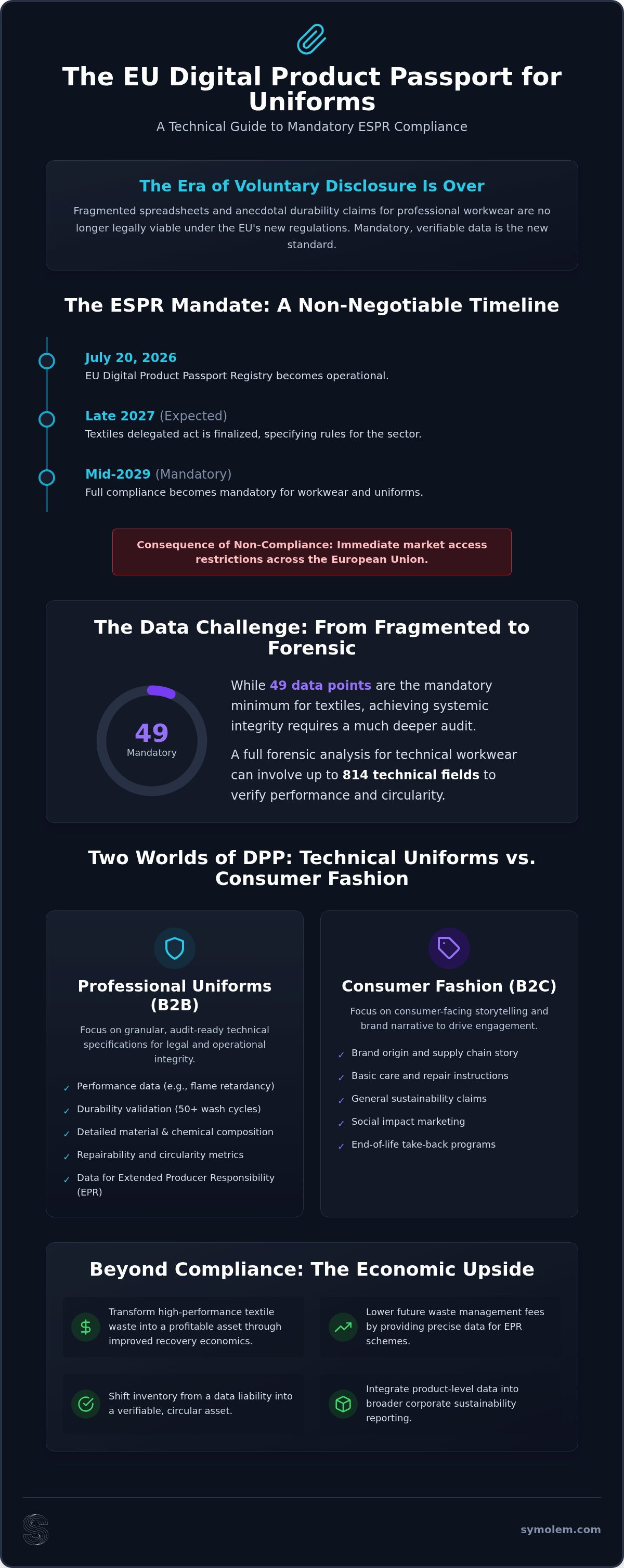
The timeline is unforgiving. With the EU DPP Registry operational as of July 20, 2026, and the textiles delegated act expected by late 2027, manufacturers must prepare for mandatory compliance by mid-2029. Professional workwear and uniforms are priority product groups because of their high material throughput and standardized replacement cycles. Non-compliance doesn't just mean a fine. It results in immediate market access restrictions across the European Union, effectively de-listing any supplier unable to provide an authenticated data string.
ESPR and the Professional Textile Sector
ESPR redefines what it means for a uniform to be durable or repairable. For high-visibility or flame-retardant gear, Digital Product Passports for uniforms must verify performance-based claims against actual usage data and industrial laundry cycles. The law identifies a specific "Economic Operator," usually the manufacturer or importer, who is legally liable for the integrity of this data. If the passport doesn't reflect the garment's technical reality after fifty industrial washes, the operator faces systemic risk and potential litigation.
The Distinction Between Fashion and Uniform DPPs
Fashion DPPs often focus on consumer storytelling, but B2B uniform inventories require granular, audit-ready technical specifications. Uniform procurement is increasingly tied to Extended Producer Responsibility (EPR) schemes, where disposal costs are calculated based on the garment’s material complexity and recyclability. Success requires navigating EPR for textiles through the lens of the DPP. This ensures that every fiber and chemical additive is mapped before the garment ever enters service, providing the data necessary to lower future waste management fees.
Technical Data Mapping: Managing the 814 DPP Data Fields
Data mapping is the primary structural hurdle for manufacturers. It is a clinical exercise in supply chain forensic auditing. While the Joint Research Centre (JRC) specifies 49 mandatory data points for textiles, achieving systemic integrity requires a much deeper dive into the up to 236 data points in the UNTP schema that define a garment's true lifecycle. For Digital Product Passports for uniforms, the complexity scales exponentially. You aren't just tracking a basic garment. You're tracking a specialized piece of protective equipment with specific chemical safety profiles, material compositions, and circularity indicators.
Technical textiles introduce unique friction. Mapping flame retardancy, anti-static properties, and high-visibility data requires verifiable proof from the fiber origin through every chemical bath. Data veracity isn't optional. It's a legal requirement. If a supplier cannot prove the durability of a finish after fifty industrial washes, the entire passport is compromised. This necessitates a move away from fragmented spreadsheets toward a centralized, immutable record.
Mapping Technical Requirements for Apparel
Understanding the Digital Product Passport technical requirements is the first step in building a compliant architecture. Manufacturers must deploy unique identifiers (UID) via data carriers like RFID or NFC tags that survive high-temperature industrial laundering. Protecting proprietary chemical data is equally critical. You must balance the "right to know" with the protection of trade secrets through secure, permissioned data layers that only reveal necessary compliance information to regulators.
Durability and Industrial Laundering Data
The industrial laundry is the ultimate stress test for data. For uniforms, the passport must record the "real" life of the garment, including the precise number of wash cycles and specific repair history. Integrating performance loss data into the digital record ensures that the garment is retired before it fails. This moves the industry from self-declaration to audited technical data. To ensure your current systems meet these rigorous standards, engaging a technical architect for a framework audit is essential for long-term viability.
Economic Advantages: How DPP Redefines Uniform Recovery
Circularity is not an ethical sentiment. It is a structural economic calculation. For the professional workwear sector, the primary barrier to profitability has always been the "sorting cost", which is the prohibitive expense of manually identifying material compositions in decommissioned stock. Digital Product Passports for uniforms eliminate this friction. By embedding machine-readable data into the garment's architecture, operators can automate recovery at scale. This transforms what was once a waste management liability into a high-value feedstock for textile-to-textile recycling.
Precise lifecycle tracking allows for the optimization of industrial laundry operations. Instead of retiring uniforms based on arbitrary timelines, data-driven insights allow for maintenance based on actual degradation levels. This reduces inventory waste and extends the productive life of each asset. This shift also enables a viable secondary market for corporate uniforms. With a verifiable digital record of repair and decontamination, uniforms can be securely resold or redeployed, recapturing value that previously evaporated upon initial decommissioning.
Cost-Benefit Analysis of Circular Uniform Models
Justifying the transition requires a rigorous cost-benefit analysis of circular textile models. Traditional linear models ignore the rising costs of incineration and landfilling under tightening EU regulations. In contrast, DPP-enabled recovery models capitalize on the fact that over 15 kilograms of textile waste is generated per person annually in Europe. By lowering the cost of verification, brands can unlock a profit pool estimated to reach €2.2 billion by 2030. Financial modeling must now account for these avoided disposal costs and the residual value of recovered fibers.
Infrastructure for Uniform Circularity
Data alone is insufficient. It requires physical infrastructure capable of acting on that data. The 2026 landscape is defined by automated sorting technologies that utilize RFID and optical sensors to read the Digital Product Passports for uniforms in real-time. This infrastructure allows for the high-speed segregation of fibers, separating poly-cottons from pure synthetics with clinical precision. Closing the loop means moving from decommissioning to high-value fiber recovery, ensuring that the structural integrity of the original textile is preserved for its next lifecycle.
Implementation Framework: Integrating DPP into Procurement
Procurement is the primary engine of regulatory compliance. It is no longer sufficient to purchase a garment based solely on unit price and basic utility; the structural integrity of the digital record is now a prerequisite for market access. Most organizations currently operate with significant "dark data", which is unstructured information buried in legacy supplier contracts, fragmented PDFs, and anecdotal durability claims. Identifying these gaps requires a forensic audit of the existing supply chain architecture to ensure alignment with the Corporate Sustainability Reporting Directive (CSRD) and upcoming government tender requirements.
Digital Product Passports for uniforms provide the granular verification necessary to substantiate high-stakes sustainability claims in competitive bidding. Building a cross-functional compliance team is essential for this transition. Procurement must define the data requirements, IT must build the interoperable pipelines, and Sustainability must verify the impact metrics. This is not a peripheral project. It is a core business transformation that demands a clinical, methodical approach to data governance.
Step-by-Step Implementation Strategy
- Phase 1: Diagnostic and gap analysis. Conduct a rigorous assessment of existing textile data against the mandatory fields required by the ESPR.
- Phase 2: Supplier engagement. Establish standardized data protocols and mandate that all upstream partners provide verified, machine-readable technical specifications.
- Phase 3: Pilot testing. Deploy data carriers, such as RFID or NFC tags, in industrial wash environments to verify physical durability and data readability over time.
- Phase 4: Full integration. Embed the Digital Product Passports for uniforms into your existing ERP and procurement systems to automate compliance reporting and inventory management.
Procurement as a Driver for DPP
Writing DPP requirements into uniform supply contracts is the most effective way to mitigate regulatory risk. Organizations must evaluate suppliers based on their data transparency and ESPR readiness rather than just their manufacturing capacity. This shift often necessitates a move from "buying garments" to "leasing textile services." In a service-based model, the provider retains ownership and responsibility for the garment’s digital twin, ensuring that the data remains accurate throughout the entire lifecycle. To begin this transition, you should request a strategic framework audit to identify the structural weaknesses in your current procurement model.
The Symolem Approach: ESPR Readiness and Diagnostic Rigor
Generalist consultants fail at technical textile compliance because they prioritize soft-focus narratives over structural integrity. They lack the diagnostic rigor required to map the granular complexities of high-performance textiles through industrial lifecycles. Symolem operates as a technical architect, moving beyond superficial reporting to build resilient compliance frameworks. Our proprietary approach ensures that Digital Product Passports for uniforms are not merely digital labels but immutable records of systemic transparency.
The essential first step for any organization is our ESPR Readiness Diagnostic. This clinical assessment evaluates your entire portfolio against our the UNTP schema of up to 236 data points, identifying critical data gaps that threaten market access. We don't just identify failures; we map the underlying structural reasons for them and provide the technical blueprint for remediation. This framework addresses the specific material realities of professional workwear, where durability and safety are non-negotiable legal imperatives.
Strategic Advisory for High-Stakes Compliance
We map technical data fields for global apparel manufacturers with diagnostic precision. This process involves auditing every node of the value chain to ensure that fiber origin, chemical safety, and durability metrics are verifiable. Beyond the passport, we design the cost-effective circular infrastructure required to act on this data. This includes modeling the economics of uniform recovery and advising on policy shifts to keep your business ahead of evolving EU mandates. Our advisory ensures that your recovery systems are not just compliant but economically self-sustaining.
Securing Your Supply Chain Future
Compliance is a moving target. Moving from diagnostic to implementation requires an uncompromising focus on verification rigor. This means ensuring that verifying textile sustainability claims for ESPR is natively integrated into your DPP architecture. Without this foundation, your claims remain vulnerable to legal scrutiny and financial penalties. We provide the strategic clarity needed to navigate this complex landscape, prioritizing systemic integrity over superficial narratives. Every data point we map serves a dual purpose: fulfilling a regulatory requirement and optimizing a business asset.
The era of voluntary transparency is over. Organizations must choose between structural obsolescence and technical integration. Contact Symolem today to secure your strategic compliance diagnostic and ensure your uniform inventory is prepared for the 2026 regulatory landscape.
Architecting Systemic Integrity in Professional Workwear
The era of voluntary sustainability is extinct. Organizations that continue to rely on fragmented supply chain data are inviting structural obsolescence as the EU's ESPR mandates take hold. Implementing Digital Product Passports for uniforms requires more than just a digital label; it demands a forensic re-engineering of how technical textile data is captured and verified. By shifting from anecdotal durability claims to audited, machine-readable technical fields, manufacturers can turn regulatory compliance into a strategic economic asset.
Success in this landscape depends on the precision of your data architecture. As an independent technical advisory with global expertise in textile policy and circularity, Symolem provides the strategic clarity necessary to navigate these complexities. We specialize in mapping the up to 236 data points in the UNTP schema required for systemic integration, ensuring your inventory meets the highest standards of verification. Don't wait for market access restrictions to dictate your strategy. Secure your regulatory future with a Symolem ESPR Readiness Diagnostic and build a resilient, circular foundation for your professional workwear portfolio.
Frequently Asked Questions
What specific data must be included in a Digital Product Passport for uniforms?
Mandatory data includes unique product identifiers, material composition by weight, and the presence of substances of concern. For professional workwear, compliance documentation regarding protective performance and durability standards is critical. While the JRC specifies 49 points, technical implementation often requires mapping hundreds of additional fields to ensure supply chain integrity. This data must remain accessible to regulators, repairers, and recyclers throughout the garment's operational life to support circularity.
When will the Digital Product Passport become mandatory for uniforms in the EU?
Compliance becomes mandatory between late 2028 and mid-2029. The delegated act for textiles is expected by the end of 2027, which will define the specific technical requirements for the industry. Uniform providers must align their data architecture now, as the first collections to be impacted will be Spring/Summer 2028. The EU DPP Registry is already operational as of July 20, 2026, signaling that the preparatory phase for mandatory disclosure is ending.
Can RFID tags used in uniforms serve as a Digital Product Passport data carrier?
RFID tags are highly effective data carriers for Digital Product Passports for uniforms because they survive high-temperature industrial wash cycles. These tags allow for automated, high-speed data retrieval without direct line-of-sight. However, the physical carrier must link to a decentralized registry that complies with EU interoperability standards. Simply having a tag isn't enough; it must point to a persistent, verifiable digital twin that contains the full regulatory data set.
How does the ESPR affect uniform manufacturers located outside of the EU?
Any manufacturer placing uniforms on the EU market must comply with ESPR, regardless of their geographic location. Non-EU entities must appoint an authorized representative or importer to act as the legal "Economic Operator" responsible for data integrity. Failure to provide a valid Digital Product Passport results in immediate market access restrictions. This regulation effectively forces global supply chains to adopt EU transparency standards to maintain their European trade routes and partnerships.
Who is legally responsible for the data in a uniform’s Digital Product Passport?
The "Economic Operator" bears the ultimate legal liability for the accuracy and availability of the passport data. This role is typically filled by the manufacturer or the importer who first places the product on the EU market. They must ensure the data remains authentic and accessible for at least ten years after the product is decommissioned. If the digital record is found to be fraudulent or incomplete during a regulatory audit, this operator faces significant financial penalties.
What happens to the Digital Product Passport data when a uniform is recycled?
The passport data serves as a technical blueprint for the recycler, identifying fiber types and chemical finishes to optimize the recovery process. Once the garment is mechanically or chemically processed into new raw materials, the original passport is deactivated. Any new product created from those recycled fibers will receive its own unique Digital Product Passport. This ensures a continuous, verifiable chain of custody from one product lifecycle to the next, supporting systemic integrity.
How can DPP data be used to improve the economics of uniform take-back programs?
Digital Product Passports for uniforms eliminate the prohibitive costs of manual material identification during sorting. By providing instant access to material composition and chemical safety data, DPPs enable automated, high-speed segregation of decommissioned stock. This precision increases the value of recovered fibers and reduces the risk of batch contamination. Consequently, take-back programs transition from loss-leading sustainability initiatives into profitable, data-driven supply chain operations that recapture significant material value.
How much does it cost to implement Digital Product Passports for a large uniform inventory?
Implementation costs depend on the complexity of your existing data architecture and the scale of your inventory. Expenses typically fall into three categories: technical hardware such as RFID tags, software integration for data management, and the strategic advisory required for forensic data mapping. While the initial capital expenditure is necessary for compliance, it's often offset by long-term gains in operational efficiency and reduced waste disposal fees. Organizations should focus on the cost of non-compliance as the primary risk.