UFLPA: Corporate Compliance, Import Presumptions, and Evidence
The UFLPA makes supply-chain evidence central to U.S. import decisions for goods linked to Xinjiang or covered entities. Its rebuttable presumption places a demanding proof burden on importers seeking to show that goods were not made wholly or partly with forced labour. For fashion businesses, this is more than a customs issue: it tests whether product and supplier records support claims about a garment’s origins and production.
Meeting that test requires clear ownership of information across sourcing, compliance and import teams. Records may be held by different suppliers, cover different production stages or fail to connect clearly to the product being shipped. This article explains how the law affects corporate decisions, which goods and entities fall within its scope, how the Entity List changes, and what evidence importers may use to support their position. It also considers how CBP handles shipments and how retailers and brands can strengthen processes before documentation gaps become border problems.
Key Takeaways
- Trace material origins beyond direct suppliers to identify exposure that may be hidden several tiers upstream.
- Distinguish goods linked to Xinjiang from goods connected to listed entities; both can trigger import scrutiny.
- Organise records that connect suppliers, materials, production and transactions to support an evidence-based response.
- Monitor changes to the Entity List, as an entity’s status can affect sourcing and import decisions.
- Use pre-purchase-order screening and focused evidence retrieval to identify gaps before they disrupt shipments.
Table of Contents
- Has the UFLPA Changed Corporate Behavior and Increased Compliance?
- What Is the Uyghur Forced Labor Prevention Act?
- Rebuttable presumption for goods linked to Xinjiang or listed entities
- When did the UFLPA take effect, and what goods does it cover?
- What entities are on the UFLPA Entity List, and how is the list updated
- Symolem: Automated Compliance Screening
Has the UFLPA Changed Corporate Behavior and Increased Compliance?
Yes. The UFLPA has made supply-chain evidence part of import control, changing how companies prepare for U.S. border review. A supplier policy alone cannot show where a product’s inputs came from or how they were processed. Importers need to connect product records to actual suppliers, facilities and transactions.
The shift is operational. Sourcing, compliance and customs teams need shared records, clear responsibility for retrieving evidence, and a process for responding to shipment questions. If information is fragmented across suppliers, the importer may struggle to assemble a coherent account under time pressure.
Border Evidence Requirements
Border evidence is shipment-specific documentation used to assess admissibility and the product’s production history.
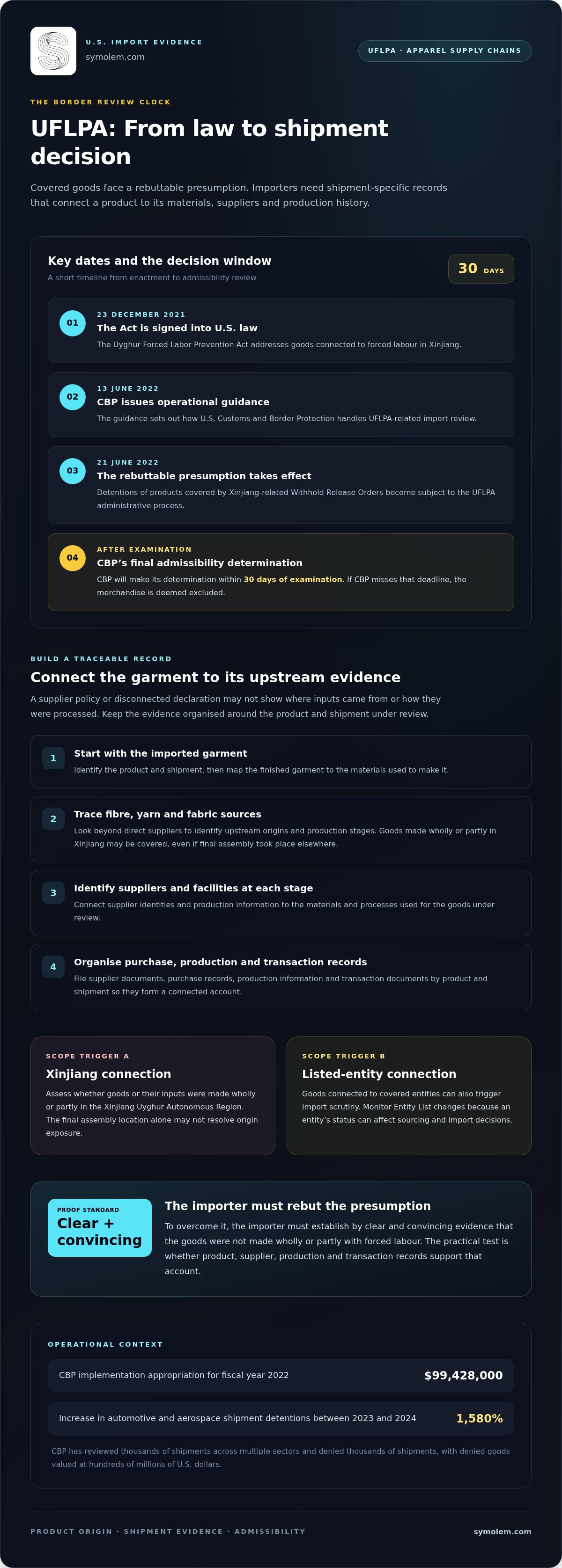
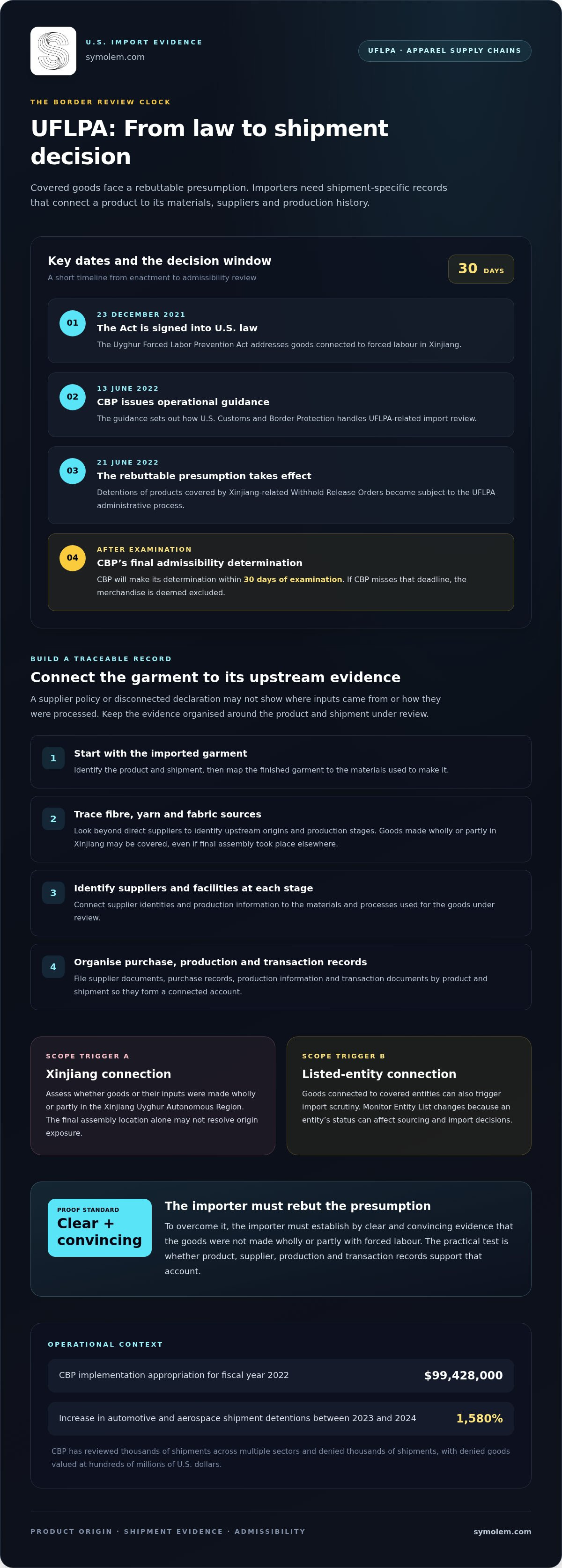
U.S. Customs and Border Protection issued UFLPA Operational Guidance on June 13, 2022. From June 21, 2022, detentions of products covered by Xinjiang-related Withhold Release Orders became subject to the UFLPA administrative process under 19 CFR § 151.16. An apparel importer should therefore keep documents organised around the goods under review, linking supplier identities, production records and transaction documents rather than submitting disconnected declarations.
Under 19 CFR § 151.16, CBP will make a final admissibility determination within 30 days of examination, and merchandise is deemed excluded if CBP misses that deadline, according to the Electronic Code of Federal Regulations. That deadline makes timely evidence retrieval consequential.
Penalties and Business Risks
Business risks are the trade and operational consequences when goods face detention or exclusion.
The central exposure is whether the shipment can enter the United States. Detention can disrupt planned delivery; exclusion can require a business to consider re-export or other commercial responses. These are consequences for admissibility, not a single automatic monetary penalty for every importer. The practical risk depends on the shipment, the available evidence and the resulting customs decision.
For apparel businesses, delayed stock can also affect fulfilment commitments and later purchasing decisions. Compliance teams should promptly route a detention notice to colleagues who can retrieve supplier records and map them to the imported goods.
Enforcement Measures and Priority Sectors
Enforcement combines border review with government resources and attention focused on higher-risk supply chains.
Congress appropriated $99,428,000 to U.S. Customs and Border Protection for UFLPA implementation in fiscal year 2022. CBP has reviewed thousands of shipments from sectors including electronics, apparel, footwear, pharmaceuticals, agriculture, industry and automotive. It has also denied thousands of shipments, with denied goods valued at hundreds of millions of U.S. dollars.
Enforcement therefore reaches beyond one product category. Automotive and aerospace shipment detentions increased by 1,580% between 2023 and 2024, demonstrating the breadth of review across supply chains. For fashion importers, the operational response is to identify upstream inputs and facilities before shipment, assign evidence ownership, and keep product records retrievable when CBP raises questions.
What Is the Uyghur Forced Labor Prevention Act?
The Uyghur Forced Labor Prevention Act is a U.S. trade law addressing goods connected to forced labour in Xinjiang. It links import decisions to the origin and production history of covered goods.
Importer Traceability and Documentation
Importer traceability means being able to connect a product to its materials, suppliers and production stages.
For an apparel order, map the finished garment to its fabric, yarn and fibre sources, then identify the facilities involved at each stage. Keep purchase records, production information and supplier documents organised by product and shipment. This structure helps distinguish a documented origin from an unsupported supplier statement. To overcome the presumption, an importer must establish by clear and convincing evidence that goods were not made wholly or partly with forced labour, according to U.S. Congress.
Xinjiang-Linked Import Restrictions
Xinjiang-linked restrictions apply to goods connected to the Xinjiang Uyghur Autonomous Region, including through covered entities.
The Uyghur Forced Labor Prevention Act was signed into U.S. law on December 23, 2021, according to U.S. Congress. The restriction is relevant to goods made wholly or partly in the region, not only products finished there. A garment assembled outside Xinjiang may still require origin analysis if its fabric or other inputs came through a covered production chain. Importers should assess materials and processing locations alongside the final assembly site.
The Import Ban and Presumption
The import ban bars covered goods unless the importer rebuts the statutory presumption.
The UFLPA’s rebuttable presumption took effect on June 21, 2022, according to U.S. Customs and Border Protection. It changes the evidence required for covered imports: the importer must substantiate the goods’ production history rather than rely on a general statement that no forced labour was identified. The United States has prohibited imports made with forced labour since 1930. The 2015 legislative modification removed barriers to enforcing that prohibition; this Act establishes a targeted presumption for specified Xinjiang and entity links.
Government Action on Forced-Labor Imports
Government action combines import enforcement with a strategy focused on forced-labour risks linked to China, particularly Xinjiang.
The Act directs the Forced Labor Enforcement Task Force to develop a strategy supporting enforcement of the prohibition on importing goods made wholly or partly with forced labour in China, especially in the Xinjiang Uyghur Autonomous Region. The Department of Homeland Security’s Task Force released its UFLPA strategy on June 17, 2022. For companies, the practical implication is to translate government categories into sourcing controls: identify suppliers and production locations, map material origins, and retain records that connect those facts to imported goods.
Rebuttable presumption for goods linked to Xinjiang or listed entities
A rebuttable presumption is a legal starting point: covered goods are treated as made with forced labour unless the importer meets the required standard of proof. Under U.S. law, a link to Xinjiang or a listed entity can trigger that presumption, even if the finished product is assembled elsewhere. A supplier’s location alone therefore cannot establish whether a garment’s materials have relevant connections.
The Entity List identifies entities associated with specified Xinjiang-linked production and labour schemes. Its categories include entities that mine, produce or manufacture goods wholly or partly with forced labour; entities involved in transferring workers or members of persecuted groups from Xinjiang; and entities exporting goods made by listed entities. It also covers certain sourcing from Xinjiang for government labour schemes. For an apparel company, the question is not simply whether its direct cut-and-sew factory is on the list. It must also consider upstream material sources and supplier relationships.
List changes make dated supplier checks insufficient. On August 3, 2026, the Forced Labor Enforcement Task Force added 43 Chinese companies, bringing the total to 187. Roughly half of those 43 companies operated outside Xinjiang, China. This matters for industrial supply chains: a supplier’s location outside the region does not, by itself, rule out a covered connection. Importers need to compare supplier and entity names, then trace relevant inputs and transactions through the production chain.
State Department reporting provides wider context for Xinjiang-related due diligence. The U.S. Department of State and other U.S. agencies issued an updated Xinjiang Supply Chain Business Advisory on July 13, 2021. An addendum issued on September 26, 2023 highlighted the urgency of supply-chain due diligence. For businesses, these named advisories reinforce the need to investigate links beyond a first-tier supplier instead of relying only on a general sourcing declaration.
Forced labour transfers describe the movement of workers through labour programmes that can create supply-chain exposure. PRC government reports stated that state agencies conducted upward of 3 million worker transfers in 2023. That figure does not establish that a particular garment used forced labour, but it underscores why a company must assess how facilities, entities and materials connect. The operational step is to map each relevant supplier relationship and preserve supporting records for the specific product.
To rebut the presumption, importers must assemble evidence about the goods’ origins and production, rather than rely on a broad corporate policy. A practical review matches entity names against the current list, identifies links in material sourcing, and reconciles supplier records with product and shipment documents. The burden is product-specific: a gap in the chain can leave a connection unresolved, even when other stages are documented.
When did the UFLPA take effect, and what goods does it cover?
The import presumption took effect on June 21, 2022, according to U.S. Customs and Border Protection. It applies to goods connected to Xinjiang or entities covered by the law. The date matters because importers must assess relevant shipments against the presumption, not merely note when an order was placed or a supplier relationship began.
Covered goods include products made wholly or partly in the Xinjiang Uyghur Autonomous Region. The rule concerns goods with a relevant production connection, not only items finally assembled there. For a textile product, trace the materials and processing steps, then identify where they took place. A finished garment made elsewhere may still need careful origin analysis if upstream inputs connect to the region.
The law also covers goods connected to specified entities, including products made wholly or partly by entities in covered categories. The Entity List includes entities that produce goods with forced labour and entities involved in certain labour-transfer programmes. It also includes some goods exported to the United States from China when entities in the first categories produced them, wholly or partly. Importers should assess both the production site and the identity of relevant upstream suppliers.
Product coverage is not limited to one industry or finished-goods category. CBP has reviewed thousands of shipments from sectors including apparel, footwear, electronics, pharmaceuticals, agriculture, industrial goods and automotive products. These categories do not mean every shipment faces the same outcome. They show why importers need product- and supplier-level checks, rather than assumptions based on broad industry labels.
For apparel, start with the imported item and work backwards through its inputs. Identify the garment maker, fabric mill, yarn source and relevant upstream processing facilities. Compare supplier and entity names against the applicable list, then connect the results to invoices, production records and shipment documents. A cut-and-sew factory’s location alone cannot establish the origins of the fabric or fibre used in the garment.
The key questions are whether a covered connection exists and whether the importer can substantiate the goods’ production chain. Keep records tied to specific products and shipments, not just a general supplier policy. If a record names a trading company but not the producing facility, trace the transaction to its source. This helps distinguish a documented supply chain from one with unresolved links before goods enter the United States.
What entities are on the UFLPA Entity List, and how is the list updated
The UFLPA Entity List identifies businesses and organisations linked to specified forced-labour concerns. Its categories include entities in Xinjiang that mine, produce or manufacture goods wholly or partly with forced labour. It also names entities working with the Xinjiang government to transfer workers or members of persecuted groups from the region. Another category covers certain goods exported to the United States that were made, wholly or partly, by entities in the first categories.
The list is not limited to companies based in Xinjiang. Xinjiang Production and Construction Corps and its subordinate and affiliated entities have been listed since June 21, 2022. Hoshine Silicon Industry (Shanshan) Co., Ltd. and subsidiaries also have that effective date. These entries show why screening only the immediate supplier’s address can miss relevant ownership, production or sourcing relationships.
Named additions span different industries and dates. The list includes Xinjiang Tianshan Wool Textile Co. Ltd., effective September 27, 2023, and Esquel Group, effective November 1, 2024. Xinjiang East Hope Nonferrous Metals Co., Ltd. was added effective November 25, 2024. For apparel sourcing teams, these examples make company-name checks and upstream supplier mapping material parts of import preparation.
List updates follow a government review process. The Department of Labor’s Bureau of International Labor Affairs works with other Forced Labor Enforcement Task Force agencies to develop the methodology and process for reviewing entities. The Task Force then adds entities to relevant list categories. Importers should record the list version and review date used for each sourcing assessment, then repeat screening when the list changes.
Effective dates help distinguish an entity’s listing status over time. For example, Camel Group Co., Ltd. has an effective date of August 2, 2023, while Ninestar Corporation’s effective date is June 12, 2023. A company should compare legal names, known subsidiaries and supplier records against listed entries, rather than relying on a similar trading name alone. Keep the result linked to the relevant material and shipment records.
For a textile supply chain, follow a defined sequence: identify the product’s direct suppliers, map material sources and production sites, then compare the entities against current list entries. If a fabric supplier uses another mill or processor, include that relationship in the review. This creates a traceable basis for resolving potential matches and identifying where more origin evidence is needed before import.
Symolem: Automated Compliance Screening
Symolem helps fashion retailers and marketplaces screen third-party brand ranges before purchase orders are signed. Symolem-ID checks products against 50+ global textile regulations in seconds, helping teams identify compliance gaps before they become sourcing or import problems.
For apparel brands, the challenge may be evidence beyond the direct supplier. Symolem’s Tier 1-3 Regulations Data Retrieval Advisory traces missing records, including fibre-origin documentation and transaction certificates. Its Social Accounting & Due Diligence Advisory provides human-led audits and auditable evidence packs covering worker welfare, fair wages and human rights compliance under the UFLPA.
Use Symolem-ID to screen brand ranges before purchase, and turn to Symolem’s evidence retrieval or social due diligence advisory when supplier records or worker-welfare evidence need investigation. Visit symolem.com to discuss the compliance support relevant to your supply chain.
Make evidence readiness part of sourcing decisions
The next step is operational: assign responsibility for supplier evidence, define escalation routes for unresolved origin questions, and make documentation status visible before purchase commitments. This turns compliance from a shipment-by-shipment scramble into a control built into sourcing decisions. For fashion businesses, the test is whether teams can connect product records to the suppliers and materials behind them.
Symolem supports retailers with pre-purchase-order screening and brands with supplier evidence retrieval or human-led social due diligence. These services help teams address record gaps and organise a clear response to UFLPA-related import scrutiny. Start with the product range or supplier relationship where missing evidence presents the clearest operational risk.
Contact Symolem about UFLPA compliance to discuss the next step for your supply chain. Clear ownership and structured evidence make action possible.
Frequently Asked Questions
Have questions about UFLPA Enforcement?
Yes. The main operational questions concern product scope, supplier connections, evidence quality and CBP’s decision on a specific shipment. Begin by identifying the imported goods and the facilities that produced their materials, then compare relevant business names against the Entity List. This distinguishes a potential match needing investigation from a documented supply-chain connection that can be assessed using shipment-specific records.
What is the Uyghur Forced Labor Prevention Act (UFLPA)?
It is a U.S. law establishing a targeted import presumption for goods connected to Xinjiang or listed entities. The measure operates alongside the existing prohibition on importing goods made with forced labour; it does not replace that prohibition. For compliance teams, the practical distinction is the presumption: specified links change the evidentiary position for the goods, making supplier and production records central to import decisions.
How does the UFLPA rebuttable presumption work for imports from Xinjiang?
The presumption applies to goods made wholly or partly in Xinjiang, or connected to entities covered by the law. A shipment’s final assembly location does not, by itself, resolve upstream material or supplier links. For example, a garment made outside the region still needs an origin review if its fabric or other inputs have an unresolved connection. The importer must address the relevant link with evidence tied to the goods.
How can importers request an exception or rebut the UFLPA presumption?
An importer seeking to overcome the presumption must present clear and convincing evidence that the goods were not made wholly or partly with forced labour. The response should address the specific product and its production chain, rather than rely only on a general supplier policy. Organise supporting records around the shipment, explain how each document connects to the goods, and resolve inconsistencies across supplier, production and transaction records.
What documentation and supply chain traceability do UFLPA importers need?
Importers need records that let them reconstruct how a product was made and where its inputs came from. For a textile order, create a product-specific file linking the bill of materials, supplier identities, production locations, purchase records and shipment paperwork. Check that quantities and dates align across documents. If a trading intermediary appears instead of the producing facility, trace the transaction further and document the relationship.
How does U.S. Customs and Border Protection enforce the UFLPA, including detention and seizure procedures?
CBP reviews imports, examines shipments and determines admissibility when it identifies concerns. A detention is a customs hold while the shipment’s admissibility is assessed; it does not mean the goods have been seized or finally denied entry. Preserve the notice, identify the affected goods, gather relevant supplier and production records, and organise a coherent response around the specific shipment.
What are the UFLPA statistics on shipments detained, denied, or released by industry and country?
CBP updates enforcement statistics quarterly, and the available figures show activity across several industries. In 2024, CBP held an average of 428 shipments per month, compared with 342 per month in 2023; November 2024 saw 648 detentions. As of August 2025, 16,755 shipments had been detained, valued at nearly $3.7 billion. These figures are aggregate, not a country-by-country breakdown.
What steps should companies take to assess and reduce UFLPA supply chain risk?
Start with products intended for the United States, then map their materials, production sites and supplier relationships. Compare identified entities against the current list, investigate potential name matches, and record the evidence behind each conclusion. Escalate gaps to the sourcing or compliance owner before shipment planning advances. Retailers can also screen third-party ranges before purchase orders, while brands can prioritise deeper investigation where upstream origin records are incomplete.
Frequently Asked Questions
Talk to a consultant
Have a question about how this applies to your brand?
Ask Lavinia Fernandes directly. Tell us your products and markets and you get a straight answer on what applies and what to do first.