
Fashion Brand DPP Readiness: A Compliance Assessment Guide
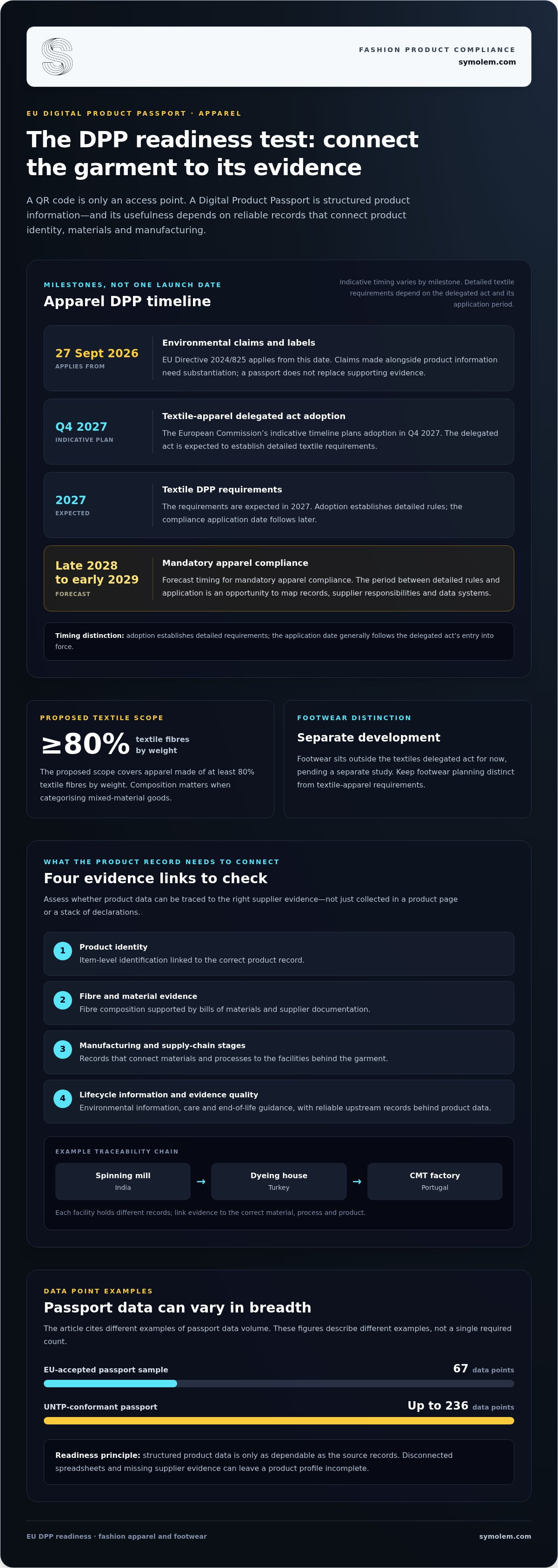
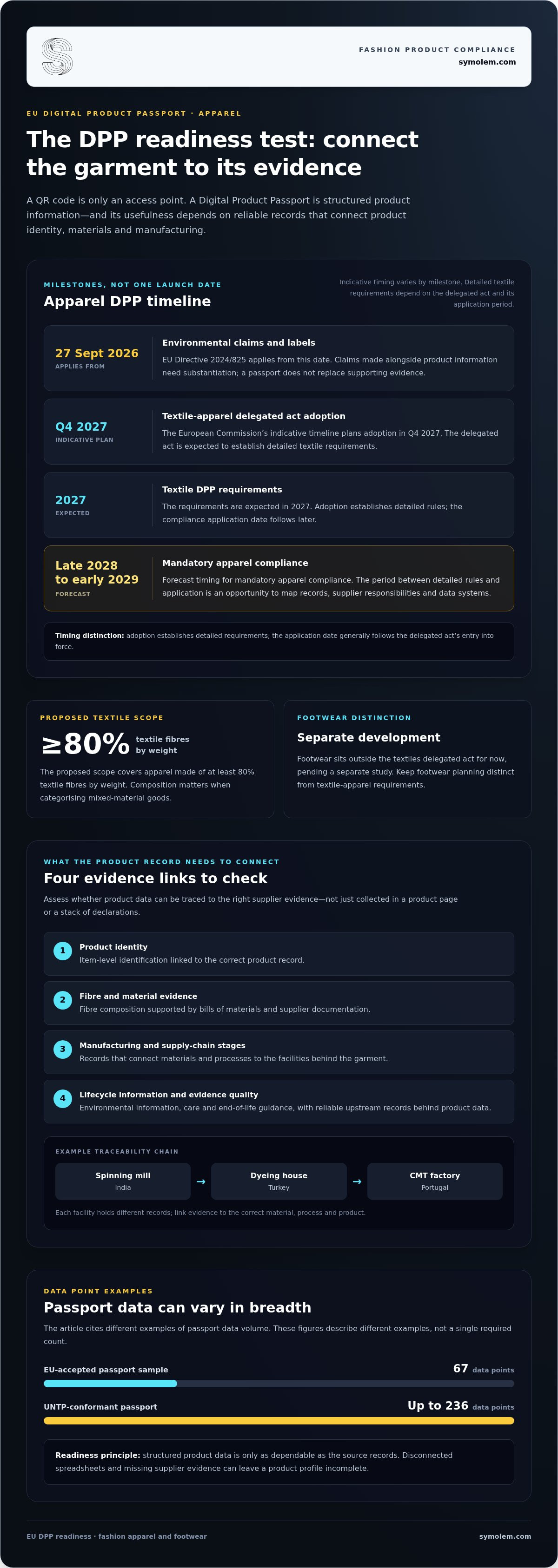
A QR code is only an access point; a Digital Product Passport is structured product information covering matters such as product identity, fibre composition, manufacturing and supply-chain stages, and care or end-of-life guidance. For a fashion brand, a DPP readiness assessment tests whether this information can be traced to reliable product and supplier evidence. Detailed EU textile requirements are expected in 2027.
The regulatory direction is clear, but the operational test is more demanding: can your records connect a garment to the materials, processes and facilities behind it? A product page or a stack of supplier declarations may not provide the structured, verifiable information a passport requires.
This guide explains what the EU Digital Product Passport means for fashion, what is known about its expected timing and proposed apparel scope, and which supply-chain gaps can undermine readiness. It also shows how to assess product identification, fibre and processing records, supplier traceability and evidence quality before those gaps become barriers to market access.
Key Takeaways
- A Digital Product Passport is structured product information, not simply a QR code linking to a product page. Its usefulness depends on traceable evidence behind the product data.
- Apparel requirements are tied to EU textile delegated acts, so readiness planning must account for both the detailed rules and the period allowed for implementation.
- Assess whether fibre composition, processing and manufacturing records connect across suppliers, from the spinning mill and dyeing house to the garment factory.
- Brands based outside the EU should assess applicability by where products are placed on the market, as well as the product’s composition and supply-chain evidence.
- Identify missing records early: supplier evidence gaps can affect the quality and completeness of product information prepared for a passport.
Table of Contents
- WHAT IS THE EU DIGITAL PRODUCT PASSPORT?
- Expected EU Digital Product Passport timing for apparel and footwear
- Textile-specific delegated acts and implementation timelines
- Supply-chain traceability and manufacturing locations
- EU ESPR scope and applicability to international fashion brands
- Symolem: Symolem-ID Automated Compliance Screening Automated pre-PO screening platform for fashion retailers and marketplaces to verify third-party brand ranges against 50+ global textile regulations in seconds.
WHAT IS THE EU DIGITAL PRODUCT PASSPORT?
A Digital Product Passport (DPP) is a structured record that connects a product’s identity with material, manufacturing and lifecycle information. For a fashion brand, readiness means establishing whether product data can be traced to evidence across suppliers and systems.
The Business of Fashion examines why apparel businesses must prepare for DPP requirements and regulation.
Supply Chain and Environmental Inputs
Supply-chain and environmental inputs connect a garment’s materials and production stages to product-level evidence. A cotton shirt may involve a spinning mill in India, a dyeing house in Turkey and a CMT factory in Portugal. Because each facility holds different records, brands need systems that link supplier evidence to the correct material, process and product.
Environmental data can include impacts associated with materials and processing, alongside lifecycle information. Life Cycle Assessment (LCA)-led software structures product-level environmental data, while traceability systems map suppliers and production steps. Both rely on reliable upstream records. Disconnected spreadsheets can leave a product profile incomplete.
Fashion Product Data Requirements
Fashion DPP data can cover product identification, fibre composition, manufacturing stages, environmental information, care and end-of-life guidance. A digital access point, such as a QR code, should lead to structured information rather than just a basic product page. Brands should prepare item-level identification and connect each record to relevant evidence.
ESPR Article 7(6)(b) rules out exemptions for Candidate List substances of concern above 0.1% by weight, according to the European Union. That makes material and chemical records consequential, not supplementary. A DPP readiness assessment for a fashion brand should therefore test whether bills of materials and supplier documentation support the product’s stated composition.
The EU-accepted passport sample carried 67 data points, while a UNTP-conformant passport carries up to 236. Reusing structured product data can also support CSRD and GHG Protocol reporting, but only when definitions, boundaries and evidence remain consistent. LCA-led systems can help organise environmental metrics; they cannot correct inaccurate source records.
Platforms, Costs, and Data Risks
DPP approaches differ in their data architecture. Traceability-led providers map materials and suppliers, LCA-led platforms organise environmental metrics, and layered systems aggregate information from tools such as PLM and traceability software. Compare them by how they structure product records, preserve evidence and exchange data, not just by their consumer-facing design.
Implementation costs depend on the product range, existing systems, supplier evidence and data-maintenance requirements. Platform subscriptions and integration choices also affect the total. Data sharing can expose commercially sensitive supplier or production information to parties without a defined need. Control access by role, limit shared fields, and assess authentication, storage and transfer safeguards against the systems holding the records.
Expected EU Digital Product Passport timing for apparel and footwear
The timetable has several stages, not one universal launch date. Textile requirements depend on the EU delegated act, its product scope and the application period set for compliance.
The European Commission’s indicative timeline plans adoption of the textile-apparel delegated act in Q4 2027. Textile DPP requirements are also expected in 2027, while forecasts place mandatory apparel compliance in late 2028 to early 2029. These dates describe different milestones: adoption establishes detailed requirements, while application follows later.
Under the ESPR, an application date generally follows the delegated act’s entry into force, rather than starting when the act is first discussed. The expected transition period gives businesses time to map product records, supplier responsibilities and data systems. Use this period to identify missing evidence instead of waiting until the final deadline to assess readiness.
EU Directive 2024/825 applies from 27 September 2026, according to the European Union. It addresses environmental claims and sustainability labels, so apparel businesses need substantiation for claims made alongside product information. A passport cannot replace evidence: composition, origin or environmental statements still need records that support their meaning.
The proposed textile scope covers apparel made of at least 80% textile fibres by weight. Product composition therefore matters when brands categorise mixed-material goods and determine which requirements apply. Footwear sits outside the textiles delegated act for now, pending a separate study, so footwear businesses should distinguish textile apparel planning from footwear-specific developments.
Marketplaces and retailers also face operational exposure. They sell third-party ranges without controlling every factory or material record, yet incomplete product information can disrupt onboarding and create de-listing risk. Pre-purchase-order screening can flag missing evidence before buying teams commit to products. Brands, in turn, need processes that provide accurate records in time for retail review.
Preparation should connect product identification with actual production batches. A style-level record may not capture differences between batches when fibre sources, dyeing facilities or manufacturing locations change. Item-level identifiers distinguish products, while batch records preserve the link between each production run and its supplier evidence.
Customer-facing access can make a passport useful beyond compliance. A scan may help customers find care instructions, repair guidance or end-of-life information. Brands may also support authentication, ownership verification and resale experiences. These functions depend on accurate records and a stable digital access point, not merely a QR code printed on a label.
For a fashion brand, readiness means establishing who owns each record, how supplier changes are captured and whether product data can transfer into passport systems. A DPP readiness assessment should prioritise composition, production locations, batch distinctions and evidence supporting claims. Assign owners to close gaps before the applicable compliance date.
Textile-specific delegated acts and implementation timelines
The ESPR sets the framework; the textile delegated act will define sector-specific requirements. Its publication, entry into force and application date are separate milestones. Fashion brands need to plan for each because product data, supplier evidence and system changes require operational lead time.
The European Commission’s indicative timeline plans adoption of the textile-apparel delegated act in Q4 2027. The textile sector’s detailed requirements depend on that act, including the ecodesign parameters and passport data it establishes. JRC 4th Milestone results are expected in late 2026 and are intended to resolve textile ecodesign parameter details. These stages shape the implementation question: which product records and evidence must be ready, and by when?
Under ESPR Article 4(4), according to the European Union, the application date of a delegated act generally cannot be earlier than 18 months after its entry into force, except in duly justified cases. This is a legal minimum, not a complete preparation schedule. Mandatory textile compliance is expected 18-36 months after the delegated acts are issued, while estimates place textile compliance dates 18 to 24 months after adoption. Brands should distinguish the statutory application period from the time needed to close internal gaps.
That distinction matters in supplier audits. Closing DPP readiness gaps typically requires 24 to 36 months of lead time, and structured collection from resistant Tier 2 suppliers requires at least 12 to 18 months. A brand sourcing fabric from a spinning mill in India and dyeing in Turkey may need separate evidence from each site. Starting with supplier mapping and record ownership gives production teams time to resolve missing information before compliance becomes applicable.
A readiness assessment can translate those findings into a prioritised implementation record. The described assessment format includes a personalised PDF of approximately 20 pages and a 90-day prioritised action plan. It also allows follow-up questions within five working days of receiving the report. These deliverables help teams assign owners, sequence supplier requests and track corrective actions, but they do not replace the delegated act’s final requirements.
Use the report to separate immediate data controls from changes that depend on the delegated act. For example, assign responsibility for material records now, then map those records against the final technical requirements when published. A 2025-2028 implementation roadmap can align evidence retrieval, system work and internal review with the expected policy milestones, rather than treating passport preparation as a last-minute upload task.
The critical record is not simply a forecast date. It is the link between each requirement, its evidence owner, the source document and the product or production batch it supports. This structure helps compliance teams explain progress, identify unresolved gaps and update implementation decisions as textile rules move from delegated act to application.
Supply-chain traceability and manufacturing locations
A DPP record is only as reliable as the supplier evidence behind it. Traceability must connect materials, facilities and production records to the relevant product.
Supply-Chain Mapping and Documentation
Supply-chain mapping records the facilities and organisations involved in making a product, then links each stage to its supporting documents. This matters because brands need to show where materials originate and which production steps they pass through.
Build the map from product and supplier records, not just a list of trading partners. For each material category, record the supplier, facility, process and document owner. A fabric merchant may sell the cloth, while a separate mill spins the yarn and another site dyes it. Give each role a clear place in the map.
Documentation should identify the product or material it supports and the facility that issued it. Fibre-origin documents, transaction certificates, bills of materials and chemical test reports serve different purposes. Store each against the relevant supplier and production record, so a compliance team can retrieve evidence without reconstructing the chain from email threads.
Scale makes this a practical control issue. Certificates for 80 styles across 40 suppliers can take days to compile manually during an audit or regulatory inquiry. Structured records, consistent categories and named document owners reduce repeated chasing and make gaps visible before a retail review.
Supplier Data and Material Traceability
Supplier data verification compares a supplier’s statements with supporting records and the product’s actual production path. For a DPP, trace each material from origin through processing and assembly, then link the evidence to the product record.
How can a fashion brand verify supplier data and trace materials for a DPP? Match fibre-origin documents and transaction certificates to the relevant material, supplier and production batch. Then compare those records with the bill of materials, facility details and chemical test reports, and resolve inconsistencies before updating the product record.
Digital collaboration makes these controls repeatable. Give suppliers a structured request that names the required document, product category, facility and reporting period. Train sourcing teams to spot incomplete records, expired or mismatched evidence, and changes in material sources. A supplier portal or shared workspace can support controlled submissions, while a named internal owner reviews each record.
Supplier training should explain why accuracy matters, not just how to upload a file. A spinning mill needs to connect fibre-origin evidence to the yarn supplied; a dyeing house must identify the process and material covered by its records. Clear categories reduce ambiguous responses and help suppliers correct errors at source.
Traceability also supports claims about durability, repair and end-of-life handling when product information relies on verified construction or material details. Link each claim to its supporting evidence. When a supplier or process changes, update the affected product records and preserve the previous version for a clear audit trail.
EU ESPR scope and applicability to international fashion brands
For international fashion businesses, scope analysis starts with the commercial route of each product. Map the brand owner, seller, importer and retailer involved in supplying EU customers, then record which entity controls each product record. This makes responsibility visible across group companies and trading partners instead of leaving it implicit in contracts or supplier correspondence.
For non-EU manufacturers, Regulation (EU) 2019/1020, Article 4 requires an EU-based responsible economic operator, such as an importer or authorised representative, or, if neither is established in the Union, an EU-based fulfilment service provider. That role does not replace the manufacturer’s product evidence. It makes clear communication between the manufacturer and the EU-based operator essential for accurate records and regulatory responses.
Build an internal responsibility matrix around product data. Assign owners for composition, supplier documentation, product identification and market-facing claims, then identify who approves changes. For example, sourcing may hold mill documentation while product development owns the bill of materials. Without a defined handover, the person preparing a retail submission may use an outdated specification.
Retailers and marketplaces need intake controls for third-party ranges. A buying team can require product-level records before a purchase order, then route missing evidence to the brand’s nominated contact. This is more effective than relying on a general supplier declaration, which may not identify the affected style or the production record supporting it. Clear status categories help compliance and merchandising teams act on gaps.
Environmental and sustainability claims need an evidence trail distinct from passport data management. A claim about recycled fibre, for instance, should link to records supporting both the material and the wording used in product communications. Keep claim approval and product-record approval linked but distinct: a complete passport record does not automatically substantiate every marketing statement.
International brands can use a structured ESPR and DPP readiness assessment to examine how product data, evidence ownership and retail handovers fit together. The useful outcome is a record of accountability: who supplies each item of evidence, who validates it, and how updates reach the relevant market-facing systems. That map gives compliance and commercial teams a workable basis for managing cross-border product records.
Symolem: Symolem-ID Automated Compliance Screening
Symolem-ID screens third-party fashion brand ranges against 50+ global textile regulations in seconds, before purchase orders are signed. Retailers and marketplaces receive a per-SKU status: Cleared, Blocked or Missing Evidence, helping buying and compliance teams identify records that need attention before onboarding.
For fashion brands preparing product data, an ESPR and DPP readiness diagnostic can identify evidence gaps against EU ESPR technical standards and UNTP data protocols. When supplier records are missing, structured findings help teams prioritise what to retrieve and organise for retail review. Symolem audits and verifies product records, and does not build or issue consumer-facing Digital Product Passports.
To discuss pre-purchase screening or DPP readiness for your fashion business, visit symolem.com.
Turn DPP readiness into operational ownership
A DPP readiness assessment for a fashion brand should lead to accountable decisions, not another static report. Assign ownership for product records, supplier evidence and updates when materials or production sites change. This governance connects compliance planning with sourcing and merchandising decisions, helping teams address evidence gaps before they affect retail onboarding.
Symolem can support the next stage with evidence advisory and compliance screening. Retailers can assess third-party ranges before purchase orders, while brands can address missing supplier records or social accounting evidence for stockists. Choose the route that matches the operational gap your team needs to resolve.
Contact Symolem about DPP readiness to discuss a practical next step for your business.
Screen third-party brand compliance before signing the PO. Explore Symolem-ID or run a free product scan.
Need to retrieve missing Tier 1-3 supplier evidence or substantiate social accounting for retail stockists? Take the 5-minute Free Assessment or Book an Advisory Consultation.
Frequently Asked Questions
HOW SHOULD APPAREL BRANDS PREPARE FOR DPP REQUIREMENTS?
Define governance for product information before selecting technical tools. Name a data owner for each function, such as sourcing, product development and compliance, and document who approves corrections. Establish a version history so teams can identify which record was used for a product release. For example, if a supplier corrects a fibre declaration, review, record and communicate the change to relevant teams.
How Do DPP Requirements Vary by Category?
Requirements vary according to the product group and its applicable delegated act. A business selling apparel and footwear should maintain separate category classifications rather than assume one data template covers both. This also matters for mixed ranges containing garments, accessories and shoes: categorise each product according to its characteristics, then associate it with the relevant compliance workflow. Review categorisation when product design or composition changes.
What is a Digital Product Passport (DPP) and how does it apply to fashion brands?
For a fashion brand, a DPP is an operational product record that must stay connected to the product as it moves through commercial systems. Its application affects how a brand prepares data for internal teams, retail partners and other authorised users. Keep the product record aligned with the identifier used in the brand’s own systems to reduce confusion when similar styles or colourways share documentation.
What EU regulations and deadlines require DPPs for fashion and textile products?
ESPR establishes the regulatory framework for product-specific DPP obligations, with delegated acts providing sector detail. Directive (EU) 2024/825 addresses environmental claims and sustainability labels, creating a related but distinct evidence concern. Brands should distinguish passport data obligations from substantiation of claims: one record may support both processes, but each claim still needs evidence appropriate to its wording and context.
Which product and supply-chain data must a fashion brand include in a DPP?
Build each data field around its source and verification trail. Record where the value originated, which supplier or internal system provided it, who reviewed it and when it was last updated. This field-level lineage helps teams investigate conflicting documents without treating every supplier file as equally authoritative. It also supports controlled updates when a component specification changes between product development and production.
How can a fashion brand assess its current DPP readiness?
Test record quality by tracing a product from its internal product system to the documents supporting its values. Look for inconsistent naming, duplicated records, missing owners and values that cannot be tied to a source. Include products with different sourcing arrangements, rather than testing only the simplest style. The results show whether the issue is missing evidence, fragmented systems or unclear responsibility.
What steps should a fashion brand take to prepare for DPP compliance?
After identifying gaps, create a corrective-action register that assigns each issue to an accountable team and records its status. Separate actions the brand controls, such as updating product-system fields, from those requiring supplier input. Set an escalation route for overdue or conflicting documents, and define how approved corrections reach retail partners. This turns isolated data requests into a repeatable operational process.
What systems and technologies can create and manage fashion product passports?
Fashion brands can use product lifecycle management, traceability and environmental data systems as sources for passport records, with a DPP provider managing the passport experience. Assess whether the provider can accept structured, auditable data from existing systems and preserve updates. Symolem audits and verifies product compliance records, then assigns a Verification ID that can feed a chosen DPP provider. It does not issue consumer passport apps.
Frequently Asked Questions
Talk to a consultant
Have a question about how this applies to your brand?
Ask Lavinia Fernandes directly. Tell us your products and markets and you get a straight answer on what applies and what to do first.